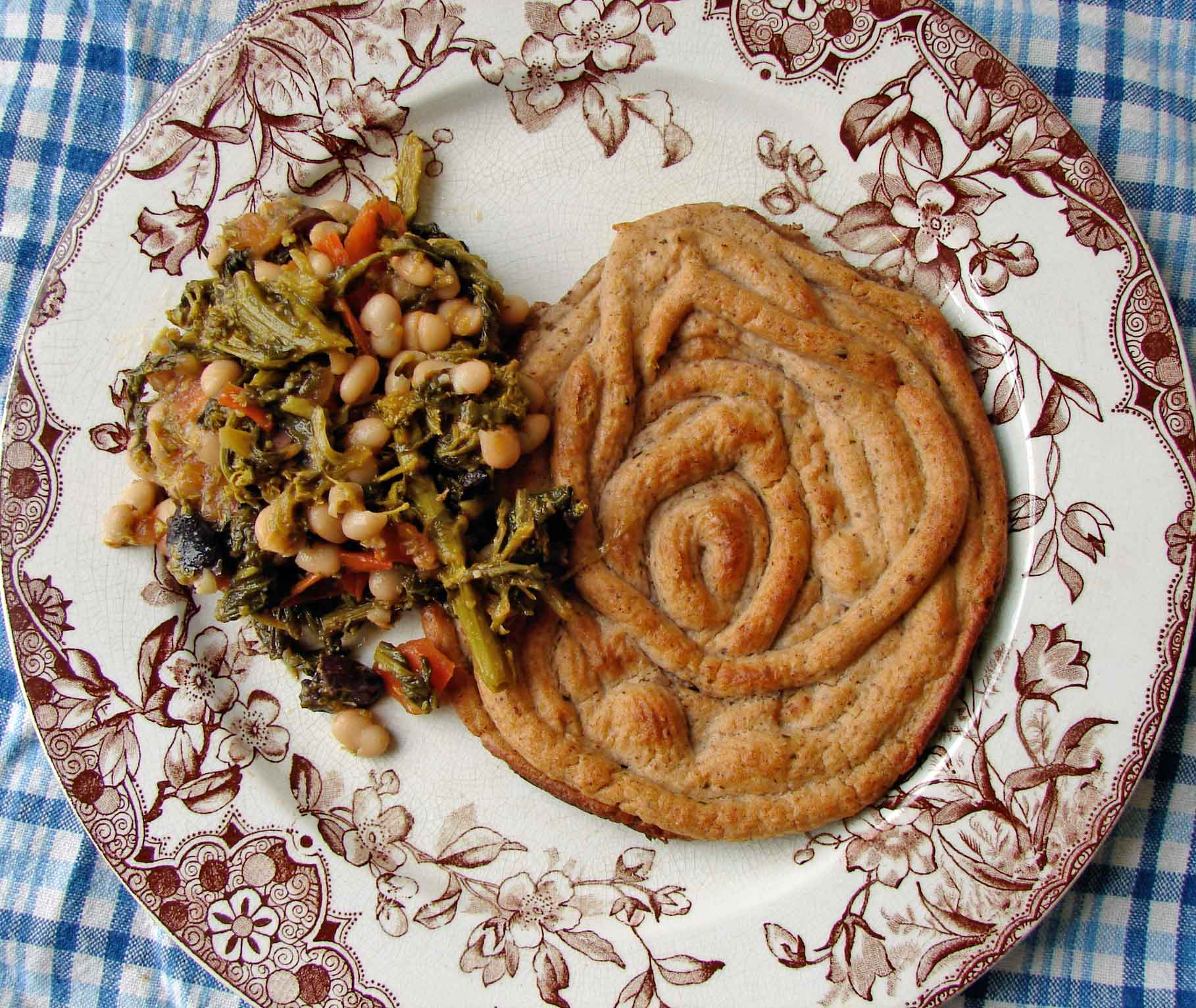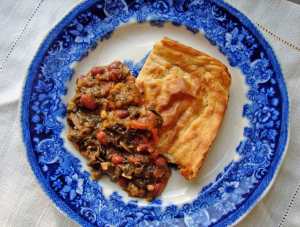
Cauliflower, potato, tarragon, and pecan nests with broccoli rabe, white beans, olives and tomatoes

Cauliflower, pecan and potato nest

Cauliflower, pecan and potato nest

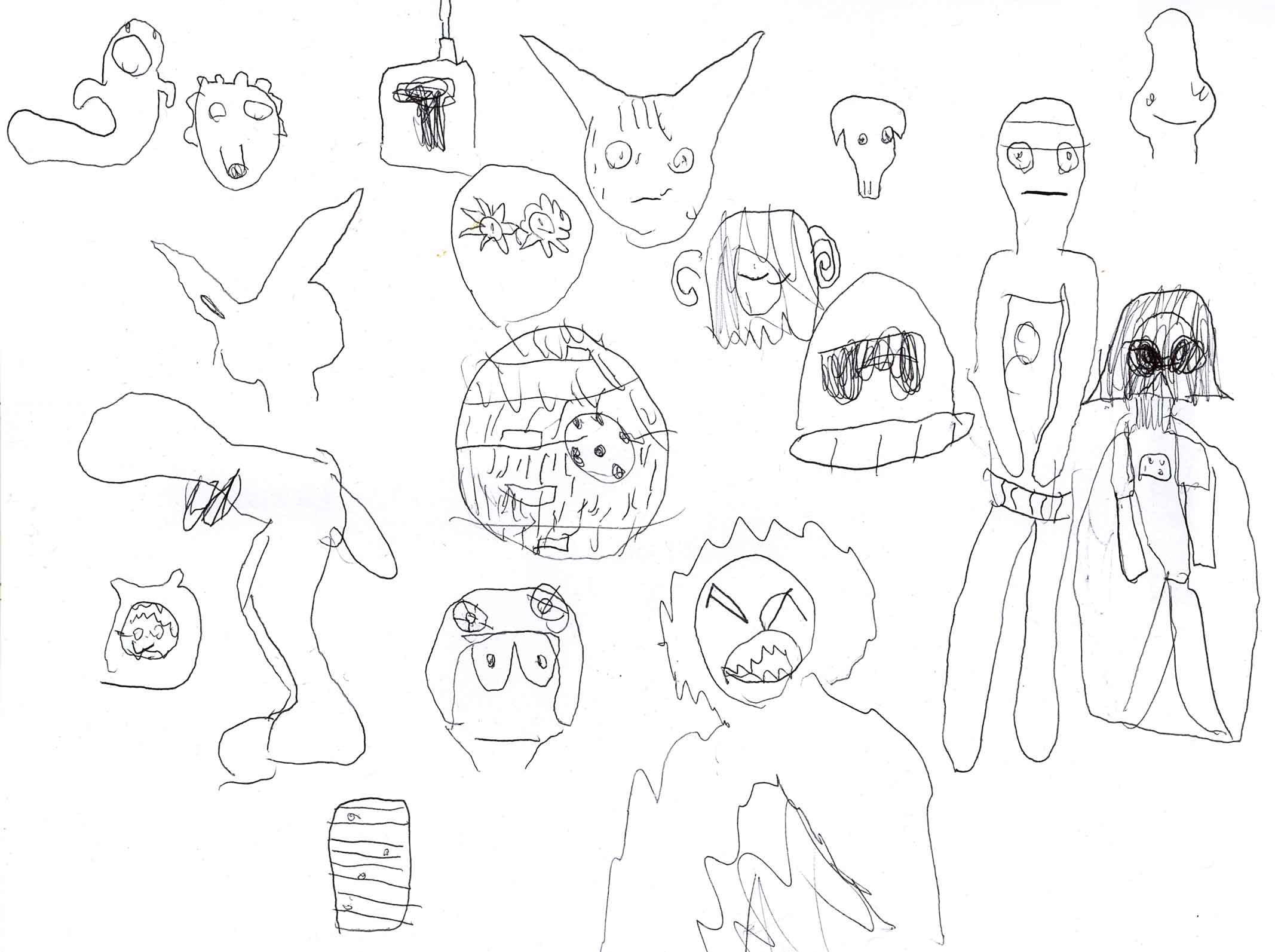
“Daddy, do you want to play with star wars toys?” asked Isaac in his bright voice. “Nobody’s said that to me in thirty years!” said David. (He did want to play.) I remember the first time I saw Star Wars. It was 1977 (of course) and we waited on line. We saw it in a theater in a mall, and it was a seventies mall, all orange and brown and drab and fluorescent. And of course we loved the movie! It’s so bright and inventive and richly imagined. I love to think about George Lucas with this whole universe inside of him, and how joyful it must have been to make the movie and to watch the movie, and to see that people liked it. I love the fact that Star Wars has a history, even the first movie had a future and a past, and though it would be decades before we’d know the full story, even in that first (fourth) film, you could feel the haunting weight of memory. Which is a sort of a beautiful thing in a film! Star Wars is about generations, so it seems fitting and wonderful that we can share it with our sons. I love that our boys love it! (Actually, I like the fact that all boys love it!) It feels good to share this modern mythology with them, a mythology that’s probably shaped our consciousness more than we know! Like most mythology it’s about good versus evil, strength versus weakness, in the world at large and within ourselves. It’s about the struggle to understand where we’re from and where we’re supposed to go, and who we should trust to go with us. It’s about discovering that we have some invisible power within ourselves that we have to harness and struggle to control, and learn to use for good. Epic! The other night, whilst watching Star Wars for the gazillionth time, we played a game. I named Star Wars characters, and David and the boys had to try to draw them from memory. It was more fun than it sounds! Unless it sounds really fun to you. I LOVE the pictures they drew, and I love the way they illustrate visual memory, and the working of busy minds, and the fact that drawing ability has been handed from father to sons. Here they are…
Isaac's

Isaac’s

Malcolm's

Malcolm’s

David's

David’s

So today’s Sunday interactive playlist is about generations…about a sense of history, a memory of the past or an anticipation of the future. Advice from elders, sass from youngsters…any of this will do!

Cauliflower nest

Cauliflower nest

ANd this crazy meal was the result of some leftover mashed potatoes and a desire to play with my pastry tube. I decided to combine the potatoes with some steamed cauliflower, some pecans and some tarragon, (as well as some eggs and cheese) and make a smooth thick batter I could shape into a sort of nest. And since all of these things (potatoes, pecans, cauliflower, eggs and cheese) are sort of mild and comforting, I thought I’d combine them with something bright and saucy, like broccoli rabe and tomatoes. So that’s what I did! I thought it all turned out very tasty. You pecans and tarragon are very nice together. You could serve these with any kind of greens, or any sort of saucy dish that you like.
Continue reading

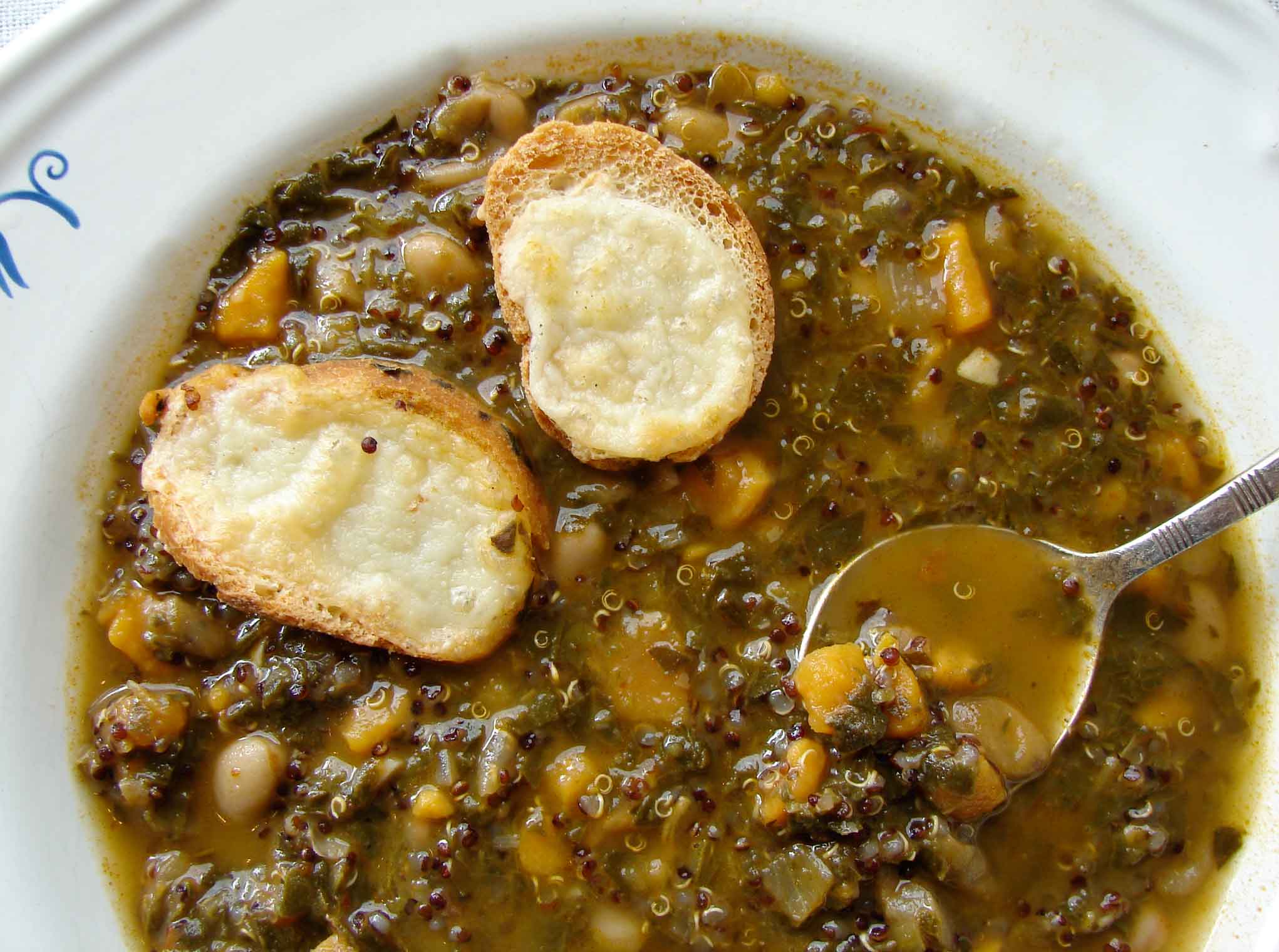
Red quinoa with chard, sweet potatoes and white beans

red-quinoa-white-beanYesterday was Nina Simone’s birthday. Today I want to write about her, but I don’t know where to begin. It’s hard to talk about something that you love as much as I love her music, it’s hard to talk about something that means so much to you. I suppose everybody is familiar with the autobiographical facts, so I’ll keep it brief. She was born Eunice Kathleen Waymon in Tryon, North Carolina in 1933. Her mother was a methodist preacher and a housemaid, her father was a handyman. From a very early age, she was determined to be a concert pianist. Her mother’s employer provided funds for piano lessons. After high school, she applied to the Curtis Institute, in Philadelphia, but was rejected. She moved to New York and studied at Juliard, supporting herself by playing piano in a bar, where she took the name Nina Simone to hide her profession from her mother. She was discovered, had a hit with I Loves You Porgy, and continued to record and play, jumping from one record company to another for most of the rest of her life. Her friendship with Lorraine Hansberry, Langston Hughes, James Baldwin and others helped to focus her fire, and she worked for civil rights with characteristic passion. She wrote the blistering song Mississippi Goddam (which has come to mind more than once this week!) in response the the murder of Medgar Evers and to the death of 4 black children after the bombing of a church. She eventually grew disillusioned in America, and moved abroad. She would live in Barbados, Liberia, the Netherlands, Switzerland, London, and finally the South of France, where she felt peaceful and free, and grew grapes, peaches, strawberries and raspberries. She was known to be temperamental, moody and volatile. She was a hypnotic performer, but an unpredictable one, and on more than one occasion she would berate the audience for talking. “My original plan was to be the first black concert pianist–not a singer–and it never occurred to me that I’d be playing to audiences that were talking and drinking and carrying on when I played the piano. So I felt that if they didn’t want to listen, they could go the hell home.” She defied labels, combining jazz, pop, blues, classical, gospel. She disliked the term “jazz,” which she saw as a way for white people to define black people, and she preferred to think of the genre as black classical music. Her voice is unmistakable and indefinable, deep, rich but light, raw and full of emotion, but with an odd, edgy coolness that cuts right to the most vulnerable part of you. She can take the sappiest song and make it speak to you about the human condition in such an intensely honest way that you feel she understands. She brings a magnetic dignity and gravity to everything she does, but she’s funny as hell, too, and light-hearted and surprising. After I’d had Isaac, Malcolm got very sick, and I was struggling with some poisonous combination of anxiety, postpartum depression and sleep deprivation. I felt down. I listened to Nina Simone sing Ooh Child, her voice full of compassion and gentle triumph, over and over, and I believed her, I believed things would get better. I knew that she’d been down, too, and she knew what she was talking about. “I feel what they feel. And people who listen to me know that, and it makes them feel like they’re not alone.” Langston Hughes, who wrote her song Backlash Blues wrote of Simone, “She is strange. So are the plays of Brendan Behan, Jean Genet and Bertolt Brecht. She is far out, and at the same time common. So are raw eggs in Worcestershire. She is different. So was Billie Holiday, St. Francis and John Donne. So is Mort Sahl, so is Ernie Banks. You either like her or you don’t. If you don’t, you won’t. If you do — wheee-ouuueu! You do!” Well that’s it! Whee-ouuuueu! She’s strange in a way that makes it good to be strange, for all of us to be strange, and in a way that feels so perfect and necessary that it almost seems normal. Or what normal should be – with that much inspiration, intelligence, intensity, wit, and passion. Nina travelled the world looking for freedom – freedom from oppression and greed, maybe freedom from her demons. In a remarkable performance of I Wish I Knew How it Feels to Be Free (which I’ve talked about before), she defines freedom as freedom from fear, as a new way of seeing, as a chance to be a “little less like me.” She’d learn to fly, and she’d look down and see herself, and she wouldn’t know herself – she’d have new hands, new vision. She tells us that the Bible says be transformed by the renewal of your mind. And her songs create a world with their intensely honest eccentricity, a world where you feel moved to your soul, and inspired to renew your mind, and be brave enough to see things anew, as they really are, or as they could be.

I’ve made a small playlist of some of my favorite songs. Including House of the Rising Sun, which she did before Dylan or the animals or Von Ronk; and Feeling Good, which is the best invocation of spring I know; and Nina’s Blues (two versions!) which is my favorite song of all. Beautiful, sad, and triumphant.

Oh yes, and here’s a recipe for red quinoa, chard, white beans and sweet potatoes. A nice combination of sweet, savory, earthy and bright. The boys liked it, which was all part of my evil plan, because I want them to eat more protein. I used great northern beans, because they’re nice and meaty, but you could use any manner of white beans you like. I made this like a thick stew, but you could add a bit more water and have a brothy soup, or add less water and have a nice side dish. We ate it with cheese toasts!

Continue reading

Farro pilaf with pan-fried butterbeans

Farro pilaf and fried butterbeans

Farro pilaf and fried butterbeans

Here at The Ordinary, we’ve uncovered the secret inner-workings of society as we know it, and we’re prepared to share that discovery with you. Points. That’s right, points. We’ll get straight to the point, with a pointed argument, and if you find yourself adrift in the vagaries of the conversation and unsure of your point of sail, pick up a handy pocket map at the point of sale to guide you back to the point of no return. Which is where we are, and this is how it goes. Everybody is allotted a certain number of points to start out with, according to no criteria whatsoever. If this seems arbitrary, that’s because, in point of fact, it is. At this point I should point out that if you happen to be somebody that starts out with an obscene number of points, nothing that follows really applies to you. You can carry on as you like without penalty. Everybody else, however, starts with a certain number of points, which will be depleted or augmented according to various rules of behavior, pretty much from the first. Points well be taken away for sloppy handwriting, for tardiness, and for poor spelling. Points will be taken away for daydreaming or over-enthusiasm. We’re glad you know the answer, but you called it out of turn. Points will be subtracted. We’re pleased that you got the right solution, but you didn’t show your work. Points will be subtracted. You got the right answer and showed your work, but it was the wrong work. Points will be subtracted. Points will be taken away for creativity, unless you’ve invented some way that humans can stay more permanently and utterly attached to their computers, in which case points will be rewarded. Points will be awarded for compliance, for cleanliness, for prettiness, and for whiteness of teeth. If you have many points, it will be easier to get more points. Points will be subtracted if you’re missing part of your uniform. Points will be subtracted if your uniform is not pressed and perfect. If you run out of points, that’s very bad, and more points will be taken away from you. Since you don’t have points at this point, points will be loaned to you at a very great interest, and if it seems like you’ll never be able to pay them back, that’s because you won’t. Of course we value kindness and compassion, but they won’t be on the test, and no points will be rewarded. What’s the point of it all? That’s beside the point, it is a completely pointless question, so we’ll all just carry on, shall we?

So! I bought a can of butter beans, because they looked nice. I decided to fry them up in olive oil with some herbs, and then mix them with tomatoes at the end. So they’d stay somewhat firm – almost crispy on the edges. And I made a sort of pilaf with farro, carrots and peas to go with them. I seasoned the farro with a pre-mixed red zatar, but if you don’t have such a thing, any combination of sesame seeds, fennel seeds, sumac, cumin or coriander would work. Or just some thyme and oregano. Actually, you can’t go wrong with any sort of seasoning that you like! We ate these all together with some little boiled potatoes tossed in butter, and it was all very good together. Lovely flavors and textures. And I am now a big fan of butter beans! We had quite a bit of everything leftover the next day, so I mushed it all together to make burgers, which I fried up in a pan, topped with a slice of cheese, and ate on a bun. Yum.

Here’s Yo La Tengo, with The Point of It

And here’s a wonderful scene from Home Movies explaining the importance of points.

Continue reading

Empanadas with potatoes, black beans, spinach and smoked gouda

Potato and black bean empanadas

Potato and black bean empanadas

We saw the most beautiful movie the other day – The Maid, written and directed by Sebastian Silva. It isn’t stylistically gorgeous – it has the look of home videos from a decade or so ago – it is emotionally beautiful – full of honesty and grace and sly humor. Raquel, played by Catalina Saavedra in a remarkably precise, powerful and restrained performance – is the live-in maid for a middle class family in Chile. She’s been with them more than half of her life, their world is her world. She roams the house when everybody is gone, with vacuum and duster, but she has dominion over only a tiny portion, a cell-like bedroom that looks out onto the kitchen. She loves the family, and they love her, but with a stunted, confused sort of love that cannot express itself in real affection. She’s started to have horrible headaches and dizzy spells, so they decide to hire somebody to help her, despite her protestations. With a devastating blow of well-meaning cruelty, they give the new “girl” care of the kitchen and the food, thus taking away the source of Raquel’s comfort and power, the nexus between two worlds. This is the space where Raquel has control, where she is vitally important, the space from which she nurtures the family. When this is taken away from her, she doesn’t make life easy for the new maids, and the script cunningly plays on our expectations to suggest that we’re going to follow Raquel into a world of darkness and depravity. The manner in which these expectations are gratified or denied is a source of great film-watching joy, so I can’t say too much more without spoiling the film. I’ll just say that a few moments of exquisitely portrayed human connection, in all of its poignant confusion, happiness, and sorrow made this simple, understated tale of an ordinary woman one of the most powerful films I’ve seen in a long while. Honestly, I’ve put off writing about it all day because I can’t do it justice!

I know they have empanadas in Chile, but I don’t suppose they have any like these! I thought of them as a sort of cross between samosas and empanadas. So they have potatoes and peas (comforting and bright!) and they have smoky paprika, smoked gouda, spinach, and earthy black beans. The crunchy crust is made with masa harina, cayenne and black pepper. These were really delicious! I felt proud of them, and happy with the combination of flavors.

Here’s Ayayayay by Pedro Piedra from The Maid’s soundtrack.

And here’s Promesas by Los Mono, which is a video I was very taken with a few years ago. Turns out Sebastian Silva is Los Mono! Who knew?!?!
Continue reading

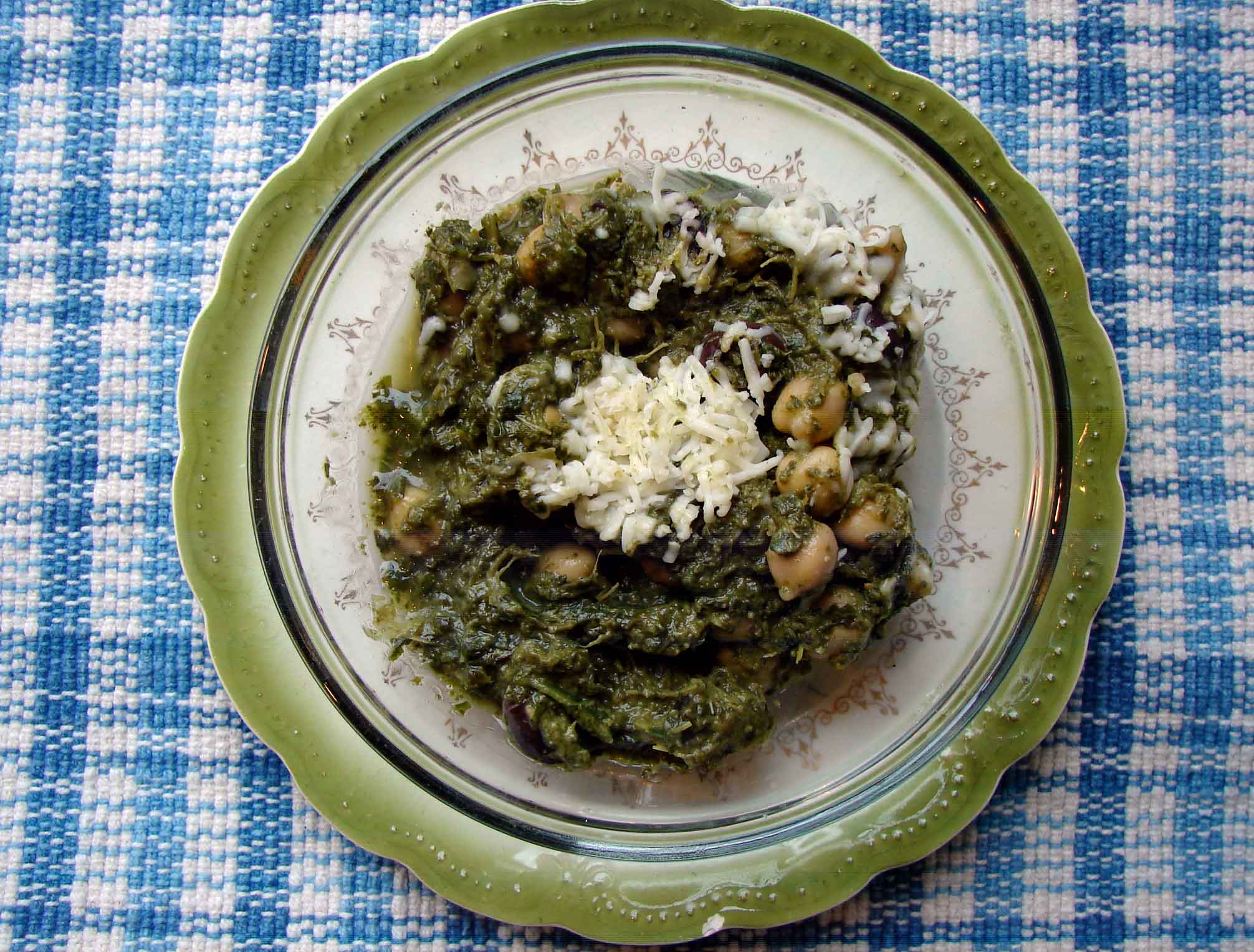
Savory french toast (with truffle butter) and broccoli rabe pesto purée with chickpeas

Broccoli rabe pesto purée

Broccoli rabe pesto purée

Yesterday we talked about Ivan Karamazov’s devil, and it got me thinking about the long tradition of imaginary friends in film and literature. Ghosts, angels, devils, goblins, spirits, pookas – each representing something important for the character they befriend. These phantasms are concocted from a little kernel of conscience, or guilt, or fear, or loneliness. Sometimes others see them, sometimes they don’t, they’re shifting and dreamlike, and they operate according to their own rules. They’re wise or bewildering, in turn; they speak in riddles, they speak a questionable truth, changing and suspect, like all truths. They’re a nuisance, but they can’t be denied. You can’t accuse them of being a bit of underdone potato and say you’d really rather get back to bed. We’ve got Hamlet’s ghostly father, Macbeth’s ghostly dinner guest, poor Ebenezer Scrooge’s ghost and three spirits, Elwood P Dowd’s giant rabbit, and, of course, George Bailey’s guardian angel. Jimmy Stewart seems to have a thing for imaginary friends! I love these last two examples because they remind me most of Ivan’s devil, in that their relationship with their friend is oddly human – frustrating, complicated, and even humorous at times. Harvey is so well-written! We watched it recently, and I’d forgotten just how full of poetry it is! Elwood, of course, is a very ordinary man, but he’s let go of the reality that held him back, and now he’s in a sort of blissful state of pleasantness. “Well, I’ve wrestled with reality for 35 years, Doctor, and I’m happy to state I finally won out over it…Years ago, my mother used to say to me, she’d say ‘In this world, Elwood, you can be oh so so smart, or oh so pleasant.’ Well, for years I was smart… I recommend pleasant.” His pleasantness shines out of him as a sort of beam, and his thoughtfulness and kindness confuses but pleases everyone around him. He sets his world aglow with his kindness – touching off the same sort of warm light in everyone he meets. “Harvey and I sit in the bars… have a drink or two… play the juke box. And soon the faces of all the other people they turn toward mine and they smile. And they’re saying, ‘We don’t know your name, mister, but you’re a very nice fella.’ Harvey and I warm ourselves in all these golden moments. We’ve entered as strangers – soon we have friends. And they come over… and they sit with us… and they drink with us… and they talk to us. They tell about the big terrible things they’ve done and the big wonderful things they’ll do. Their hopes, and their regrets, and their loves, and their hates. All very large, because nobody ever brings anything small into a bar. And then I introduce them to Harvey… and he’s bigger and grander than anything they offer me. And when they leave, they leave impressed.” And then there’s Clarence, George Bailey’s guardian angel. “That’s what I was sent down for. I’m your guardian angel.” “I wouldn’t be a bit surprised…you look about like the kind of an angel I’d get.” His angel is just like he is! Disappointed, kind, well-meaning but baffled. They need each other, they’re connected, and they’re oddly good friends.

So today’s Sunday Collaborative Playlist is on the subject of ghosts, devils, angels and spirits. Some sort of interaction with a human would be nice, but a good song is a good song! I’ll make it collaborative, so feel free to add what you like. I think it’s a very good list, so far! It would make a good soundtrack for a halloween party! And for bonus points, can you think of any other examples of imaginary friends in film and literature? I’ve been racking my brain for a few that are just on the edge of my memory.

We made savory french toast out of the honey oatmeal walnut bread. We spread it with a bit of truffle butter, scattered a little mozzarella cheese on, so that it melted, and then topped it with pureed broccoli rabe and pesto mixed with chickpeas and olives. It was delicious! So delicious that I don’t have a piece of french toast left to photograph. I wasn’t going to tell Malcolm he couldn’t have another piece, just so I could save it for a picture! That would be crazy! This was a quick, easy, satisfying, comforting winter meal. I added a little smoked paprika and rosemary to the french toast, which was nice. This would work with any bread you like, and it would be fine without truffle butter, although that did add a beautiful facet of flavor.

Here’s the Angel/devil/ghost/spirit playlist so far!
Continue reading

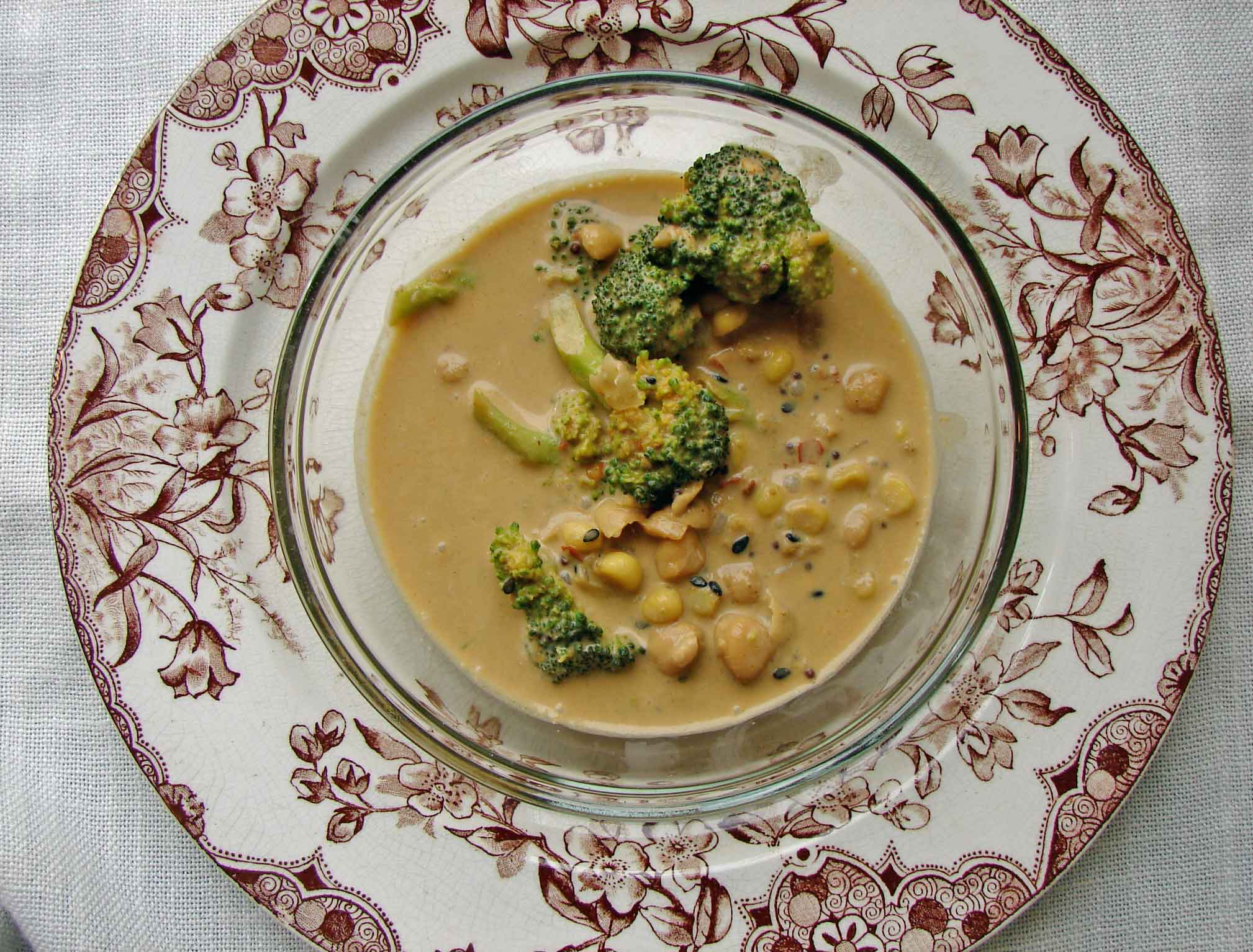
Broccoli and chickpeas in coconut curry sauce

Broccoli chickpea coconut curry

Broccoli chickpea coconut curry

Well! I’ve finally finished Brothers Karamazov, and to celebrate we’re going to have a party. I sent Malcolm to the store and I told him to tell the shopkeeper that Claire sends her greetings, “and will be there directly…. But listen, listen, tell them to have champagne, three dozen bottles, ready before I come, and packed as it was to take to Mokroe. I took four dozen with me then…they know all about it, don’t you trouble…Stay, listen; tell them to put in cheese, Strasburg pies, smoked fish, ham, caviare, and everything, everything they’ve got, up to a hundred roubles, or a hundred and twenty as before…. But wait: don’t let them forget dessert, sweets, pears, watermelons, two or three or four — no, one melon’s enough, and chocolate, candy, toffee, fondants;” That being vegetarian versions of smoked fish and ham, of course! And David said I have to write a twenty page paper on the book, so I’ll share that here, shall I? Ready? Do you have your glass of tea and plate of salted fish and cherry jam? Let’s begin! I’m kidding, of course! No scholarly paper. However, I read that Dostoyevsky had intended to write a sequel about the life of Alyosha, but he died before he had the chance. So I’ve decided to take it upon myself to complete the task. A bit of Karamazov fan fiction, if you will. Of course, we’re going to sex it up a bit for our modern audience. No tortured discussions about spirituality or morality – there’s just no market for that these days. Instead, it’s all going to go like this… Lise, of course, is a vampire. Weak, pale, pretty and wicked, what else could she be? But she’s one of those sparkly vampires. And she bites Alyosha, and then dresses him like this, “I should like you to have a dark blue velvet coat, a white pique waistcoat, and a soft grey felt hat….” And then Alyosha, instead of wandering around trying to solve everybody’s problems and worrying for their souls, will solve all their problems by relieving them of their souls, and turning them, too, into sparkly vampires. Meanwhile, Dmitri’s attempt at escape from prison (which will be described in nail-bitingly extensive detail) will fail, and he’ll be sent to Siberia in exile. But this won’t be a dull, workaday work camp kind of story. Oh no! It will be subtitled Survivor: Siberia, and will tell the tale of a bevy of lordly types roughing it in a grand competition in the frozen wastes of Siberia. They’ll be voted out of exile one at a time, until the winner remains alone. Sadly, he’ll still be alone in exile for twenty years, which will be dull, so we’ll forget all about him. And Ivan, broody young Ivan, will provide the comic relief, as he sets up an apartment with his pesky devil, and they bicker humorously about whether or not either of them exists! Until, of course, he’s turned into a vampire by Lise and then… Well, I confess I haven’t figured out how to end it yet. Something big! Something thrilling! Leave them wanting more! Yes. Actually, I feel a little irreverent for speaking of Brothers Karamazov in this way! It touched me very deeply, and gave me much to think about, and I feel such genuine affection for Dmitri, with his wild impulsive ways and his generous heart, Ivan, with his oddly hopeful despairing cynicism, and, of course sweet, honest, strong Alyosha.

So, broccoli, chickpeas and corn in a curried coconut sauce. This was delicious! And every member of the family liked it and ate several helpings, and I ate the leftovers cold before bed one night. It struck me that the mix of ingredients and spices was a little odd, but I liked them all together. It’s a little sweet, a little spicy, and quite savory all at once. We ate it over basmati rice, and that was nice!

Here’s Saint Behind the Glass by Los Lobos (from Nacho Libre), because it seems to fit!

Continue reading

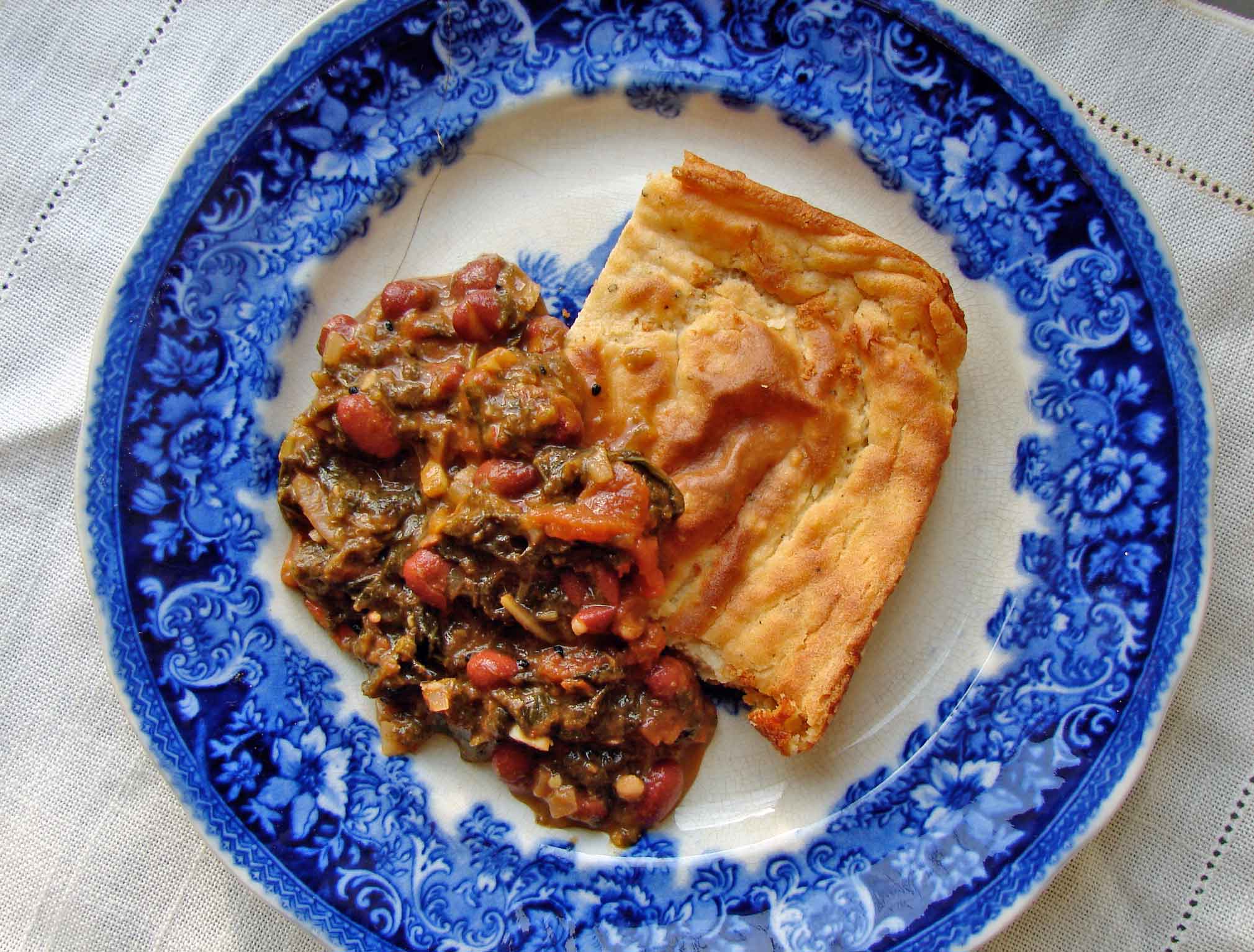
Collards and red beans with smoky masa harina pudding-bread

Masa harina bread and collards

Masa harina bread and collards

So I seem to have brought some sort of stomach bug home from work this weekend. Ug. I feel better now, but I’m tired. I spent yesterday morning in bed with my eyes closed feeling like a big ball of nothing but sick-feeling pain. And then as I started to feel better, I watched the reflection from the windows on the ceiling, and the way it changed like rippling water every time a car passed the house. I felt like I was rocking a little, and the cars sounded like waves as they crashed by in the wet street. Did you know that the word “nauseous” comes from the latin which comes from the Greek for “ship”? I felt like I was on a bright ship lurching along on clear, light, choppy waters. I thought that this would be a good time to really think. Not just about all of the odd figures I saw in the brown patches on our cow-print curtains, but to think about big things, about everything. To form thoughts and connect thoughts, and try to sort things out, and try to remember, and try to plan. It turns out lying in bed fighting off nausea is not a good time to think. I felt very old and not strong enough to fight off a creeping feeling of dispiritedness, and now I feel very tired. And that’s all I’m going to say about that! I’ll talk instead about Joan Aiken, because I love Joan Aiken, and I find her incredibly comforting. Joan Aiken was a writer of brilliant children’s books that never caught on in America, which I think is a crime. Her characters are so lively and engaging, her settings, with their invented historical epochs, so appealing. I love her vast knowledge on small and eccentric subjects – fabrics and styles, music and paintings, nautical matters. And food. Joan Aiken’s books are delicious. She brings her characters into situations of great deprivation – they’re cold, wet, hungry, poor and miserable – and then through some gracefully wrought turn of events, they suddenly find themselves in warmth and comfort, with something tasty and toasty to sooth them. Even the names of the dishes bring solace – pipkins of soup, hampers of pies, and hot possets for all! In the way that certain foods can bring comfort when you’re ill, once you’re well enough to think about food at all, and certain books can bring comfort when your head isn’t so achey you can’t read, Aiken’s warm and timely meals strengthen and console, not just the characters, but the reader, too. Viz: Bonnie and Sylvia are ice skating through the grounds of Willoughby Chase when they find themselves impossibly far from home, with snow falling thick and fast, and wolves gathering in the shadows. What do they do? Take shelter in Simon’s cave, of course! Once they’re snug with his bees and his geese, our lithe and bright-eyed Simon makes them little cakes in the fire. “The boy had separated the fire into two glowing hillocks. From between these he now pulled a flat stone on which were baking a number of little cakes. The two children ate them hungrily as soon as they were cool enough to hold. They were brown on the outside, white and floury within, and sweet to the taste. ‘Your cakes are splendid, Simon,’ Bonnie said, ‘How do you make them?’ ‘From chestnut flour, Miss Bonnie. I gather up the chestnuts in the autumn and pound them to flour between two stones.'” As they’re leaving the cave, “The boy Simon dug in shallow sand at the side of the cave and brought out a large leather bottle and a horn drinking cup. He gave the girls each a small drink from the bottle. It was a strong, heady stuff, tasting of honey. ‘That will hearten you for the walk,’he said. ‘What is it, Simon?”Metheglin, miss. I make it in the summer from heather honey.'” OF COURSE HE DOES! Of course Simon gathers chestnuts in autumn and heather in the summer, and makes lovely restorative cakes and tinctures with them! And I love him for it! I could make a list a mile long of scenes such as this…spice cakes and plum brandy, ginger bread and applesauce, thick comforting chowder. But I’ll give you this bittersweet example, instead. I love Aiken’s Go Saddle the Sea trilogy. It’s so dark and wild and richly imagined; the characters so strong and complicated and bizarre. The central figure, of course, is Felix. He lives in Spain with his cold and unloving grandfather and great aunts. His only friend is Bernadina the cook. Her bustling kitchen is a haven for him, and she shows her love with special treats she prepares for him. When she dies, he visits her kitchen…”It looked as if she had been making herself a merienda just before she had taken ill. A pestle and mortar stood on the big scrubbed table with some chocolate in it she’d been pounding, and a platter held a pastry cake sprinkled with salt, my favorite food. Maybe she was going to sneak it up to me in my room. Now I couldn’t touch a crumb of it.” Poor Felix! One of my very great pleasures, here at The Ordinary, is to bring attention to books and movies and songs that I think should be better known. Joan Aiken is one of those things, in America at least. Put down your sparkly vampires and your derivative wizards, and discover the mad, wild, dark and beautiful world of Joan Aiken. It’s like a warm, restorative, complexly-seasoned posset!

This meal was very comforting in its way. The masa harina bread was soft and dense inside, which is why I think it’s pudding like, and it has the lovely mysterious flavor of masa harina. I love collards! They’re quickly becoming my favorite green. I don’t know why they’re not as popular as kale, but I’d like to announce my campaign to make them so!! Here they’re sauteed with red beans, tomatoes, and lots of lovely spices, like ginger, smoked paprika, and cardamom, to make them spicy, smoky and a tiny bit sweet. Delicious!

Here’s Bessie Smith with Thinking Blues.
Continue reading

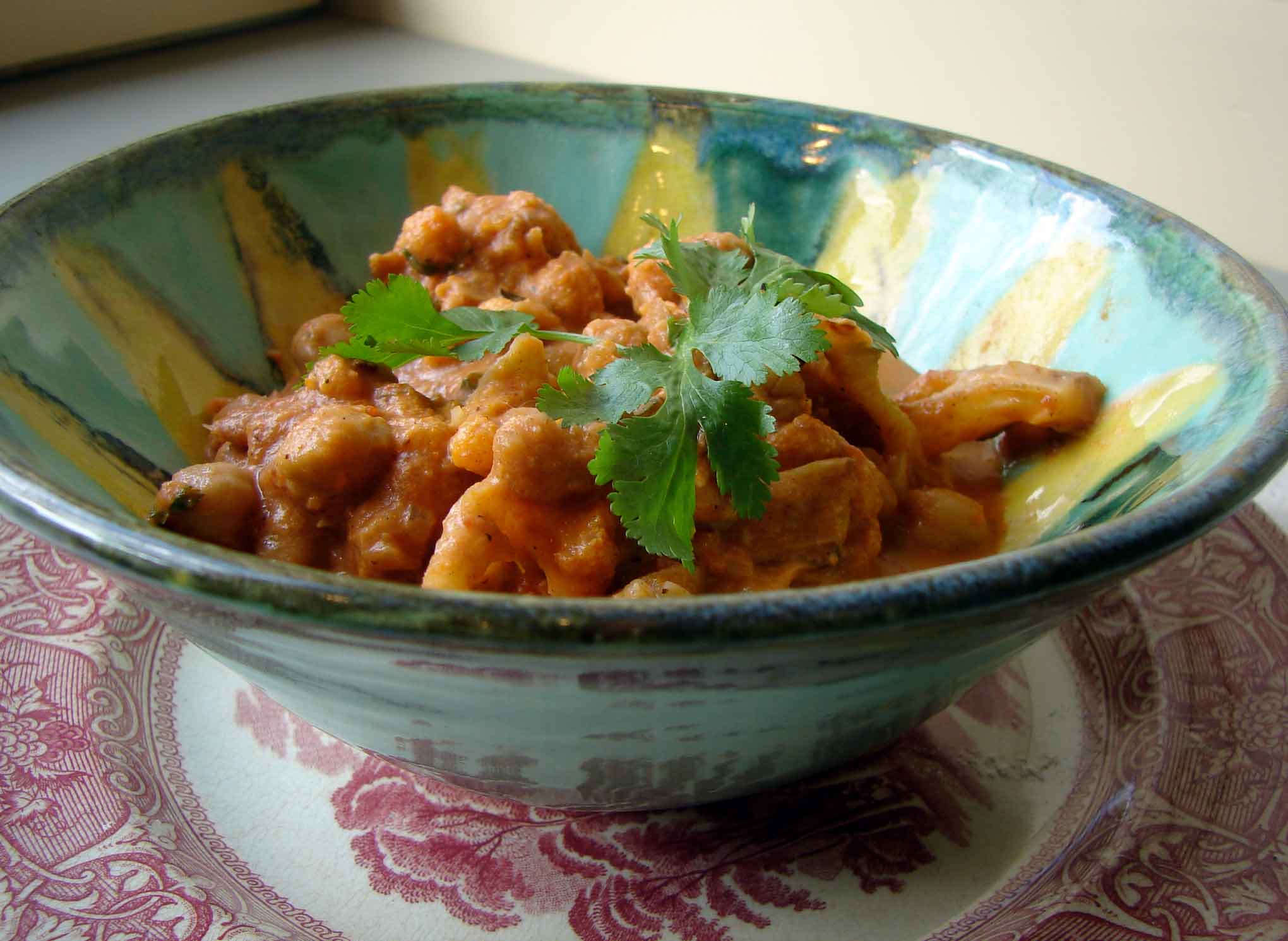
Curried chickpeas and cauliflower in spicy rich tomato sauce

Chickpea cauliflower curry

Chickpea cauliflower curry

I’ve been very fascinated by three words, lately, and I’m going to tell you why. These words are poignant, piquante, and pungent. Why do I love them? I love them because they teeter so wonderfully on the edge! They hover between senses, and they could evoke pleasure, pain, or some place that falls between the two! I love the way that, historically, they can be used to describe words, ideas, tastes, smells, expressions, or even hedgehog quills. They’re so keen and vibrant and cutting! According to my (shoddy) research, they all stem from a similar root. (I learned this while sitting on the couch next to Malcolm on a snowy evening, drinking a glass of wine and reading a dictionary. Honestly, what could be better than that?) They’re all the descendants of words that mean “to prick or to sting.” At one time, a piquant was a sharp object, like a hedgehog quill. From 1494, “The herichon…is…armyt…with spines thornys or pickandis.” And pungent described a sharp and pricking pain. From 1617, “The Vrine bloody, the Excrements purulent, and the Dolour pricking or pungent.” Each of these words also describes a flavor or smell that is sharp and piercing, sometimes pleasantly so, sometimes not. From The Canterbury Tales, “Wo was his cook but if his sauce were poynaunt and sharp.” Each word also describes ideas that are sharply or cleverly expressed. From 1661, “No author hat so pungent passages against the Pride and Covetousness of the Court of Rome.” Sometimes the effect of these words is painful or wounding. From 1651, “By some picquant words or argutenesse to put them into choler.” Piquant, pungent and poignant all describe something stimulating to the mind, feelings, or passions. From 1668, “That our Delights thereby may become more poinant and triumphant.” From Jane Eyre, “Besides, the eccentricity of the proceeding was piquant: I felt interested to see how he would go on.” From 1850, “Every amusement and all literature become more pungent.” But sometimes the emotion provoked is so strong as to become painful or unbearable, just as a scent or taste might be too sharp or spicy or sour to be palatable. From 1684, “Intolerably pungent grief and sorrow.” From 1728, “This final Answer threw the King of Portugal into the most poinant Despair.” Everything is connected! Words and ideas have flavor, scents stimulate the mind, emotions and tastes are so wonderfully provoking that it’s almost too much to bear! Mr. Rochester understood this, he describes falling in love with Jane, “…I was an intellectual epicure, and wished to prolong the gratification of making this novel and piquant acquaintance…” I love the idea of anything felt so strongly, both bitter and sweet, as life is, but fully tasted, fully explored, fully felt.

And this was a piquant dish! It’s loosely based on an Indian Makhani recipe. Makhani means “with butter,” and this does have some butter and a little bit of cream, so it’s quite rich. But it also has tomatoes and spices to keep it lively. The cauliflower is roasted separately and added at the end, stirred in carefully because it’s delicate and flavorful.

Here are Jordi Savall and Christophe Coin playing St. Colombe’s poignant Les Pleurs.

Continue reading

Roasted butternut white bean soup

Butternut and white bean soup

Butternut and white bean soup

In Kurisawa’s Ikiru, he describes a childhood memory, “Once when I was a child, I almost drowned. It’s just like that feeling. Darkness everywhere, and nothing for me to hold onto, no matter how hard I try.” This reminded me of Sleepy John Estes’ song Floating Bridge. It’s a beautiful, dream-like song, with repeated fragments of memory like waves washing over him – he nearly drowned, he was hid underneath the water five minutes, and when they dragged him out and laid him on a bed all he could hear was muddy water going round his head. And he’ll never forget the memory of people on the floating bridge, screaming and crying. It’s so powerful! So today’s Sunday collaborative playlist is on the subject of childhood memories. It could be of a person, or a food, or a song, or a definitive moment, any childhood memory will do.

And this soup is a bit like a wintery memory of summer. The squash is roasted, which makes the flavor rich and smoky, and the herbs – rosemary, sage, thyme, and tarragon – make it taste like a spring garden. The cauliflower and white beans make the soup lovely and velvety. I thought of this soup as Provencal, for some reason! The herbs, I guess!

Here’s your interactive playlist on childhood memories. Feel free to add anything you like!
Continue reading

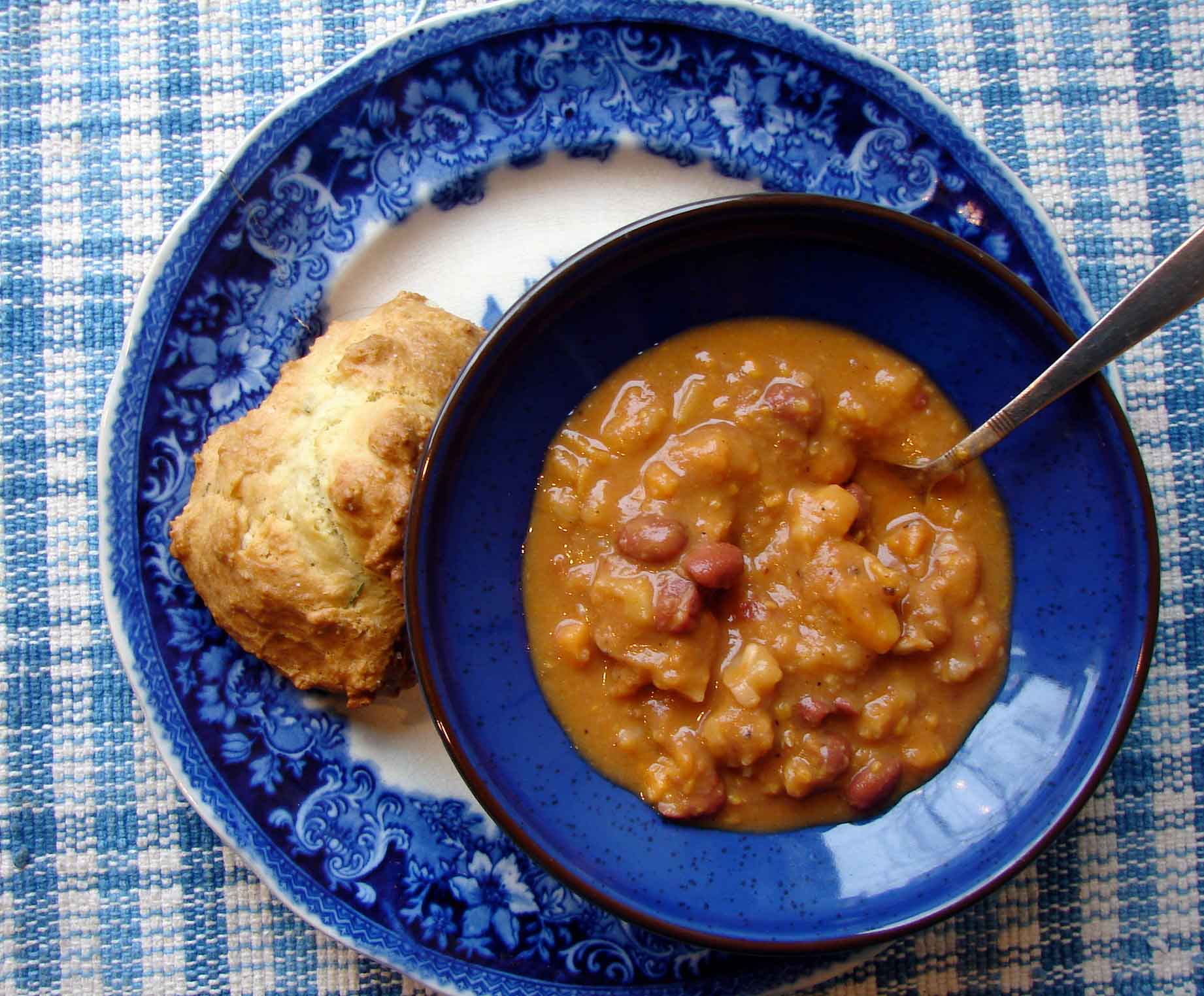
Red bean, sweet potato & hominy stew and Olive oil rosemary biscuits

Red bean & hominy stew

Red bean & hominy stew

Well, it’s been a day of catching up after working all weekend. A day of laundry and grocery shopping and trying to get the boys to clean their room. It’s been a day of thinking about Martin Luther King Jr, of driving on the grey wintery streets, listening to fragments of Barack Obama’s inauguration speech on the radio, moved to tears. Obama’s first election was fueled by hope, it was buoyant with hope. And despite snide comments about hopey changey stuff, despite the sort of fatigue and discouragement that four hard years of dealing with Bush’s financial crisis have brought upon us, at this moment I feel more hopeful than ever. It’s not a hope as bright and far-reaching as that of the first election – but it’s a stronger, fiercer hope, based in reality and hard work. I don’t agree with all of Obama’s decisions, I don’t love every action that he’s taken, but I feel so grateful to him for starting conversations about health care, gay rights, women’s rights, gun control, climate change. Of course we should talk about these things! It’s remarkable to me that in 2013 these are issues we still need to address, let alone issues that take extraordinary courage to address. I think it’s difficult to understand just how brave Obama is for speaking publicly and openly about gun control and gay marriage. Despite petty political squabbling, despite ignorance, hatred and fear, we are taking small steps in a good direction, towards a world that must be inevitable if people are as kind and thoughtful as they have the potential to be. Martin Luther King spoke of non-violence with these words, “In a real sense, Mahatma Gandhi embodied in his life certain universal principles that are inherent in the moral structure of the universe, and these principles are as inescapable as the law of gravitation.” I hope that this is true, with the deepest weightiest and yet most buoyant hope imaginable. Obama ended his speech with these words, “Let each of us now embrace, with solemn duty and awesome joy, what is our lasting birthright. With common effort and common purpose, with passion and dedication, let us answer the call of history, and carry into an uncertain future that precious light of freedom.” And that birthright is not a possession or privilege unique to Americans, but a natural or moral right possessed by everyone, the world over – to work for freedom from the darkness of fear, ignorance, and cruelty.

I felt a little silly posting a recipe today, (and doing laundry, and cleaning, and all other trivial chores). But, maybe that’s part of what it’s all about – about the freedom to get on with these things. These chores are trivial to me, but are luxuries for some people. To buy healthy, nourishing food for your family, to cook it up in a way that you feel good about. To have a safe, warm home to serve it in. Everybody deserves these things! In that spirit I present to you a recipe for a warm, comforting stew full of flavor. I bought pomegranate molasses for the first time, and I’m having fun playing with the sweet/tart continuum. I decided to pair it with a tiny bit of mustard, balsamic, sage, red pepper flakes and smoked paprika, to make a spicy, sweet, tart, smoky sauce. And the biscuits are incredibly easy to make, and very tasty, too. They’re butter-free, and the taste of olive oil in a baked good is always surprising and pleasant.

Well, there are quite a few songs I could choose for today’s post, but I’m going to give you Mos Def’s Fear Not of Men. It’s based, of course, on Fela’s Fear Not For Man, the lyrics of which go thus…

    Brothers and sisters
    The father of Pan-Africanism
    Dr. Kwame Nkrumah
    Says to all black people
    All over the world:
    “The secret of life is to have no fear”
    We all have to understand that

Mos Def’s song isn’t explicitly about Martin Luther King’s Day, but the lyrics have always resonated on this day of all days. He says, “A lot of things have changed, and a lot of things have not.” And there’s no doubt that this is true, for better or for worse. But the song is about courage in the face of danger, courage to work towards something that’s bigger than all of us. And it’s about a universal rhythm that beats through all of us, surely leading us inevitably in the same direction.

    All over the world hearts pound with the rhythm
    Fear not of men because men must die
    Mind over matter and soul before flesh
    Angels for the pain keep a record in time
    which is passin and runnin like a caravan freighter
    The world is overrun with the wealthy and the wicked
    But God is sufficient in disposin of affairs
    Gunmen and stockholders try to merit your fear
    But God is sufficient over plans they prepared.

Continue reading