Almond cake with chocolate chips and ginger

Almond cake with ginger and bittersweet chocolate chips

Almond cake with ginger and bittersweet chocolate chips

Clio’s attitude towards fetching a ball is “I could, but why would I?” Some people might think this is a sign of stupidity, but I disagree. (And not just because I’m her biggest fan!) I think it’s funny that people take it as a sign of intelligence if an animal acts like a human, or in a way that a human wants them to behave. I had a theory when I was much younger. (I had lots of theories when I was younger, I had all sorts of philosophies to explain the universe. And then I grew up and realized that everything is too shifting and complicated to be explained.) My theory was this, this was the theory that was mine. I thought that animals were wiser than humans, and that the way that they understood to live in the world made more sense than the way that we did. A cow, for instance, who spends her day eating sweet grass, feeling the sun on her back, watching her world change subtly around her, thinking god-only-knows what thoughts behind her beautiful cow eyes, has everything figured out on a fundamental level better than, say, some girl that goes to school, and has her lunch packed in plastic, and learns what she’s told to learn by people who laugh at her for saying that cows are wiser than humans. The fools! And then they’ll say, yes, but what about the fact that people build highways and cities and cars and cure diseases! And the girl with the theory says, “That doesn’t prove anything! We created a lot of the pollutants and carcinogens that cause the diseases in the first place! And highways and cities bind up the world and hurt it, and make it impossible for us to understand the wild magical truth of nature, which is the only true religion! The electric lights of our homes blind us to the variations of the gradually changing sunlight and moonlight all around us! Our walls and windows make us immune to the cool winds that blow the stagnation from our brains and make us alive! The animals understand that, look into their eyes! They feel the beauty and truth of the world around them in a way that we will never understand, and that’s why they are wiser than we will ever be!” Yes, I was a very strange child, and I grew up to talk about my past self in the third person! So I think Clio is a wise child, and very smart not to fetch the ball, but to joyfully run after it and toss it around and drop it wherever she wants to.

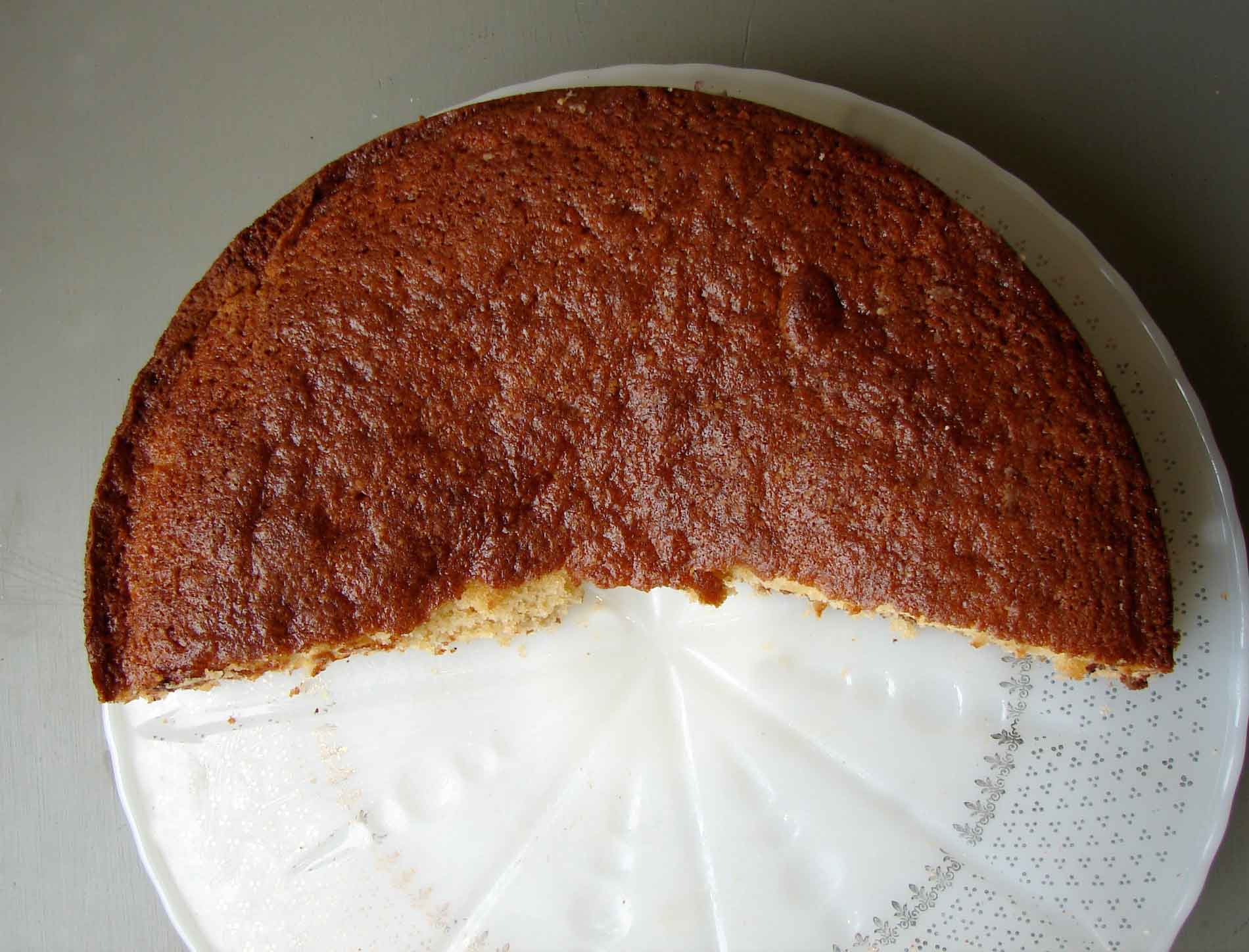
My boys go through phases with food – they’ll love something for a while and eat it every day, and then one day, they just don’t want it any more. It takes me a while to catch onto these mood swings, so I often find myself buying something they used to like, and then having to figure out some other way to use it up when they reject it. One such item is vanilla yogurt. Malcolm used to eat it by the tub, so I’d buy a big carton of it, and he’d scarf his way through it in no time. Lately he hasn’t wanted it. So I decided to use it in a cake. Yogurt makes cakes nice and dense, and I combined it, in this instance, with almonds. I whirled the almonds and yogurt together in the blender until they were perfectly smooth and creamy. This cake also has candied ginger, chocolate chips, and a few spoonfuls of marmalade, so it’s a lovely cake, simple, but complexly flavored. Comforting yet piquant. If you don’t have vanilla yogurt, you can use plain, but you might want to add an extra smidge of vanilla flavoring, and be generous when you measure the sugar.

Here’s Done by the Forces of Nature by the Jungle Brothers

Continue reading

Vanilla ice cream with salty chocolate-toasted almond bark & Maple-spice ice cream with shaved chocolate

vanilla ice cream with salty toasted almond bark

vanilla ice cream with salty toasted almond bark

CAPTAIN’S LOG:
We’re breaking down! Tempers are flaring, the crew is becoming ragged and moody, crying one moment and laughing the next. Fits of pique! Excessive displays of spleeniness! We’ve entered day four of our excursion. Tuesday afternoon we left the SS Ordinary in our rickety couch-shaped vessel, possessed only of a spiderman blanket, a pillow, a grey puppy, a stack of books, a set of colored pencils, snacks and drinks, medicaments, philtres and tinctures, and a vat of lego bricks with which to fashion a new vessel, if the puppy tears too many holes in our current conveyance. And now that the fever had broken, and the quarantine will surely be lifted, the crew is falling to pieces!
Sigh. It’s not so bad, of course. It all started when I said Isaac should turn off the cartoons and do a little of the homework that was sent home. What? NO! He’s sick! His belly hurts, he HAS to watch cartoons, IT’S A BLATANT BREACH OF SICKDAY RIGHTS! ACTION WILL BE TAKEN! In the form of tears and foot stamping. Isaac tried to have a tantrum, I think probably in imitation of certain other members of the family. He can’t really maintain it, though. He can’t stop himself from giggling if you say anything remotely funny, and that spoils the whole effect. Everybody should have to spend a week with Isaac, cast adrift from real life on a messy couch, through drizzly rain and weak winter sunlight, through brief hopeful pools of afternoon warmth and quickening dusky winds. People come home from work and school, and leave again, and we sit on the couch, watching it all go by. It’s a rare pleasure.
Isaac and James & the Wolf

Isaac and James & the Wolf

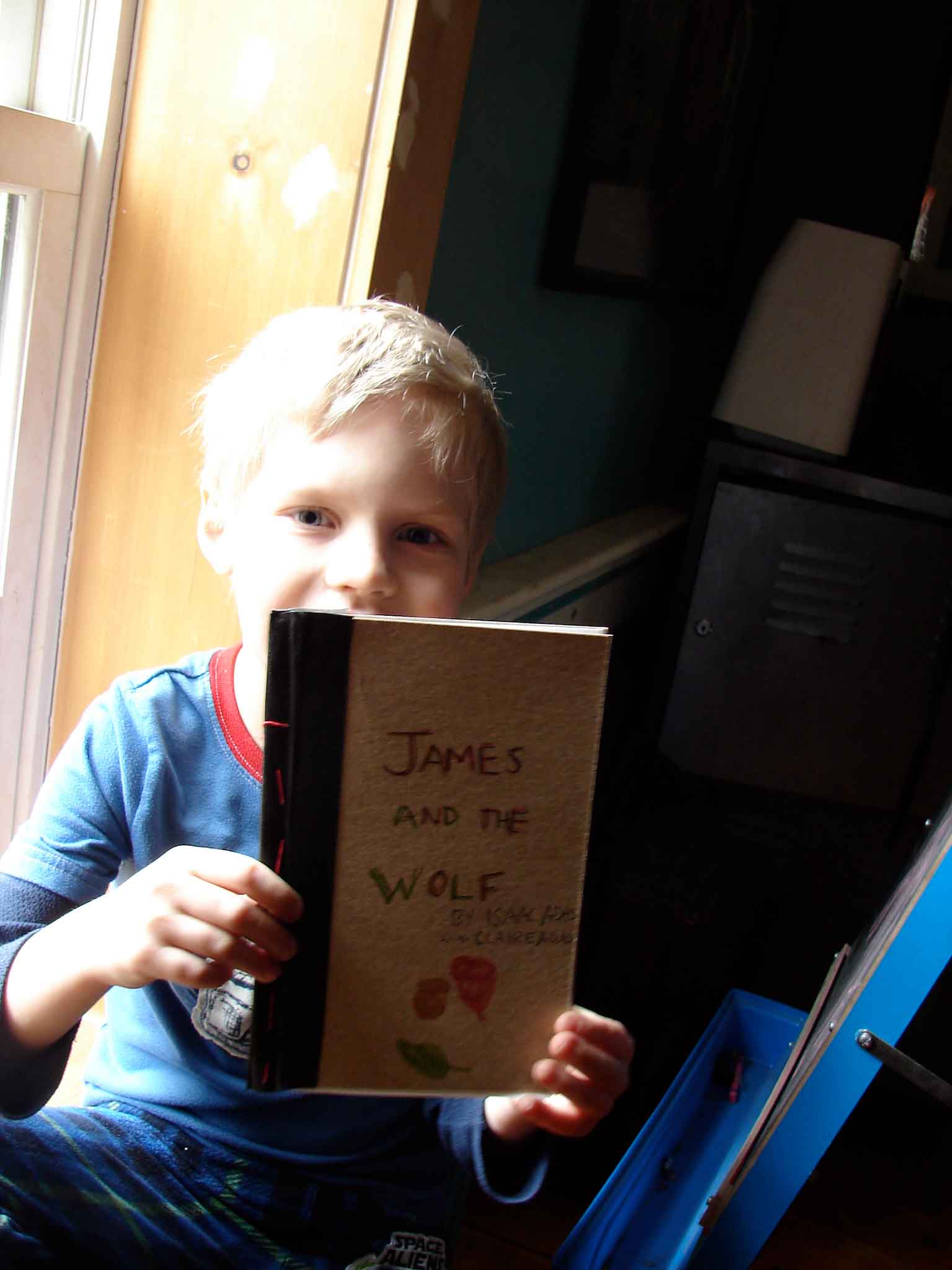
Isaac and I made a book. We gave it a cardboard and gaffer tape binding, and I broke a needle in two places trying to sew the pages through the tape. Isaac dictated, I wrote the words, and Isaac illustrated. It tells the story of a boy named James. He lives in the forest with a pack of vegetarian wolves who like to snuggle with him. (“Really?” David said, upon reading this part, “Isaac came up with that? Because it sounds suspiciously Claire-y to me.” It’s all Isaac, I swear! Of course, I made Isaac….) Let’s see, where were we? Ah yes, one day, Black Fur the wolf goes across the river to pick raspberries. A pack of non-vegetarian wolves surrounds him and tells him he should eat his friend James, because human boys are delicious. Suddenly, James and his wolves come up to the raspberry patch! (In a stunning twist nobody could have predicted, James is riding on a giant squirrel-dog named Scog.) James goes rushing at the leader of the other wolves, who is understandably afraid, but rather than hurt him, he feeds him a cake made of nuts, raspberries and leaves. Why, it’s delicious! All the wolves become vegetarian and they spend their days helping each other find food and making meals together. And that’s how it goes. The End.

Maple spice ice cream with grated chocolate

Maple spice ice cream with grated chocolate

We also made ice cream. I always bake with the boys when they’re home sick (if they’re up to it). It’s so companionable and comforting, and they have such surprising and tasty inspirations. Isaac and I wanted to make ice cream. He wanted to make “crispy ice cream.” So we had to decide what that meant. Isaac wanted to add almonds, I wanted to add chocolate. I remembered that we’d made some delicious chocolate almond bark last month, so we made that and dropped large pieces into the ice cream as it froze. So good! I toasted the almonds to deepen their flavor, and we put a sprinkle of sea salt on top. And the other week, as you may recall, Malcolm and I were playing with a hand grater and some chocolate chips. We wanted to see what the fine powdery slivers of chocolate would be like in ice cream instead of chocolate chips, so we made a simple maple spice ice cream to test it out in. Also so good!!

Here’s Precious Precious, by fellow Isaac, Isaac Hayes

Continue reading

French lentil and farro soup with spinach

French lentil farro soup

French lentil farro soup

    • “He was standing by the edge of a small pool – no more than ten feet from side to side – in a wood. The trees grew close together and were so leafy that he could get no glimpse of the sky. All the light was green light that came through the leaves: but there must have been a very strong sun overhead, for this green daylight was bright and warm. It was the quietest wood you could possibly imagine. There were no birds, no insects, no animals, and no wind. You could almost feel the trees growing. The pool he had just got out of was not the only pool. There were dozens of others – a pool every few yards as far as his eyes could reach. You could almost feel the trees drinking up the water with their roots. This wood was very much alive. When he tried to describe it afterward Digory always said, “It was a rich place: as rich as plumcake.”

The strangest thing was that almost before he had looked about him, Digory had half forgotten how he had come there. …If anyone has asked his “Where did you come from?” he would probably have said, “Ive always been here.” That was what it felt like – as if one had always been in that place and never been bored although nothing had ever happened. As he said afterward, “It’s not the sort of place things happen. The trees go on growing, that’s all.”

This, of course, is a passage from The Magician’s Nephew, by CS Lewis. He’s describing “the wood between the worlds,” a strange, lazy, dreamy green-lit place. It’s a place I think about a lot. We used to love The Chronicles of Narnia when we were little, my brother and I. Who wouldn’t like to imagine a magical world you could escape to at any time, where you could (safely) go on adventures and talk to animals? Your dog could finally tell you what she’d been thinking about all this time! We had a world of our own, in which we were talking animals, and the world had a history, a geography, a morality all its own. I’d tell you all about it, but it’s top secret! This world was almost like a religion for us, and it shaped our outlook on life to a remarkable extent. I’ve been looking forward to sharing Narnia with the boys, but I’ve been reading through parts of the books lately, and I feel a little disappointed! I’d forgotten about that whole, “Buck up, old chap, and stop your blubbering or we’ll despise you for the rest of the book” mentality. One of my favorite books was always The Horse and His Boy. I love the idea of stories that take place between the major conflicts. My idea of a good book would be a story of life when Peter was high king in which absolutely nothing happened. No drama, no evildoers to overthrow, just a tale of what day-to-day was like in this happy golden time. Well, I went back and read a bit of Horse and His Boy. It’s the story of light-haired, light-skinned noble well-intentioned people from the north fighting against swarthy-skinned, dark-haired, backwards and mean-spirited people from the South. Ugh! It’s still a good story, but I feel a little queasy when I imagine Malcolm reading it. Maybe I’m crazy.

Anyway…I’ve always loved the idea of the wood between the worlds. So many times in my life I’ve felt like I’m there, I’m in this tranquil in-between place, trying to decide which pool to jump in next. Because each pool is a world, and you don’t know what you’ll find there, when you jump in. Here in the green wood, you’re safe, all you have to do is sit still, and your memories are vague and dreamlike, and you can almost feel yourself growing. You don’t have to act, or interact with anyone. But you can’t stay forever. As Polly says, “This place is too quiet. It’s so – so dreamy. You’re almost asleep. If we once give in to it we shall just lie down and drowse for ever and ever.” So you have to exert yourself and pick a pool (or a school, or a job, or a place to live …) You have to wake up and exert yourself and engage with your life, and let the wood between the worlds become your dream. Since the boys were born, I feel like I’m having an extended stay in the wood between the worlds. I can feel the boys growing, at the incessant imperceptible rate that people grow, but how it all happened, how they got to be the boys they are now, on their way to being the boys they will someday be, is a jumble of memories and expectations and anxieties, all swathed in a glowing green light – a hopeful light, a healthy growing light. Sometimes I rouse myself from my pleasant drowse and I think about jumping into one of the pools – I apply for a job, I contact people about shooting a film – but I never seem to do much more than get my ankles wet in the wrong pool before I’m lying on the soft green grass again, wondering how I got there, listening to the boys grow, watching them get ready to choose which pool to jump into. Some day, in the glowing green future. There’s no hurry, it’s very nice here.

Well, I’ve mentioned that we’re all feeling a bit under the weather, here at The Ordinary. So I wanted to make a rich, comforting soup that would have a bit of spiciness to cut through the lurgy. So I made this soup, with french lentils and farro, for sustenance, spinach for all-around wonderfulness, and cayenne, ginger, and lemon, for salubriousness. It was very good! We floated green toast in it, made from the colcannon bread, which was lovely. This is a very hearty, meal-in-itself soup, but it wasn’t heavy at all – it had a nice warm smoky broth, and the ginger and lemon helped to brighten it.

Here’s This is Your World by Sam and Dave. What a good song!

Continue reading

Colcannon bread (kale and potato bread)

Colcannon bread

Colcannon bread

Here at The Ordinary, we’re not quite well. Isaac has an actual fever, and the rest of us feel crummy in the head, throat, and spirits. Add to that the chilly drizzliness of the day, and you have a general idea of the mood here. Actually, I quite like a day off with Isaac, as long as he’s not miserably ill. He’s such a little chattery singer, and even as his fever rises he continues a cheerful warble. We’ve cuddled on the couch; made a paper sea-dragon from a book; drawn mixed-up animals, (which Isaac decided he could name any way he wanted to, and he could spell the name any way he wanted to, because he invented them. They won’t be on the test!); discussed the philosophical and moral implications of the statement that it’s hard to be mad at Clio because she’s so cute; made a pancake with cinnamon (Isaac wanted me to tell you about that!); and watched a movie. I’m going to keep it brief so I can get back to the cuddle-couch, but I want to tell you about the movie we saw, because it was remarkable and beautiful. It’s a short, wordless, animated version of Peter and the Wolf made by Suzie Templeton. Technically and aesthetically, it’s wonderful. The film takes place in a bleak and dingy village on the edge of the woods. It’s a modern setting, replete with graffiti and chain-link fences, but even the dreariness is gorgeously rendered. The characters – a boy, a runner duck, a hooded crow, a fat cat, a blue-eyed wolf, and a grumpy old man – are full of personality and glow with inner life. The film brings a real sense of compassion and soul to the familiar story – it’s about friendship and forgiveness, cruelty and kindness. You understand, as you watch, that prey can easily become predator, bullies can be bullied, and cruelty and aggression may be valued and rewarded, but that doesn’t make them right. Everybody wants to live, and empathy extends to all creatures. I can’t wait to watch it tonight with Malcolm and David!
kale and potato bread

kale and potato bread

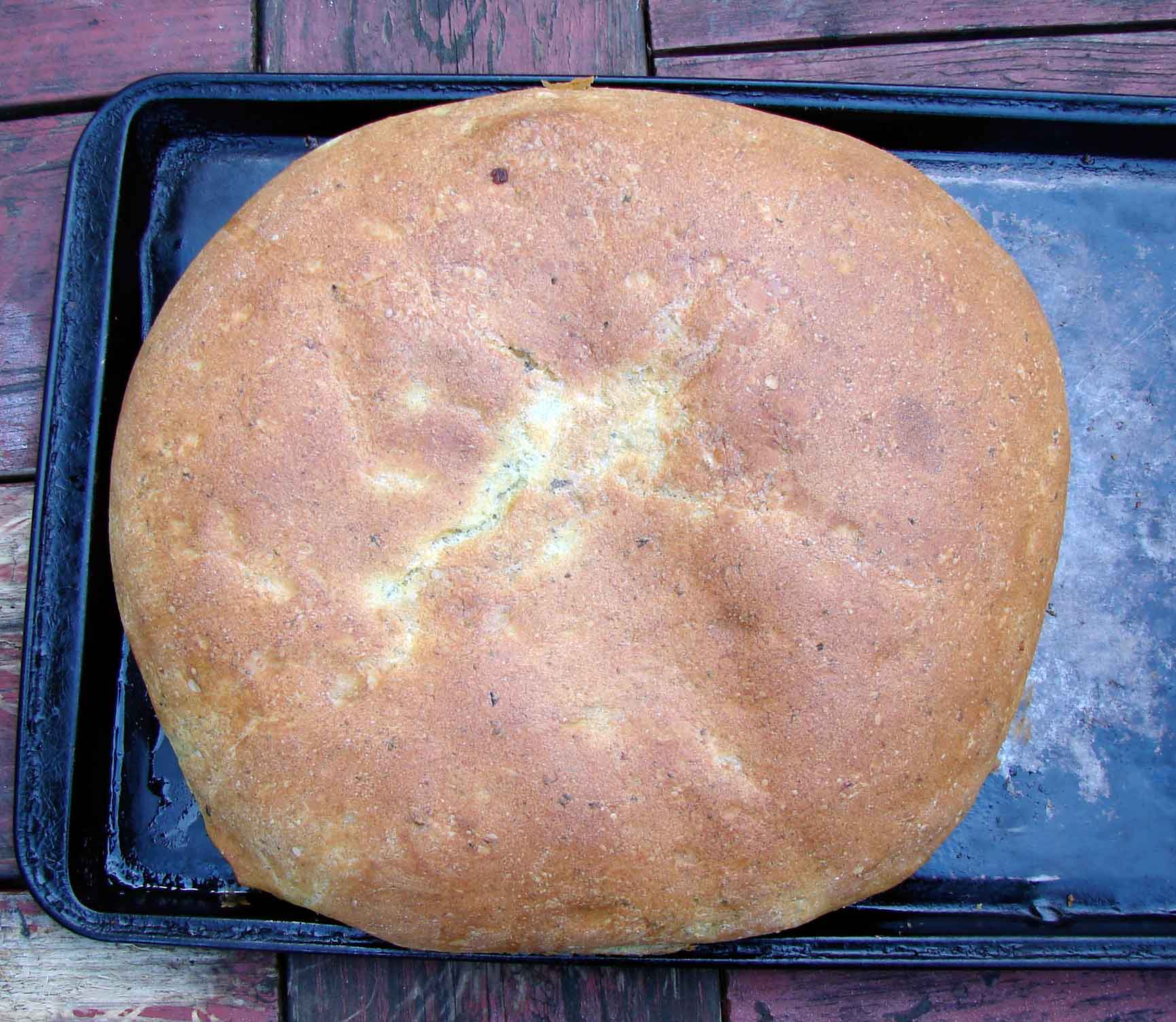
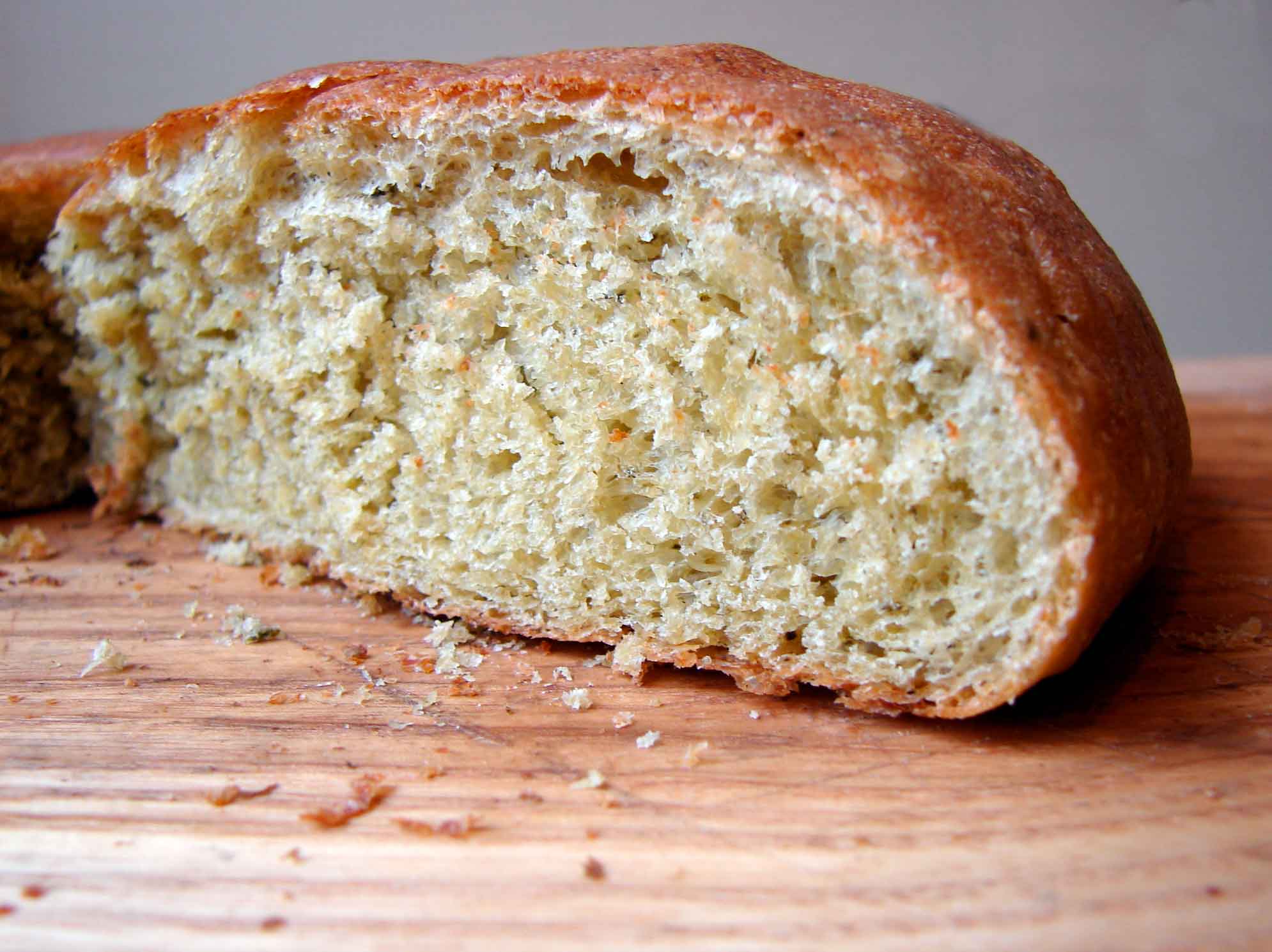
I’m very very excited about this bread! It’s the oddest thing, but I dreamed about it two nights in a row, and then I woke up and spent the rest of each night trying to figure out how to make it. Colcannon, of course, is an Irish dish that contains mashed potatoes and kale or cabbage. In my dream I made it into bread, and so…in real life I did just that! It’s a lovely, light but dense, pale green bread with darker green flecks. The flavor is very subtle – you don’t actually taste kale, just a nice savoriness (which means small boys will like it!). I added plenty of freshly ground pepper for flavor, and an egg and a bit of milk to make it soft inside. It’s got a nice crispy chewy crust. I made one huge loaf, which is very seussical looking, but it probably would have been more practical to make two smaller ones. Maybe next time!

Here’s REM with Wolves, Lower, appropriately, live in Ireland!

Continue reading

Jerk patties with pigeon peas, butternut squash and kale

Jerk patties with kale and butternut squash

Jerk patties with kale and butternut squash

Malcolm has been trying to remember a song. It’s a song I listened to all the time when he was little, that I sang along to. (These claims check out, because I do tend to become obsessed with songs and sing along with them over and over.) Malcolm is the boy with the long memory. If we’re trying to remember where we put something, or if we watched something, or who said what, we ask Malcolm. I love to think about Malcolm looking out on the world with his wise, observant, beautiful eyes, these past ten years, and collecting a trove of thoughts and images and recollections, and storing them in his remarkable brain. It’s one of the things that makes him seem wiser and more mature than his years. (As opposed to, say, giggling over fart jokes with his brother in the back seat. And there’s also plenty of that!) I used to have a good memory for strange, inconsequential things, but I feel as though my memory is fading with my eyesight, which is a weird sort of impaired, half-awake feeling. So we’ve been trying to recall this song. On Saturday night we sat on the couch, and he leaned heavily against me in the sweet way I’m sure he won’t do for much longer, and he played songs on his iPod (or fragments of songs – he’s an erratic DJ!). We thought about all the songs we’d listened to when he was very little. We listened to songs that used to make me burst into tears when I was very pregnant or just after he was born, because I was overwhelmed with the scale of our impending change. We tried to remember all of the songs he’d sing along to, with delightfully incorrect words. And there’s no medium more powerful for conjuring recollections than music! And as we listened for old memories in the songs, we were weaving new ones as well, so that years from now these songs will have layer upon layer of remembrance. We never did figure out which song he had in mind, but in the end, of course, it didn’t matter. The joy was not in remembering this one song, the joy was in remembering.

Food is another great trigger of memories! I remember walking around Central Park in the blazing hot sun during a street festival. I coveted the jerk patties, so bright and festive and fragrant, but they usually had chicken or beef in them. Not these, my friend! These have kale and pigeon peas. And I developed a new technique with the butternut squash. I grated it and then roasted it. I like it this way, especially in a pie – it turned out more roasty, and a lovely texture. I tried to minimize the time it took to make these by rolling out a long thin sheet of dough (two feet by ten inches, maybe) putting big glops of dough along one side, folding over, sealing, and then cutting apart. Kind of like making ravioli. If this seems, actually, to be more work, feel free to divide the dough in six, roll out thin rounds, and make this half-circle shaped.

Here’s Stars of Track and Field by Belle and Sebastian. Malcolm used to sing “Stars and dragons still too far.”

Continue reading

French cake a week – Galette Bretonne

Galette Bretonne

Galette Bretonne

In which Claire, who doesn’t speak french, bakes her way through the cake section of a French cookbook from 1962. It’s the day after the orgy of soulless self-adoration and styleless glamor that is the Oscars! This seems an appropriate time to return to the practice of discussing female French film makers in conjunction with our French-cake-a-week recipe. It seems particularly fitting to discuss the films of Germaine Dulac, a woman who worked with remarkably energy and passion to create a “pure” cinema with which to express the inner workings of the human mind and soul. (I should say at this point that I haven’t seen any of the Oscar-nominated films, and that I used to enjoy watching the Academy Awards, and might still if we got any television reception and if they weren’t on way past my bed time.) Dulac was born in France in 1882. Her love for film developed as the art itself was in its infancy, and she had fervent hopes for the direction it would take as it matured. She believed in a cinema separate from literature or theater, one that would achieve its full potential power by focussing on movement and montage, and would not be confined by the restrictions of narrative. She began making films in 1915, and would continue working for nearly twenty years, shaping the evolution of cinema. Her early films were commercial and narrative, serial stories based on novels or scenarios that she or others wrote, but from the first she was more interested in the musicality of film – the ability of film to create rhythm and atmosphere that plays on the emotions of the viewer – than in the dramatic action or the story. Her films became increasingly abstract and dream-like as her career advanced. She used film technology to create “Interior life rendered perceptible through images, combined with movement–this is the whole art of the cinema. Movement, interior life, these terms are not incompatible. What is more active than the life of the psyche, with its reactions, its multiple impressions, its swells, its dreams, its memories?” She sought to express spiritual life “…cadenced by the rhythm of the images, their duration, their dramatic or emotional intensity, following the sweetness or violence which emerged from the souls of my characters.” In her 1922 film The Smiling Madame Beudet, Dulac tells the story of a housewife trapped in a loveless marriage, who escapes her unhappy reality with a rich and vivid fantasy life. Dulac shows her flights of fancy in beautiful sequences that illustrate the rich creative world we all have inside of us, that we can turn to at any time, no matter what our outward circumstances. I love this era of film, when it was so new, unknown and full of promise. I love the way that people wrote about film, thought about film, and talked about film with such passion and urgency. It was so important to them not to squander the magical possibilities of their new medium, not to let it take a wrong direction that would result in it becoming stale or dull. I wonder how they would feel about the movie industry today, as typified by Hollywood and the Oscars, which seems so cynical, bloated and mercenary. Later in her career, Dulac would write an article discussing French film in relation to Hollywood, but I think it could easily apply to any film made outside of the system – independent films, home movies, even – and, in fact, it could apply beyond film to any effort to express ourselves creatively, in art, or in our lives. “We may lack faith in ourselves, and that’s the cause of our trouble. Our so-called inferiority…leads us to seek perfection through the correction of our faults rather than through the development of our good qualities…Instead of seeking inside ourselves, having lost confidence, we look to the accomplishments of others…The time has come, I believe, to listen in silence to our own song, to try to express our own personal vision, to define our own sensibility, to make our own way. Let us learn to look, let us learn to see, let us learn to feel.”

Galette bretonne

Galette bretonne

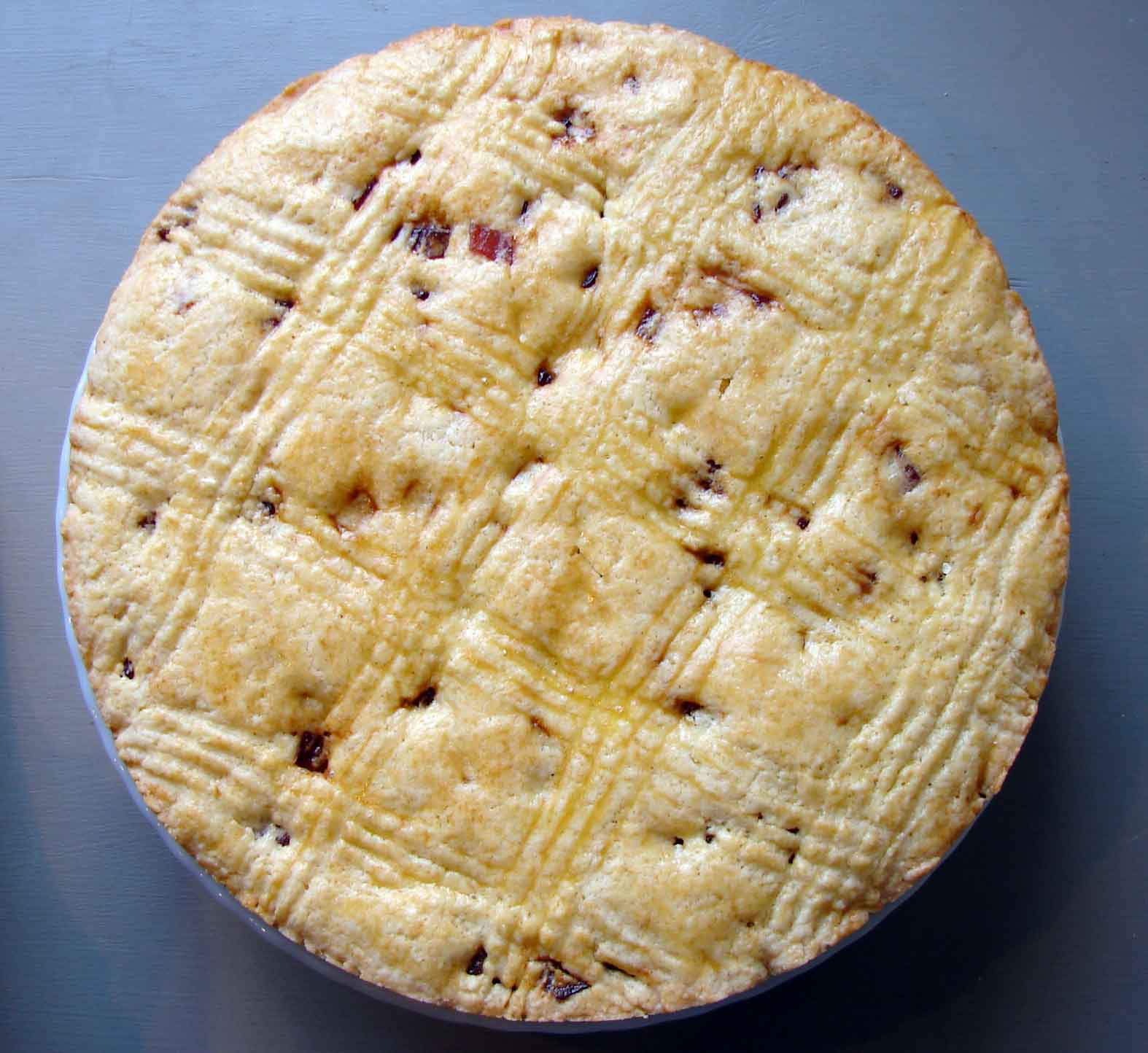
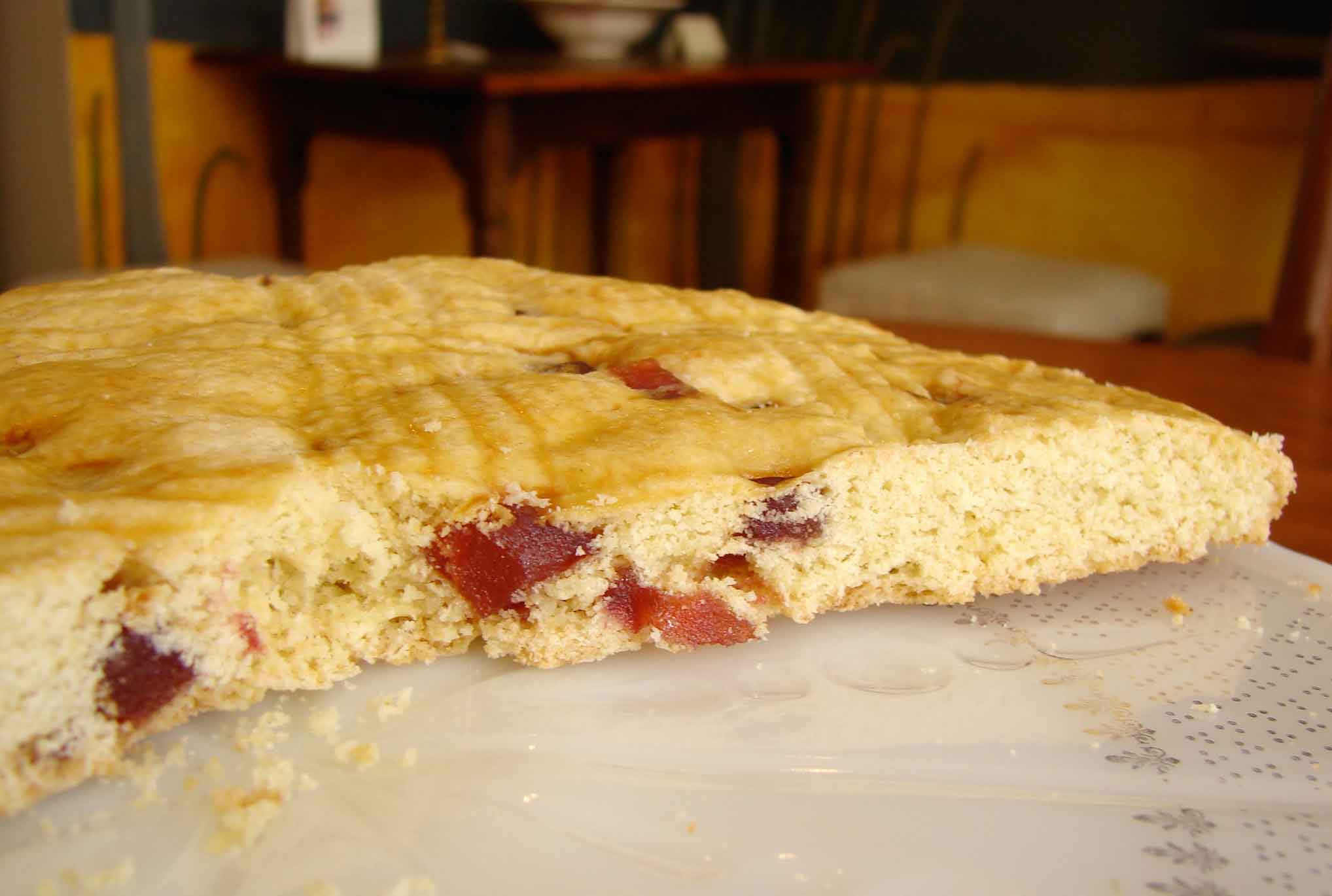
This Galette Bretonne is a lovely cake. It’s a little like a giant shortbread cookie, a bit crunchy on the outside and soft within. It calls for “fruits confits,” and since I’m not a big fan of most candied fruit, I decided to use small pieces of quince membrillo that I made at Christmas time. You could use any kind of dried or candied fruit you like. I think candied ginger would be nice, too! Or you could leave the fruit out altogether!

Here’s Space Boy Dream, by Belle and Sebastian, which is a nice expression of a flight of fancy.

Continue reading

Cauliflower, potato, tarragon, and pecan nests with broccoli rabe, white beans, olives and tomatoes

Cauliflower, pecan and potato nest

Cauliflower, pecan and potato nest

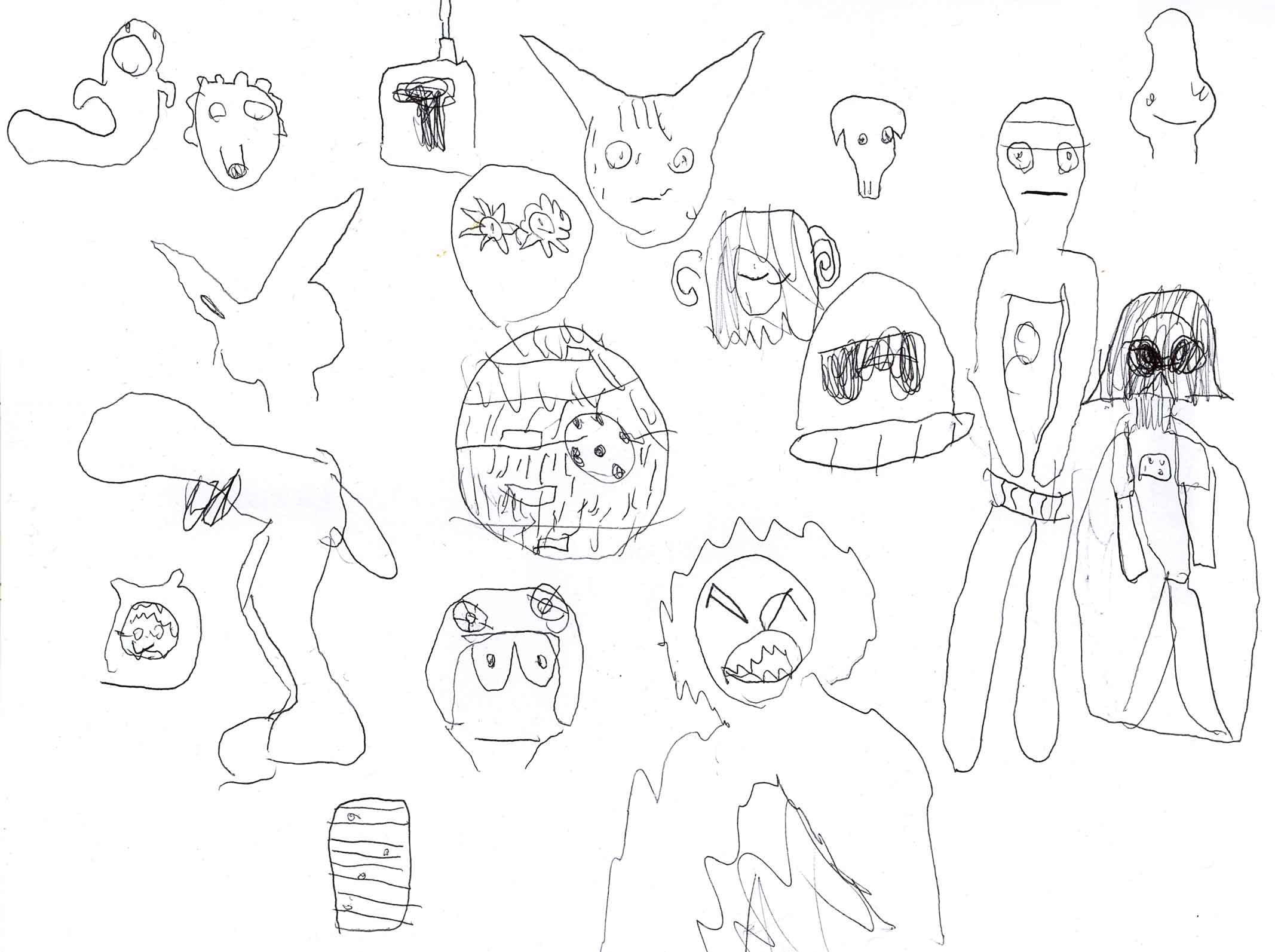
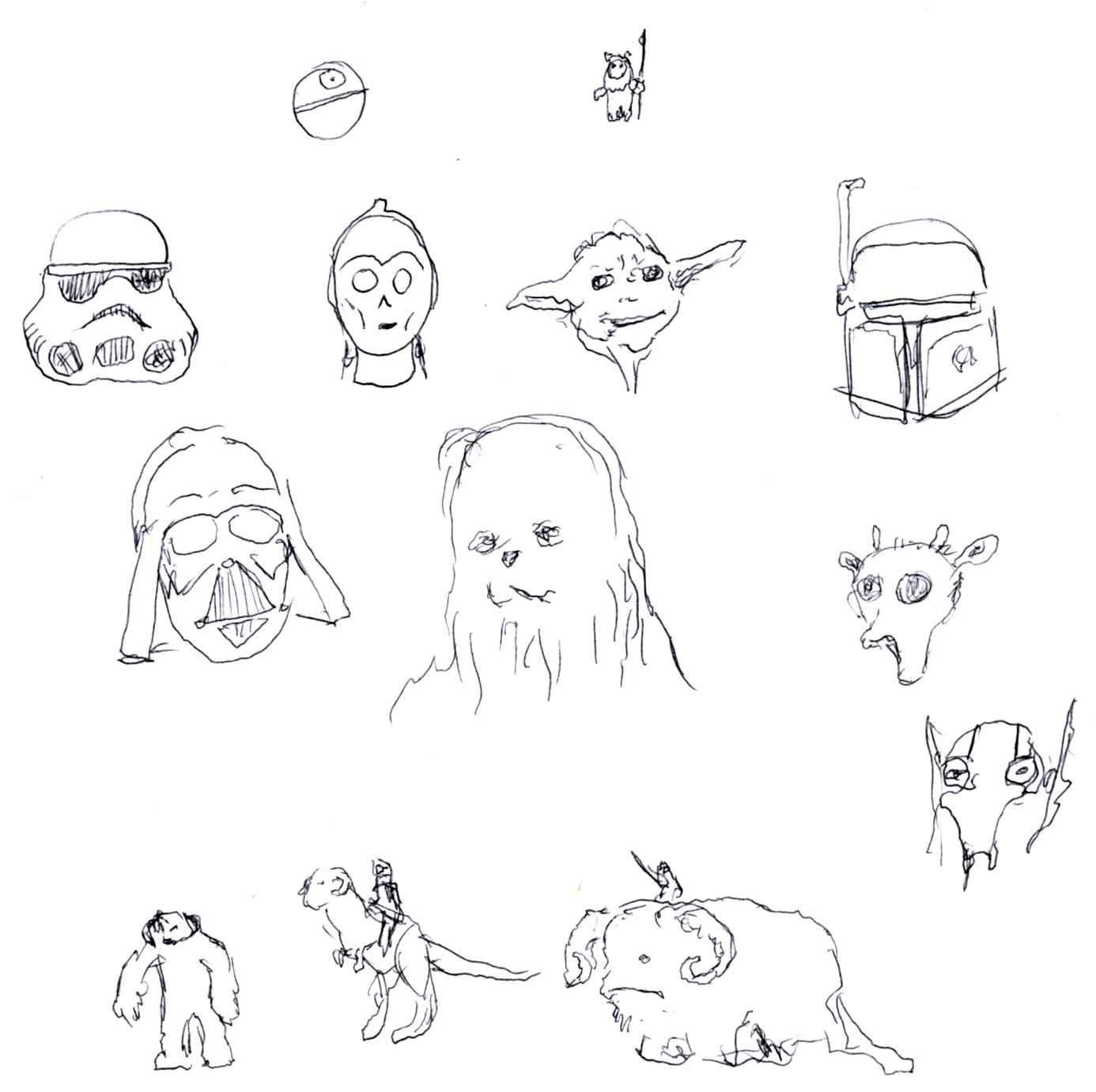
“Daddy, do you want to play with star wars toys?” asked Isaac in his bright voice. “Nobody’s said that to me in thirty years!” said David. (He did want to play.) I remember the first time I saw Star Wars. It was 1977 (of course) and we waited on line. We saw it in a theater in a mall, and it was a seventies mall, all orange and brown and drab and fluorescent. And of course we loved the movie! It’s so bright and inventive and richly imagined. I love to think about George Lucas with this whole universe inside of him, and how joyful it must have been to make the movie and to watch the movie, and to see that people liked it. I love the fact that Star Wars has a history, even the first movie had a future and a past, and though it would be decades before we’d know the full story, even in that first (fourth) film, you could feel the haunting weight of memory. Which is a sort of a beautiful thing in a film! Star Wars is about generations, so it seems fitting and wonderful that we can share it with our sons. I love that our boys love it! (Actually, I like the fact that all boys love it!) It feels good to share this modern mythology with them, a mythology that’s probably shaped our consciousness more than we know! Like most mythology it’s about good versus evil, strength versus weakness, in the world at large and within ourselves. It’s about the struggle to understand where we’re from and where we’re supposed to go, and who we should trust to go with us. It’s about discovering that we have some invisible power within ourselves that we have to harness and struggle to control, and learn to use for good. Epic! The other night, whilst watching Star Wars for the gazillionth time, we played a game. I named Star Wars characters, and David and the boys had to try to draw them from memory. It was more fun than it sounds! Unless it sounds really fun to you. I LOVE the pictures they drew, and I love the way they illustrate visual memory, and the working of busy minds, and the fact that drawing ability has been handed from father to sons. Here they are…
Isaac's

Isaac’s

Malcolm's

Malcolm’s

David's

David’s

So today’s Sunday interactive playlist is about generations…about a sense of history, a memory of the past or an anticipation of the future. Advice from elders, sass from youngsters…any of this will do!

Cauliflower nest

Cauliflower nest

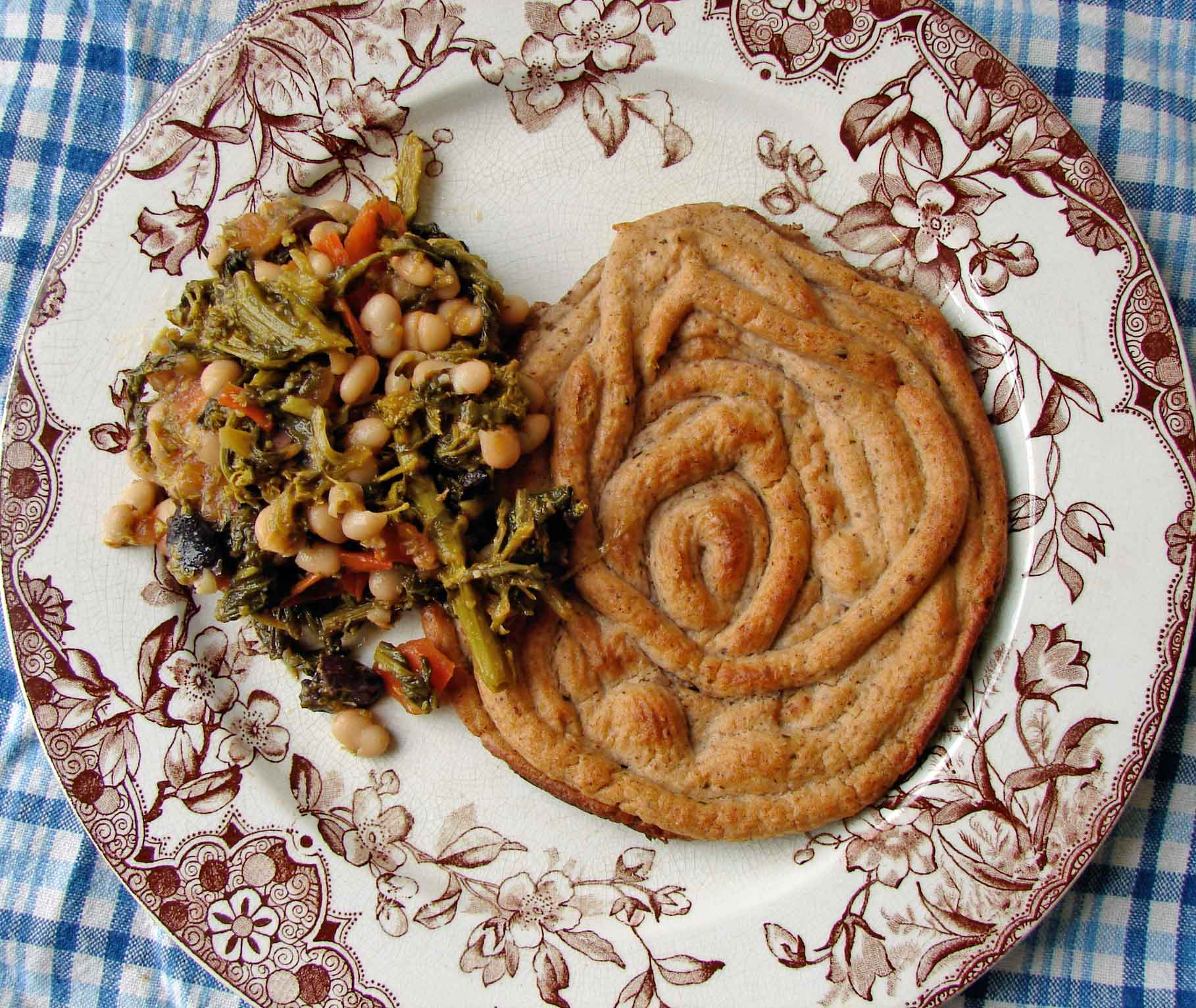
ANd this crazy meal was the result of some leftover mashed potatoes and a desire to play with my pastry tube. I decided to combine the potatoes with some steamed cauliflower, some pecans and some tarragon, (as well as some eggs and cheese) and make a smooth thick batter I could shape into a sort of nest. And since all of these things (potatoes, pecans, cauliflower, eggs and cheese) are sort of mild and comforting, I thought I’d combine them with something bright and saucy, like broccoli rabe and tomatoes. So that’s what I did! I thought it all turned out very tasty. You pecans and tarragon are very nice together. You could serve these with any kind of greens, or any sort of saucy dish that you like.
Continue reading

Roasted butternut and mushrooms with hendricks, herbs and gjetost cheese (vegetarian Norwegian reindeer stew)

Roasted butternut with hendricks and gjetost cheese

Roasted butternut with hendricks and gjetost cheese

I feel like I’ve been going on (and on) lately in an increasingly verbose fashion, and I have to get to work soon, so I’m going to let some others speak today. In the past we’ve presented a collection of quotes, in the style of Seymour and Buddy Glass, and today those quotes will all be about vegetarianism. I try not to talk about vegetarianism too much, because it invariably seems preachy and proselytizing, but it’s something I’ve been thinking about lately, and this is a vegetarian food blog! It all started when I got to thinking about George Bernard Shaw, whom I admire very much. I was thinking that however hard it occasionally is to be a vegetarian today, it must have been much harder when he lived. And I started to find a lot of quotes from people I admire, so that it seemed, as Gandhi said, that “It is very significant that some of the most thoughtful and cultured men are partisans of a pure vegetable diet.” Last week I spoke about my appreciation of generosity in novels and films, of an author’s affection for the characters they’ve created, and I started to see a connection between writers and essayists that I love because they’re kind to their characters (like Shaw or Tolstoy), and a greater philosophy of compassion for all creatures. So here are some of the wise things that have been said. I find the prophetic urgency of them very fascinating, particularly compared to the world we find ourselves in today. I love to think about people thinking about these things – about our place in the world, or relation to nature, the value of kindness – not in a judgmental way, but as a philosophical exercise in understanding the great mysteries.

    Nothing will benefit human health and increase chances for survival of life on Earth as much as the evolution to a vegetarian diet. ~Albert Einstein

    “Thou shalt not kill” does not apply to murder of one’s own kind only, but to all living beings; and this Commandment was inscribed in the human breast long before it was proclaimed from Sinai. ~Leo Tolstoy

    While we ourselves are the living graves of murdered beasts, how can we expect any ideal conditions on this earth? ~George Bernard Shaw

    I did not become a vegetarian for my health, I did it for the health of the chickens. ~Isaac Bashevis Singer

    Animals are my friends… and I don’t eat my friends. ~George Bernard Shaw

    One farmer says to me, “You cannot live on vegetable food solely, for it furnishes nothing to make the bones with;” and so he religiously devotes a part of his day to supplying himself with the raw material of bones; walking all the while he talks behind his oxen, which, with vegetable-made bones, jerk him and his lumbering plow along in spite of every obstacle. ~Henry David Thoreau

    The time will come when men such as I will look upon the murder of animals as they now look upon the murder of men.
    Leonardo Da Vinci

    The obligations of law and equity reach only to mankind; but kindness and beneficence should be extended to the creatures of every species and these will flow from the breast of a true man, as streams that issue from the living fountain.
    Plutarch

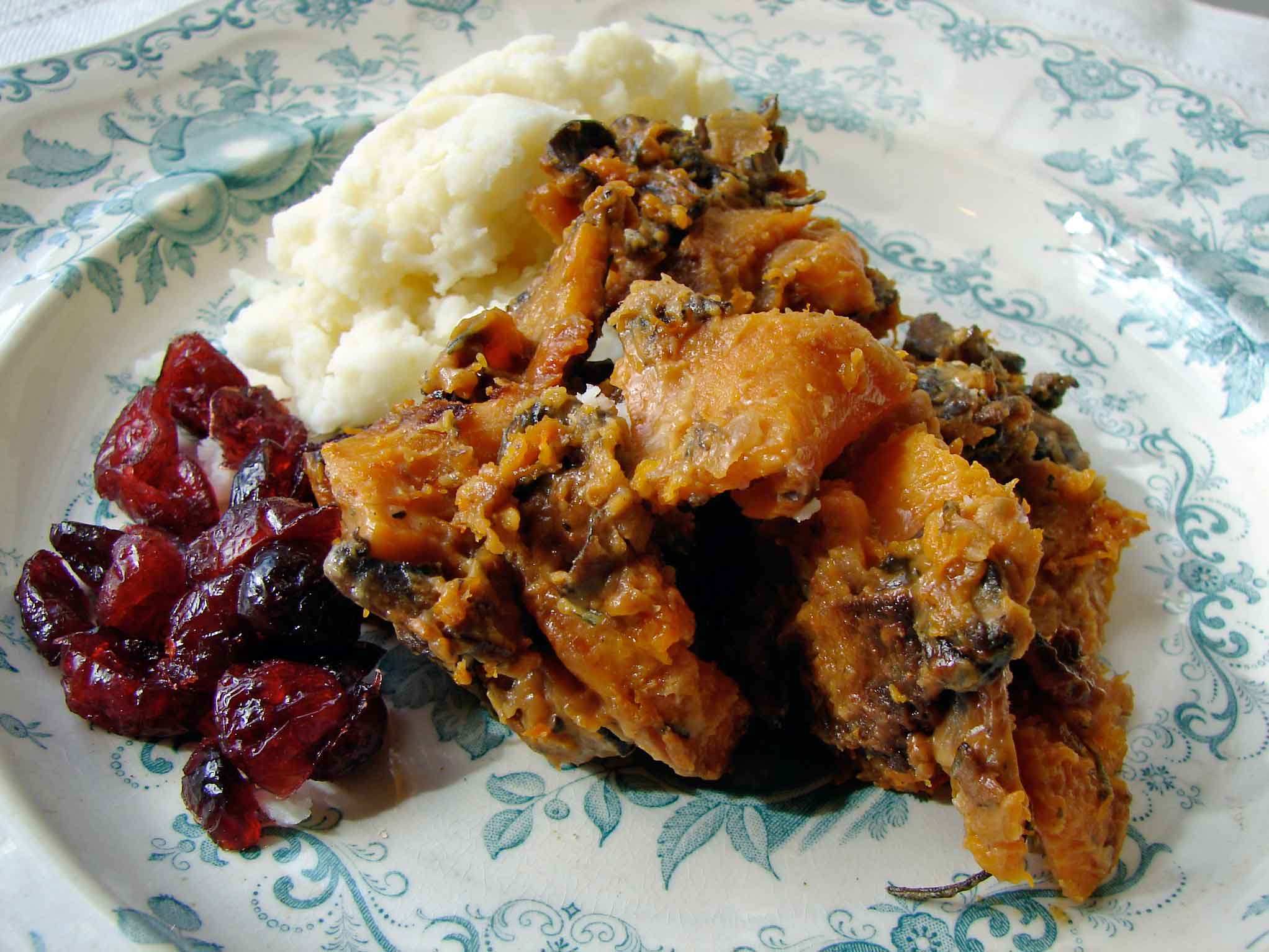
And that’s all for now! On to this meal! Surely one of the strangest but tastiest I’ve made. I bought some gjetost cheese, as I’ve mentioned. I had read in the Guardian that this cheese could be used to thicken a Norwegian reindeer stew called Finnbiff. So I looked up a few recipes, and I decided to try it! I used thinly-sliced roasted butternut squash as a replacement for the reindeer meat. I roasted them mushrooms, too. Every recipe I saw called for Juniper berries. I didn’t have juniper berries, but I did have Hendrick’s gin, which is made with juniper berries! I added a big slosh of that, as well as a little bit of rosemary, because juniper berries are said to be a little piney. This whole meal was the most umami-ish thing I’ve ever eaten! It had a depth and sweetness that was lovely. Finnbiff is eaten with mashed potatoes and cranberries (well, lingonberries, originally, I think), so we had that, too. The mashed potatoes were perfect with the squash and mushrooms, as a nicely-textured, mild-flavored foil for their strong flavor.

Here’s Desmond Dekker with Wise Man.

Continue reading

Red quinoa with chard, sweet potatoes and white beans

red-quinoa-white-beanYesterday was Nina Simone’s birthday. Today I want to write about her, but I don’t know where to begin. It’s hard to talk about something that you love as much as I love her music, it’s hard to talk about something that means so much to you. I suppose everybody is familiar with the autobiographical facts, so I’ll keep it brief. She was born Eunice Kathleen Waymon in Tryon, North Carolina in 1933. Her mother was a methodist preacher and a housemaid, her father was a handyman. From a very early age, she was determined to be a concert pianist. Her mother’s employer provided funds for piano lessons. After high school, she applied to the Curtis Institute, in Philadelphia, but was rejected. She moved to New York and studied at Juliard, supporting herself by playing piano in a bar, where she took the name Nina Simone to hide her profession from her mother. She was discovered, had a hit with I Loves You Porgy, and continued to record and play, jumping from one record company to another for most of the rest of her life. Her friendship with Lorraine Hansberry, Langston Hughes, James Baldwin and others helped to focus her fire, and she worked for civil rights with characteristic passion. She wrote the blistering song Mississippi Goddam (which has come to mind more than once this week!) in response the the murder of Medgar Evers and to the death of 4 black children after the bombing of a church. She eventually grew disillusioned in America, and moved abroad. She would live in Barbados, Liberia, the Netherlands, Switzerland, London, and finally the South of France, where she felt peaceful and free, and grew grapes, peaches, strawberries and raspberries. She was known to be temperamental, moody and volatile. She was a hypnotic performer, but an unpredictable one, and on more than one occasion she would berate the audience for talking. “My original plan was to be the first black concert pianist–not a singer–and it never occurred to me that I’d be playing to audiences that were talking and drinking and carrying on when I played the piano. So I felt that if they didn’t want to listen, they could go the hell home.” She defied labels, combining jazz, pop, blues, classical, gospel. She disliked the term “jazz,” which she saw as a way for white people to define black people, and she preferred to think of the genre as black classical music. Her voice is unmistakable and indefinable, deep, rich but light, raw and full of emotion, but with an odd, edgy coolness that cuts right to the most vulnerable part of you. She can take the sappiest song and make it speak to you about the human condition in such an intensely honest way that you feel she understands. She brings a magnetic dignity and gravity to everything she does, but she’s funny as hell, too, and light-hearted and surprising. After I’d had Isaac, Malcolm got very sick, and I was struggling with some poisonous combination of anxiety, postpartum depression and sleep deprivation. I felt down. I listened to Nina Simone sing Ooh Child, her voice full of compassion and gentle triumph, over and over, and I believed her, I believed things would get better. I knew that she’d been down, too, and she knew what she was talking about. “I feel what they feel. And people who listen to me know that, and it makes them feel like they’re not alone.” Langston Hughes, who wrote her song Backlash Blues wrote of Simone, “She is strange. So are the plays of Brendan Behan, Jean Genet and Bertolt Brecht. She is far out, and at the same time common. So are raw eggs in Worcestershire. She is different. So was Billie Holiday, St. Francis and John Donne. So is Mort Sahl, so is Ernie Banks. You either like her or you don’t. If you don’t, you won’t. If you do — wheee-ouuueu! You do!” Well that’s it! Whee-ouuuueu! She’s strange in a way that makes it good to be strange, for all of us to be strange, and in a way that feels so perfect and necessary that it almost seems normal. Or what normal should be – with that much inspiration, intelligence, intensity, wit, and passion. Nina travelled the world looking for freedom – freedom from oppression and greed, maybe freedom from her demons. In a remarkable performance of I Wish I Knew How it Feels to Be Free (which I’ve talked about before), she defines freedom as freedom from fear, as a new way of seeing, as a chance to be a “little less like me.” She’d learn to fly, and she’d look down and see herself, and she wouldn’t know herself – she’d have new hands, new vision. She tells us that the Bible says be transformed by the renewal of your mind. And her songs create a world with their intensely honest eccentricity, a world where you feel moved to your soul, and inspired to renew your mind, and be brave enough to see things anew, as they really are, or as they could be.

I’ve made a small playlist of some of my favorite songs. Including House of the Rising Sun, which she did before Dylan or the animals or Von Ronk; and Feeling Good, which is the best invocation of spring I know; and Nina’s Blues (two versions!) which is my favorite song of all. Beautiful, sad, and triumphant.

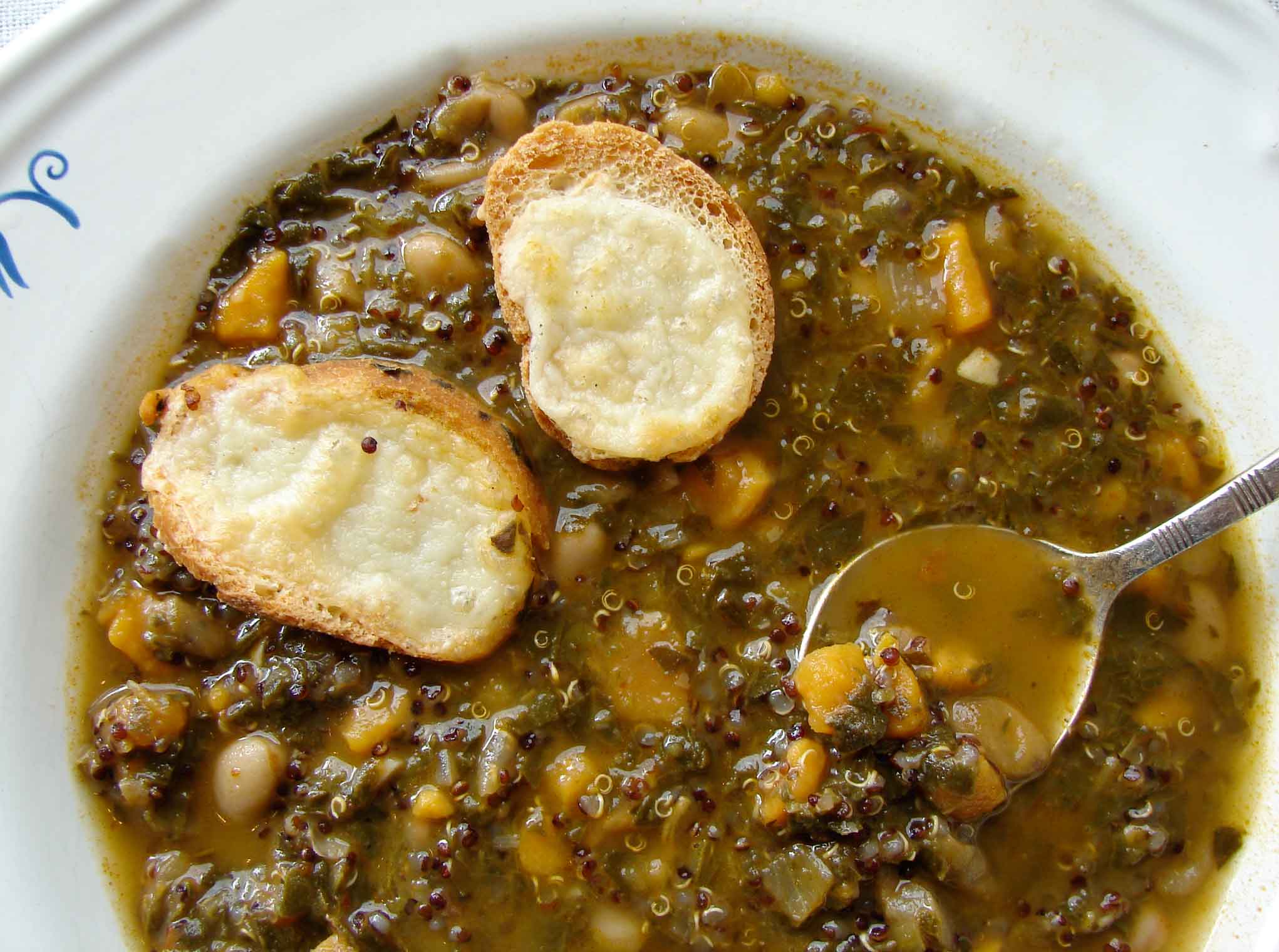
Oh yes, and here’s a recipe for red quinoa, chard, white beans and sweet potatoes. A nice combination of sweet, savory, earthy and bright. The boys liked it, which was all part of my evil plan, because I want them to eat more protein. I used great northern beans, because they’re nice and meaty, but you could use any manner of white beans you like. I made this like a thick stew, but you could add a bit more water and have a brothy soup, or add less water and have a nice side dish. We ate it with cheese toasts!

Continue reading

Malcolm’s hazelnut almond chocolate cookies

Almond, hazelnut chocolate cookie

Almond, hazelnut chocolate cookie

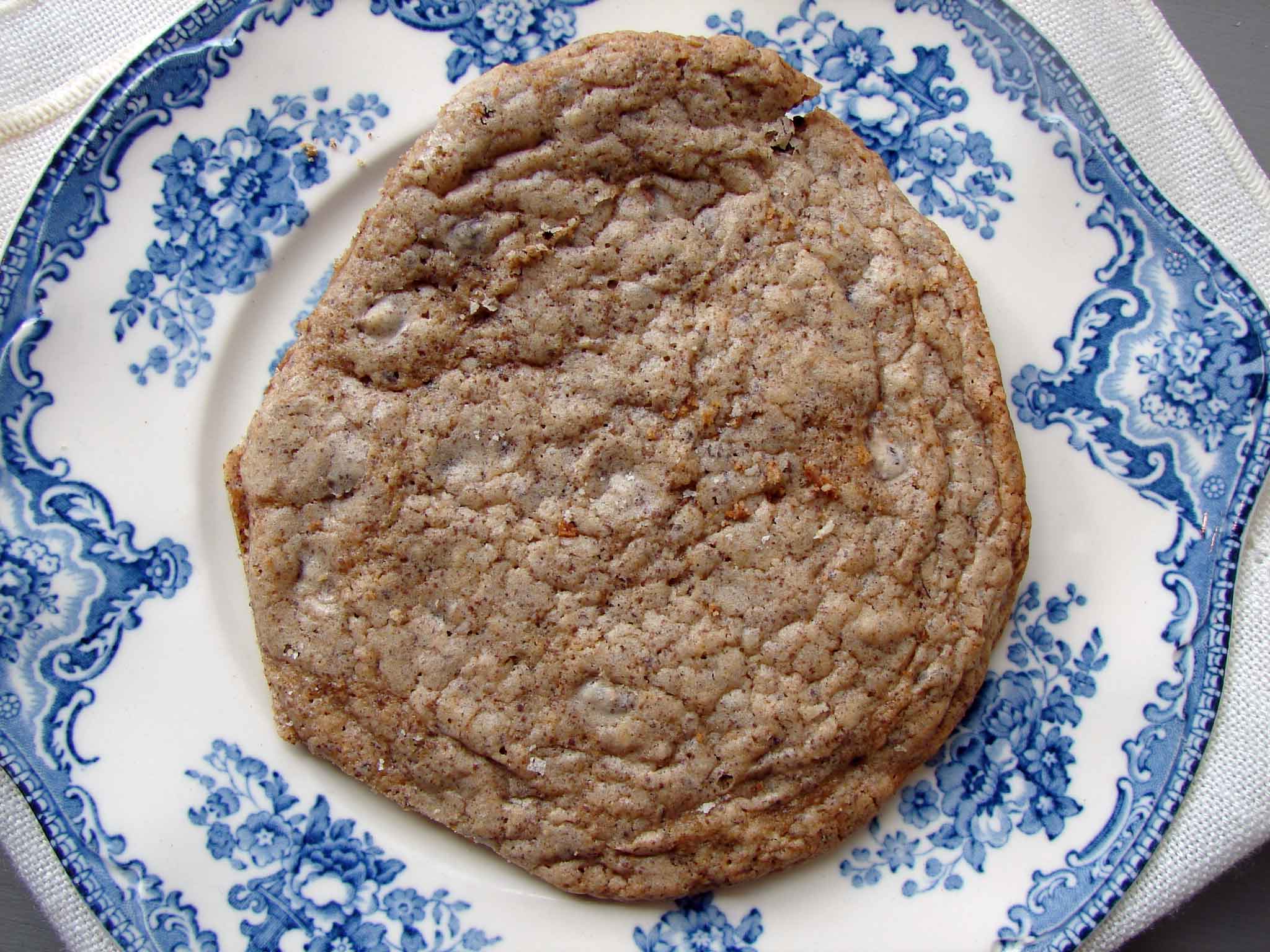
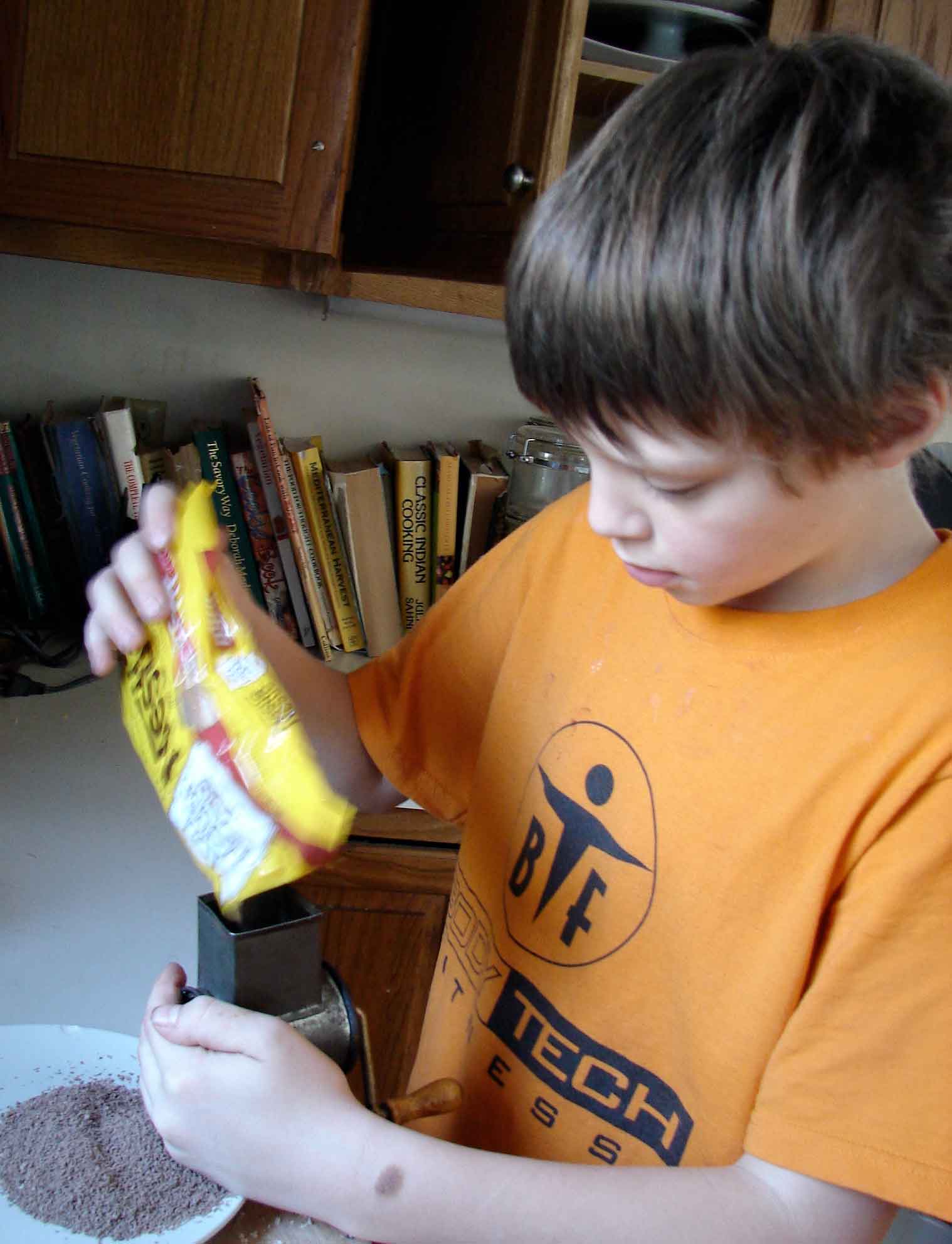
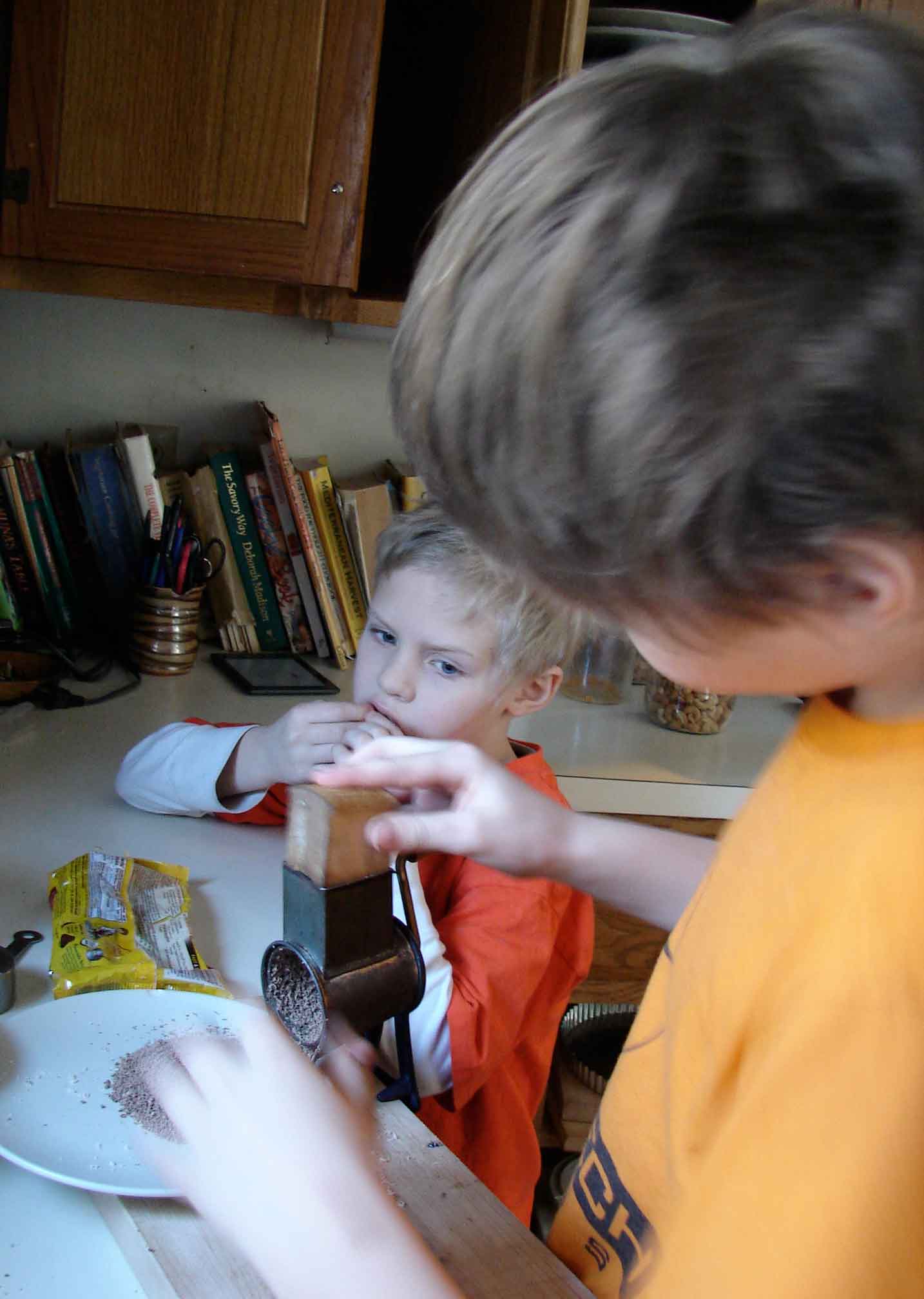
When I was little, I was very curious, I was a messer, I liked to invent things, and I liked strange gadgets. Our Malcolm has inherited all of these traits, for better or for worse. I used to beg my parents for odd devices from cooking catalogs, and they’ve all ended in a jumble in a drawer in my kitchen. It should come as no surprise that Malcolm likes to go through the drawer. He had the day off school, Monday, and I found him in the kitchen playing with two ancient hand-cranked graters. (Why did I have two? I don’t know! I don’t even remember what I used them for!) Malcolm’s plan was to grate crackers into the dog’s bowl. My first reaction was of terrible iration (shouldn’t that be a word?!?!) And then I said, no, let’s actually use the grater, to grate food that according to my foggy memory, it was designed to grate. malcolm-chocolateSo he grated some almonds. And then he used his messer-ingenuity to devise a method of attaching the grater to a cutting board for more control. And then he grated hazelnuts. And then I said, ah yes! I remember it can be used for chocolate. So he grated chocolate. malcolm-graterIt was such good fun! And he created mounds of lovely soft, fine nuts and chocolate. We decided to make cookies. Or cakes. Cookie-cakes! And as we sat eating them after dinner, I realized that it was Monday, not Sunday, so the homework we planned to put off because it wasn’t due till Tuesday was due the next day…and that brings us to “pro-social others.” As part of Malcolm’s drug awareness and education class, we do worksheets together as a family. (I should start by saying that I’m glad he’s taking the class and I’m fine with the group activity-quality of it all! Although I don’t see why they can’t just have an assembly with a taciturn policeman showing slides of OD corpses and cocaine-ravaged septums, like when we were young. You know it worked because nobody in my high school ever did drugs.) The language of the worksheets is often very jargonny and difficult to wade through for meaning, but they’re so earnestly well-intentioned that it’s hard to be critical. And some of the scenarios are a little advanced for a ten-year-old, (I can’t imagine him shopping by himself at a mall any time soon!) but that’s okay, they’re starting early. But this phrase, pro-social others, it really bothers me!! I’m no fan of the redundantly, sales-gimmicky, self-help-y word “proactive,” but pro-social seems to have more meaning than that. Apparently it came about in the 80s (did anything good come out of the 80s?) as an antonym for anti-social. It means altruistic, other-oriented, helpful, intended to create social acceptance and friendship. Lord, I love the idea of altruism and helpfulness. I’d like to imagine and encourage such a society, I’d like Malcolm to join the ranks of happy friendly people. But “pro-social others” sounds so robotic, so unfriendly and inhuman. It sounds like a phrase invented to fool us into forgetting the real words. It sounds as if you can somehow control who your children become friends with, or order them perfect, socially accepted friends from a catalog. I genuinely hope that Malcolm doesn’t ever do drugs. He’s so curious and fearless that I worry for him, sometimes. I hope he’s strong enough in himself to resist peer pressure. But surely part of that is to encourage a little bit of rebel in him, to applaud the ability to question convention and to make the decision to be anti-social when the society you find yourself in is unkind or dangerous. It’s funny how everything these days seems to boil down to my wish for my boys. I love to see them with their friends, walking slowly, heads inclined toward each other as they discuss some serious mystery; leaping happily in the air on the street corner before school, pumping their arms and trying to get trucks to honk. Of course my wish for them is to have many friends, and to have interesting friends, and to have good friends. I hope they’ll be strong enough to help friends out of trouble rather than follow them into it. I hope they’ll be able to side-step pettiness and meanness. I hope they’ll experiment with paint or pastry dough instead of hard drugs. I hope they never have an aching empty hole they feel they can’t fill. As we sat discussing the worksheet, and I told Malcolm I hope he won’t ever do drugs, he pointed to my glass of wine, with a smile. “You drive me to it lad!” I yelled! No I didn’t, of course I didn’t. I said, “well, it’s social, and legal, and in moderation.” And he said he hoped that he could have a glass of wine with us someday. And I do, too! I look forward to that as well. To making a dinner with Malcolm, who is always the most fun to cook with, and having a glass of wine, and hearing about his life, wherever in the world it takes him, and hearing about the people that he loves and that love him!malcolm's-cookie

Here’s a little playlist Malcolm put together that we’ve been listening incessantly to lately. It will always remind me of these days! (Sweary language alert!!)
Continue reading