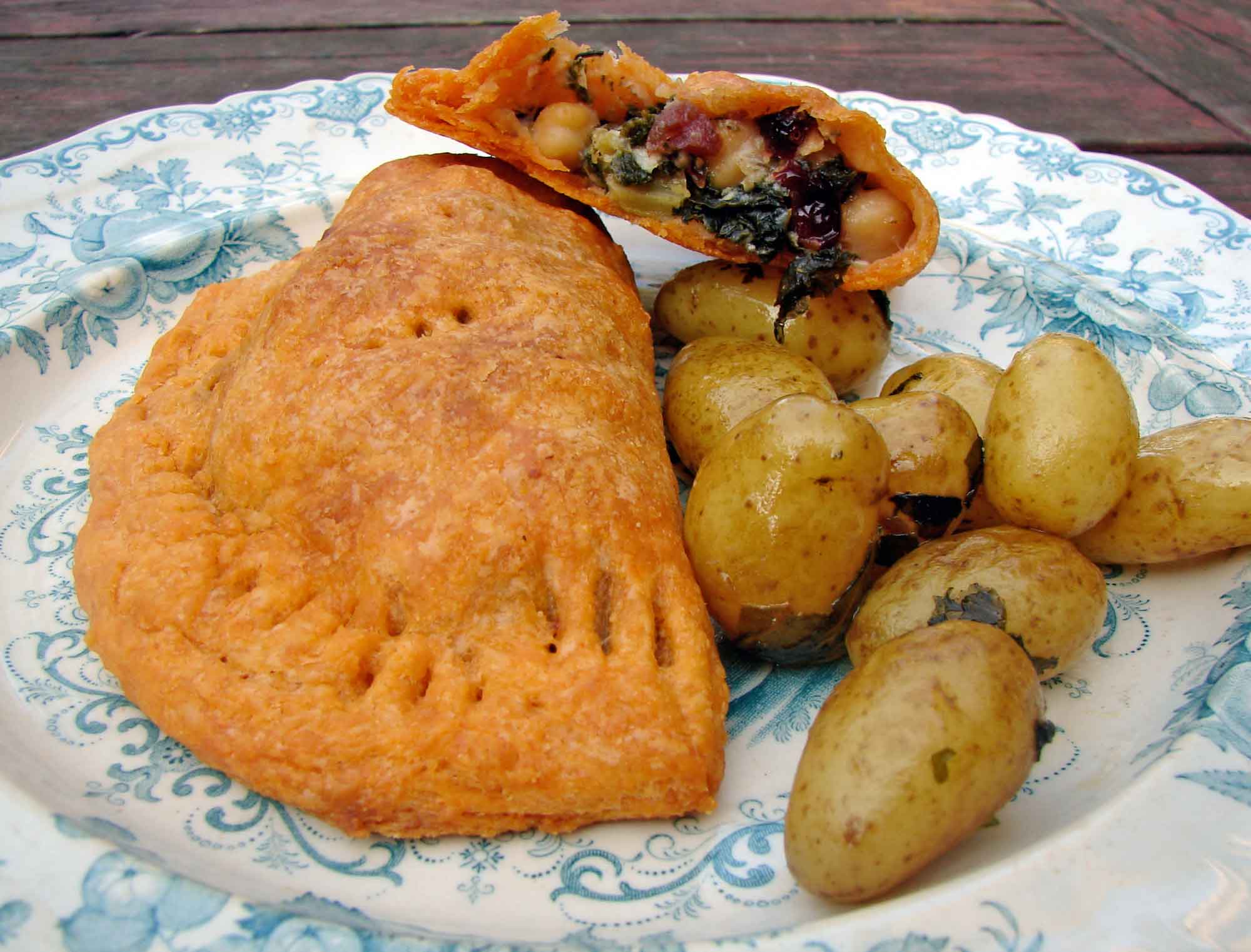
Empanadas with greens, chickpeas and cranberries

Kale, cranberry and chickpea empanadas

Kale, cranberry and chickpea empanadas

I’ve been thinking about the way our world changes, and specifically about the way people bring about that change. Our history as humans is a pattern of progress and change, progress and change. We’ll head blindly in one direction, unable to see quite where we’re going because it’s so close, and then somebody or somebodies will push us in another direction. With a grand gesture, with a slow protest, with a war, with a sit-in, with a newspaper article, with a violent act, with a strike, with a clear bold voice, or in a confused tangle of contradictory words.

I’ve been thinking about certain small acts of rebellion that I love, certain quiet ways that people have changed the rules. They change the world slowly, almost imperceptibly, but the change grows in widening waves. The personal becomes political and art becomes powerful.

I love to read about blues musicians from the last century, growing up in a world of poverty and discrimination and finding a way to make music no matter what the odds. Nobody hired them a music teacher so they’d understand the rules of musical theory. Big Bill Broonzy made a fiddle from a cigar box, Elizabeth Cotten taught herself to play guitar upside-down, they figured it out themselves, with the help of some friends. They sang about their lives, the way they actually were, the trains running by their door, the work they had to do, and they sang about the way they wished their lives could be. The rules they answered to in life were harsh and unjust, but in music they made their own rules, they made music the way they wanted it to sound–that was theirs.

And with books like Catcher in the Rye, Grapes of Wrath and To Kill a Mockingbird, we find a whole new world of writing, with the language people actually use, according to the rules of conversation and not those of grammar. These books are intimate and personal and real, and they describe the lives of normal people as they actually are. This small feat frightened people enough that they were all banned, at one time or another.

And, of course, I love filmmakers who make films the way they think they should be. Hollywood films have quite a rigid set of rules that dictate the way they’re made. These rules are nearly invisible to the viewer, because they’re designed to make a film seem more realistic, and because we’ve grown up with them, we’ve learned them, without even realizing. Well, I love a director like Yasujiro Ozu, who defies these rules. He sets the camera where he thinks it should be, he moves it when it needs to be moved (not very often!) he crosses sight lines, he leaves out plot points. Not to be rebellious, but because he knows how he wants his films to look. His films are mostly about middle-class families going about their lives. They seem placid and uneventful, at least compared to most movies. But in showing us the way we live, in showing us hurtful pettiness and gossip, thoughtlessness and ingratitude, he makes us think about the way we could live, the way we could treat the people around us. It’s subtle and slow, but it seeps into you and makes you notice everything differently and more clearly.

And I believe this small slow change is the most important, and that it extends to all things…not just to art and politics, but to life, which is the very heart of art and politics. We can change the world with the food that we eat, the cars that we drive, the books that we read. We change the world by struggling to understand it, by recognizing the rules that govern us as they are, and by deciding the way we want them to be. We change the world with every kindness to another person, and it’s a shame that this sounds sappy, because it’s true.
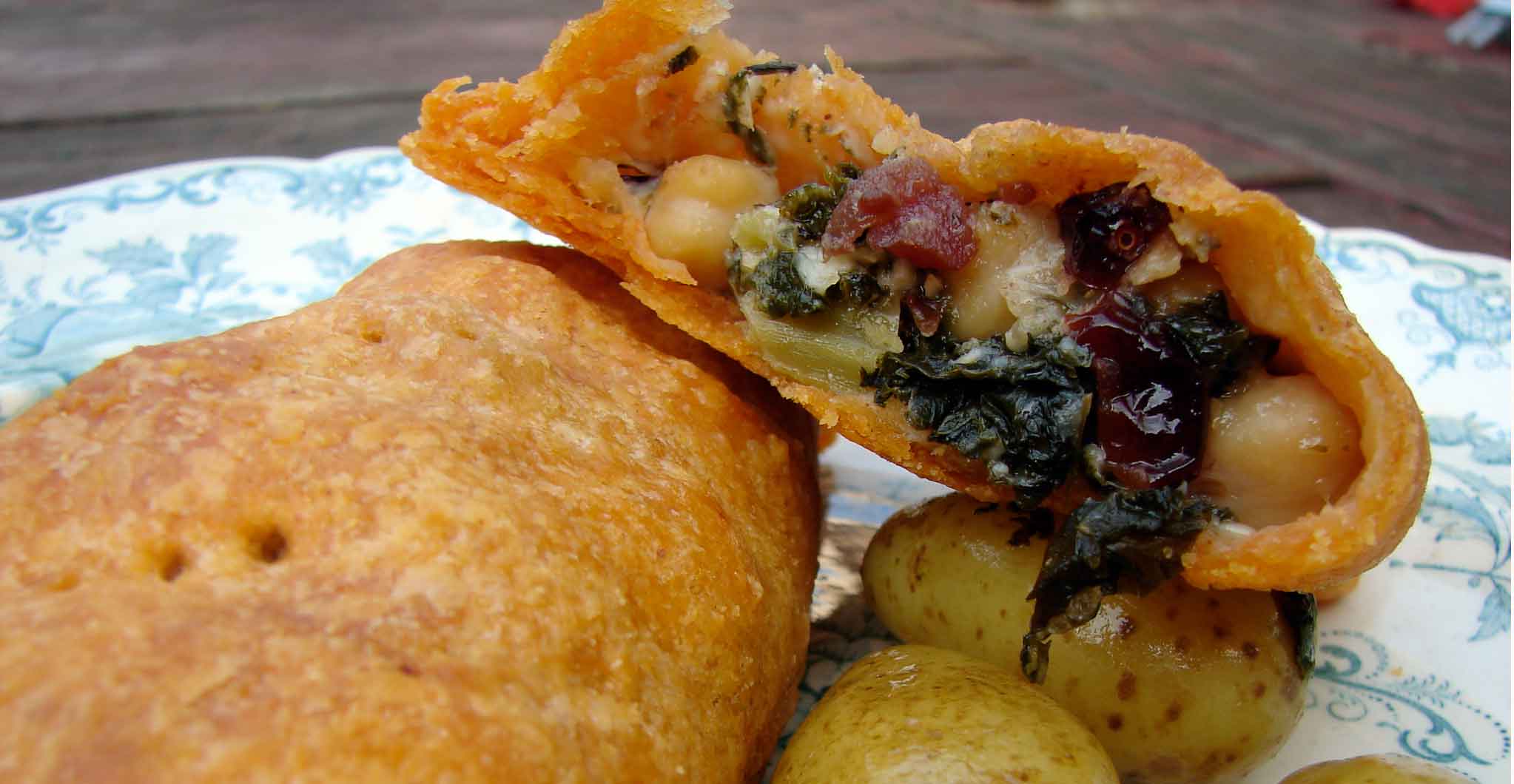
Kale, chickpea and cranberry empanadas

Kale, chickpea and cranberry empanadas

Well, I totally wasn’t going to go on and on about this today! It’s been on my mind, man. I think it’s because David and I just bought some Big Bill Broonzy CDs and they’re phenomenal, and because I’m reading this biography of Jean Vigo. Yeah. So! These are summery sorts of empanadas, I think. I made them for our anniversary picnic dinner. Empanadas make the best picnic food, because you can eat them with your hands and walk around with them, and they combine so many flavors and food groups in one neat package. I also boiled some little potatoes and tossed them with herbs and butter, and they are also a fun, if messy, picnic food. Our picnic was spoiled by dozens and dozens of ticks…a sickening tickening…but we came home and sat in our backyard and finished our empanadas, or lovely smoky, savory sweet empanadas.

Here’s Big Bill Broonzy with Feelin Low Down. Phew, what a song!

Continue reading

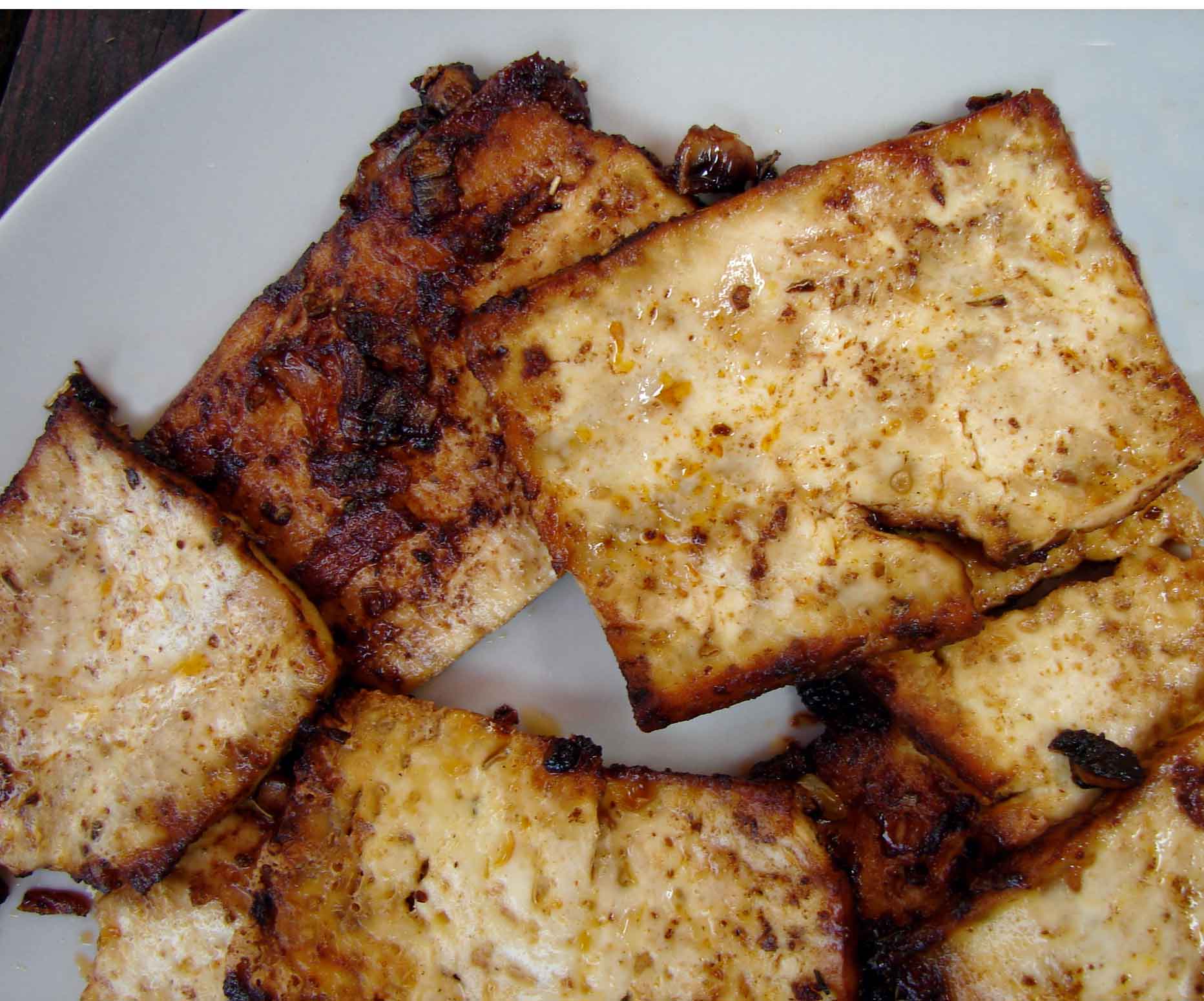
Roasted tofu with smoky chipotle tamarind sauce

Roasted saucy tofu

Roasted saucy tofu

I think we can all agree that the world would be a better place if everyone was exactly like me. Well, not like me, necessarily, just exactly like each other, but since I’m writing this from the confines of my own brain, that’s how I’ll imagine it. Think of the peace! The concord! We’d all have the same views on religion and politics. Would we even need politics anymore? We’d have no disputes to settle, no conflicts to solve. We’d have a natural empathy that would require no effort at all. We’d understand each other’s needs because they’d be our needs! So much nastiness in life is caused by envy and insecurity, but those problems would be eliminated. Nobody would be prettier than anyone else, or smarter, or more successful! Everybody would be equally good at the same things. Of course, everybody would be equally bad at the same things, too. So if everybody happened to be exactly like me, we’d have no buildings to live in, in fact our shelters would be ramshackle at best. We wouldn’t be able to help much if people got sick, because we’d never have been able to invent medicines. We wouldn’t have cars and roads, but we’d be okay with that because we’d all be pretty happy just walking around town. Of course we wouldn’t be a town, just a disorganized mess of poorly constructed lean-tos. And when there was a thunderstorm we would all go into a cold panic, huddled in our hovels, with no rational person to comfort us. We would all appreciate each other’s films (although in certain moods we’d be hyper-critical of them), and they wouldn’t cost much, because all of us would decide that we have no need for money. But we wouldn’t actually be able to make them, because we wouldn’t have ever invented the technology necessary. We would like all the food we made, but we’d have limited supplies to cook with, because we’d have no idea how to harvest wheat, or how to grow half the vegetables that we would love to eat if only we’d ever encountered them. And would we even want to cook anymore? Because we wouldn’t have the joy of sharing something with somebody, waiting to see if they like it, and then rejoicing when they do. And, you know, it wouldn’t be too boring at first, because all of us talk to ourselves in our heads half the time anyway. Eventually, yes, it might get a little stale to never ever have a new idea based on some experience you’d never had yourself, to never hear a word you’d never heard before. To never have a conversation with somebody that’s delightful because it’s completely unexpected and surprising. Never mind the fact that after a few nights of insomnia I’m so sick of my own damn thoughts that I could cry. Never you mind that! And we’d all get along, and it would be pleasant enough, we’d all sort of be friends. But there wouldn’t be anybody to be a special friend, to share a moment of unexpected intimacy, to charm you with their odd turns of phrase and fascinate you with their unique experiences or beliefs. There wouldn’t be anybody to vex you with their contrariness. There wouldn’t be anyone to surprise you with an unexpected gesture. There wouldn’t be anybody to love because they’re strange to you and you’ve never met anybody like them.
roasted tofu

roasted tofu

This is only the second tofu recipe ever on my vegetarian food blog! Weird, right? The truth is I only like tofu when it’s crispy, so I fry it in olive oil on the stove, but then my kitchen smells funny for days. Well, I thought I’d try roasting it. And I roasted it in a sauce made of smoked paprika, tamarind, chipotle, onions, shallots, sage…a version of barbeque sauce, I guess. I think it turned out very good. Not crispy, exactly, but with a nice texture, firm and yummy. The boys liked it, too, which was my goal in making it in the first place. The kids need protein!

Here’s Jumping Someone Else’s Train by The Cure. Again and again and again and again…

Continue reading

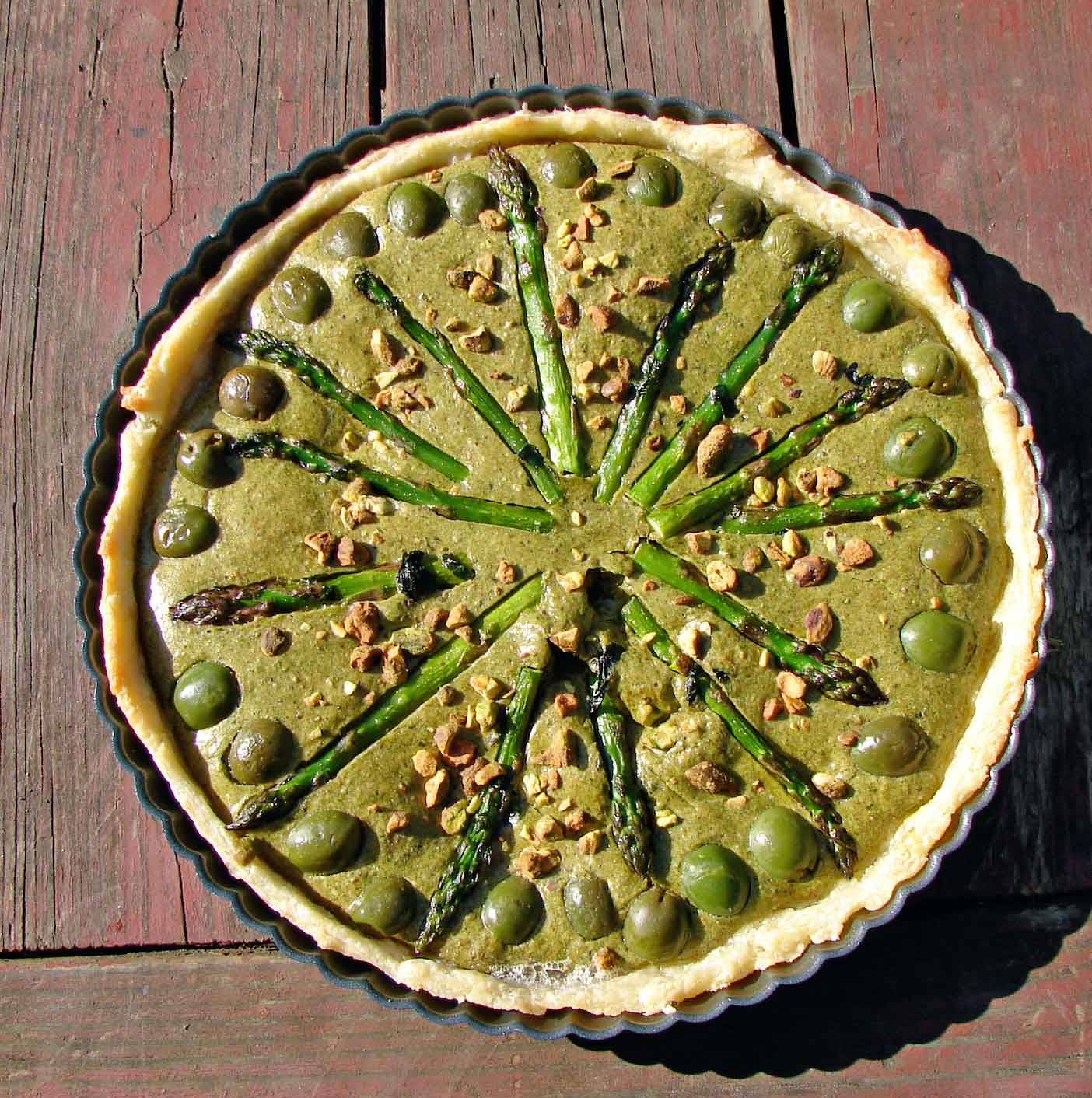
Pistachio and tarragon tart with castelvetrano olives and asparagus

Asparagus, pistachio, castelvetrano tart

Asparagus, pistachio, castelvetrano tart

If The Ordinary was a TV program, (and it’s only a matter of time, really, when you think about it) this would be the moment when we’d saunter, smiling and chatting, over to a book so large it’s printed in dozens of volumes. Everyone in the audience would jump from their seats, screaming, “The OED! Yay! Tell us how some random word was used in the 13th century! And the 15th century and the 18th, and, if possible, give us an example from only a few years ago!! Yay!!” Yes, it’s OED time! Your word for today is “sigh.” Why? Because for some reason I found myself sighing a lot this weekend. And sometimes I would just say, “sigh,” instead of sighing. And then I wrote a story about a ghost who always has a sigh in his voice, and who can shake the whole room with his sigh. Strange, very strange. So on Monday I did the obvious thing and looked the word up in the OED. Turns out its meaning hasn’t changed dramatically over the years. It’s always meant something close to “A sudden, prolonged, deep and more or less audible respiration, following on a deep-drawn breath, and esp. indicating or expressing dejection, weariness, longing, pain, or relief.” It was oft used, ere this, by the supersensitive overwrought poets and lady novelists. And yet, I find it a very fascinating word! Because it’s not a word at all. It’s a space between words. Like the grunts I found so remarkable in Ozu’s Tokyo story, which rise or fall and contain a million different easily readable meanings in one small sound, it’s almost more expressive than any actual word. And a sigh is so full of variations and possibilities! A sigh can indicate exasperation, sadness, fatigue, resignation, comfort, satisfaction. One small sound, barely a sound! Just a breath, quieter than a whisper. And everybody sighs, often without meaning to or even being aware of it. It’s a universal language. My favorite sigher at the moment is Clio. She’ll make herself perfectly comfortable, and then she’ll settle her head on her paws and heave a great sigh, as though she’s just taken care of some very important business and now she can rest for a moment. Even the leaves and the grass and the wind sigh, especially in poems. “Whenever a March-wind sighs He sets the jewel-print of your feet In violets.” A sigh can express longing, you can sigh for something or someone. You can sigh something away…even your life, “Sapores..sighed out his affrighted ghost, at the age..of seventy one,” or your soul, “Hundreds of martyrs sighed away their souls amid the flames.” Maybe your sadnesse is sigh-swolne, your age is sigh-blown, or your tone is sigh-deepened. I love the idea of communicating without words, with something only slightly more audible than a gesture or an expression, with something as vital and intimate as our breath. I love the fact that “Some sighes out their woordes. Some synges their sentences.”

Asparagus pistachio castelvetrano tart

Asparagus pistachio castelvetrano tart

I think of this as my splurge tart. I spent more money than I should on castelvetrano olives and pistachio kernels, (yes, I’m a lazy spendthrift) and asparagus, which doesn’t seem to be getting any cheaper no matter how far into spring we get. So I decided to put them all together in one tart. I made a sort of frangipane of pistachio kernels, but I added asparagus and spinach, too. I wanted it to taste very green. And asparagus and castelvetrano olives are lovely together, juicy and fresh.

Here’s Dolcissimo Sospiro (I think it means “sweet sighs”) sung by the remarkable Montserrat Figueras
Continue reading

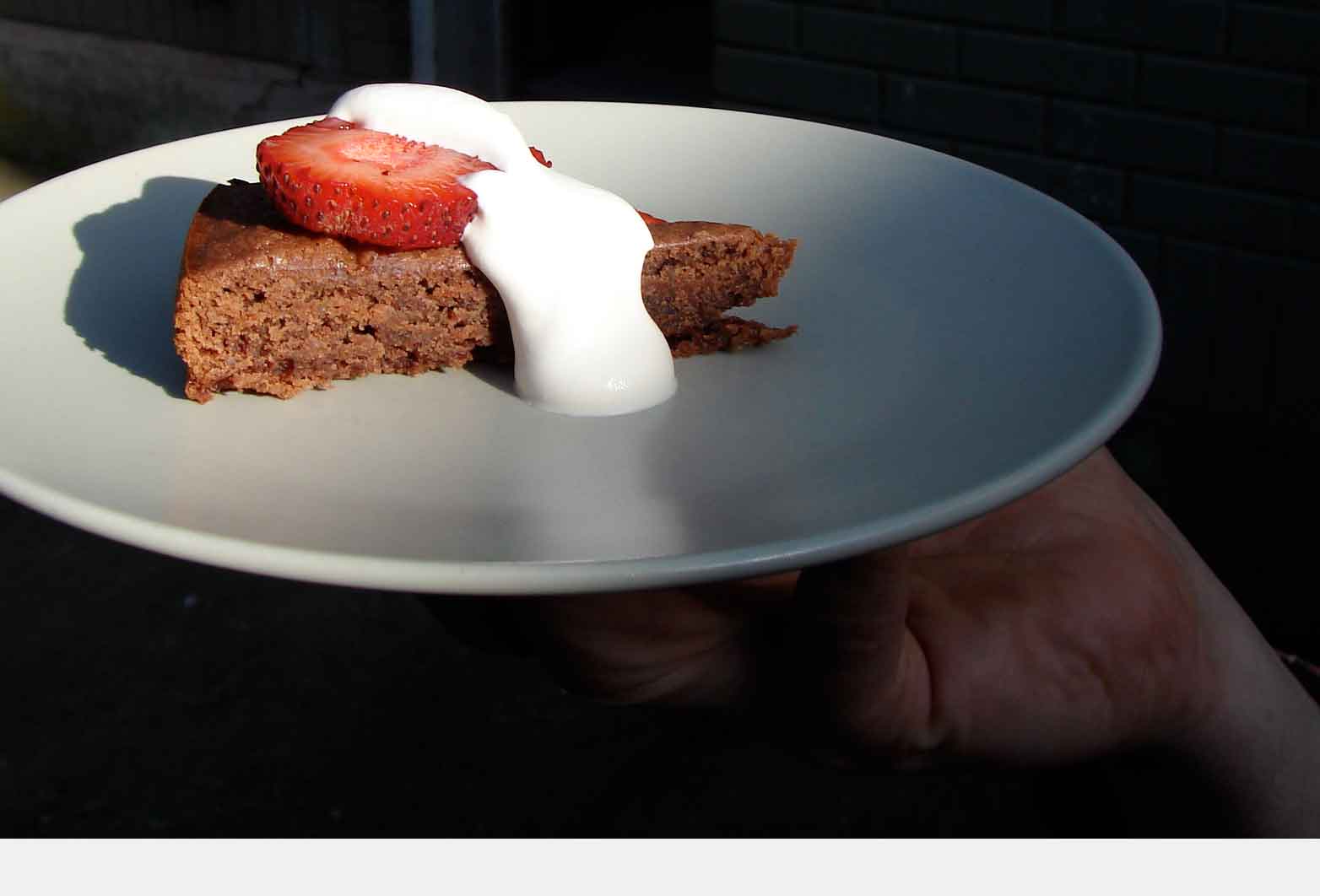
Dense dark chocolate and raspberry cake

Chocolate raspberry cake

Chocolate raspberry cake

David and I took a trip today to the towpath we used to walk along when we first met, the place where we first intentionally spent time together, where we first kissed, twenty years ago today. Twenty years! It seemed as though the same old fellow in the same straw hat was riding on the same tractor and blocking the narrow winding road. It seemed as if the same birds were nesting in the same places. Of course it couldn’t have been the same birds, but it was probably their descendants, singing lustily in the vivid, shifting new leaves, so hard to see clearly, like memories or heralds along the path. Twenty years! I must admit I felt a little overwhelmed, to think about how much our lives have changed. To think about the people we were then, and how shy and uncertain I felt. I was afraid of long silences, but almost more afraid of speech–afraid to disappoint or be disappointed. It’s strange to think about how comfortable silence is now, and how full of promise, because I love talking with David and I have never been disappointed when he spoke. And to think of all the nonsensical ideas I’ve prattled about in twenty years, and how he’s come not just to tolerate this, but to anticipate it, and then to discuss it so intelligently that he makes my nonsense make sense. Almost as if he’d given it some thought, as if his thoughts had been wandering on the same strange roads. It boggles my mind that a person can spend twenty years so closely bonded to another person: sharing the same food, watching the same movies, listening to the same music, raising the same children, dreaming in the same bed, and it’s never boring, it’s constantly surprisingly wonderfully euphoric, in a glowing, peaceful sort of way that’s actually impossible to describe. And then the boys! So like us–so strange in all the ways we’re strange (poor lads) and so beautifully strange like just themselves and nobody else on earth. Twenty years ago we had long lazy days stretching before us, we had nowhere to be and not much to do. In my fading memory, my worries seemed so slight and easily unravelled. We filled the days up with each other, and now we have responsibilities and worries and decisions, which I can’t imagine getting any easier as we grow older. But we have one another to face it all with, we’ll take it on together. Well, I feel more grateful than words can say, so I’ll stop talking now.

This is sort of like a flourless cake, because it’s rich and dense, but it does have a tiny bit of flour in it. It also has almonds, lots of chocolate, raspberry jam and framboise. You could replace the framboise with chambourd, or any other fruity liqueur that you like. And you can use any kind of jam you like–you can experiment with different combinations!! Of course you should eat this with raspberries, but we gobbled all of ours down before I could take a picture, so the strawberries agreed to stand in for them.

Here’s Listen to Me, by Buddy Holly.

Continue reading

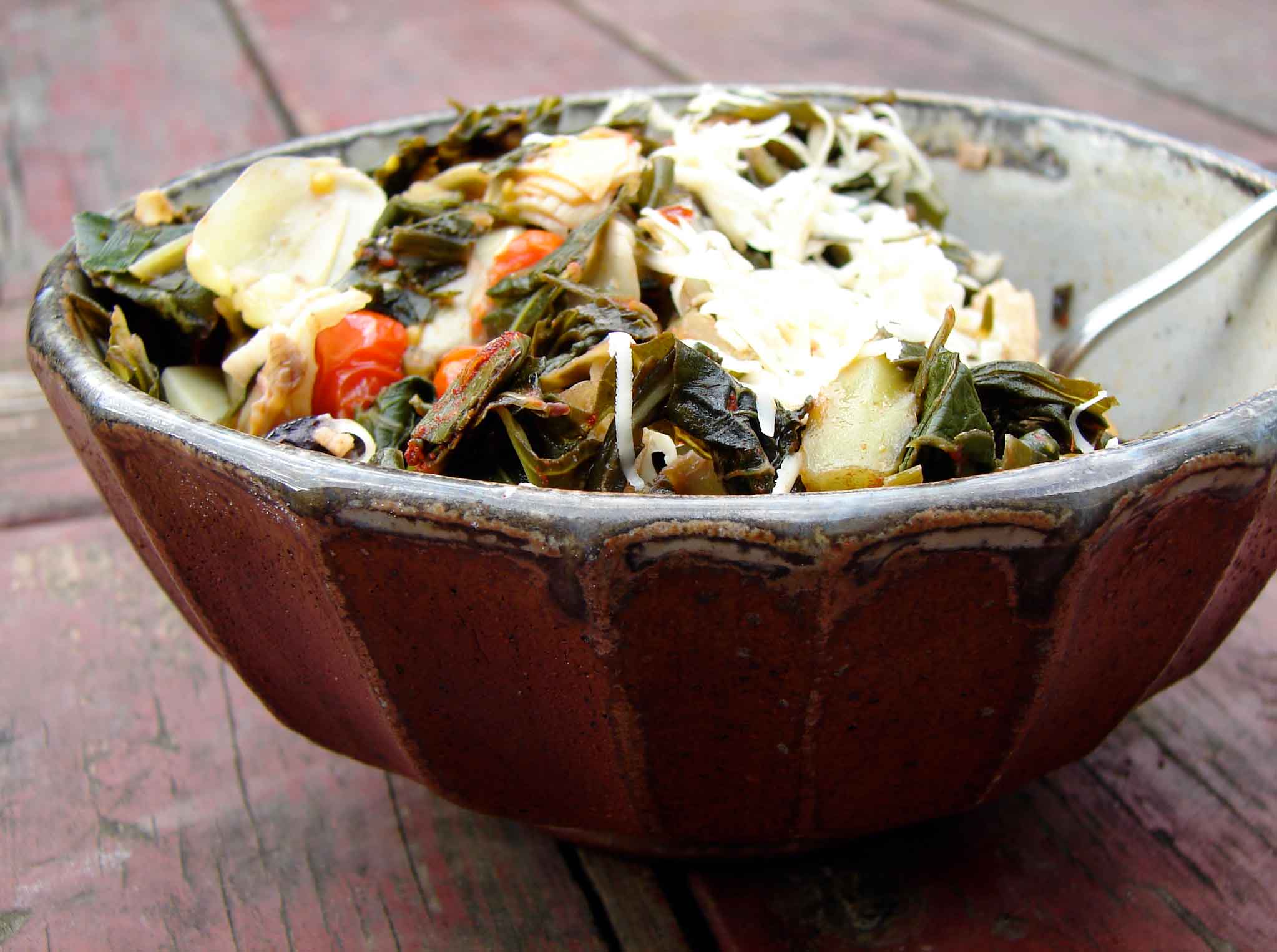
Collards with artichoke hearts, olives and capers

Collards with artichoke hearts, olives and capers

Collards with artichoke hearts, olives and capers

Isaac carried his new superhero to school today. He’s made of bright pink pipe cleaners (the superhero, not Isaac.) His name is eel man. Isaac started telling me a story about how eel man made a giant ball of electricity and threw it in the ocean and then… “Is eel man a good guy or a bad guy?” I asked. Turns out he’s both. “Ah,” I said, “So he’s morally complicated.” Yeah. He’s good when he thinks it would be fun to be good. Well, we got back to the story, but it had changed a little. I could hear the little wheels whirring in Isaac’s head. “Wait, I’m talking to mom, and she’s actually listening to me.” Suddenly eel man’s exploits seemed a little too dangerous for all of the innocent bystanders who might be bobbing in the waves of eel man’s ocean. In the new ending, eel man cuts the nets of fishermen to free the fish. Which proves how well Isaac knows me, but is also morally complicated, if you think about it too much, because now what will happen to the poor fisherman and his imaginary starving family? Everything is morally complicated if you think about it too much! And I think that’s a good thing. I think it’s good to think about it too much, and try to find some sort of balance that helps you navigate waters made choppy by giant balls of electricity. I’ve been reading my new biography of Jean Vigo. His father took the nomme de guerre Miguel Almereyda, and anagram for “there’s the shit.” He had a hard life, he had plenty of reasons to be angry at the world. His family abandoned him, and as a teenager he found himself sick, alone and starving. He was imprisoned several times as a boy…once for “borrowing” money to pay rent, and once for attempting to blow up a pissoir, although he was so worried about hurting innocent people that he bungled the whole effort. He was sent to prison none-the-less, where he was kept in solitary confinement and semi-darkness and abused by sadistic warders. He found comfort and friendship amongst the anarchists, communists, socialists and syndicalists, and he found an outlet for his passionate anger at society. It’s so strange to read about this world, so morally complicated as to be contradictory–so appealing and flawed, so concerned with organizing and yet so chaotic. We meet violently angry pacifists, militant anti-militarists. They started a newspaper and words were their weapons. Their ideals changed subtly all the time as the world about them changed, and they spoke with complete certainty and passion about each changing belief. Their words were so effective that they were received with fear and distrust as if they had been actual weapons. Almereyda found himself in and out of prison, sentenced again and again for articles that questioned the system, that encouraged strikes by workers and soldiers. Everything fell apart with WWI. Everything changed in ways that were beyond Almereyda’s control. But it seems that he and his friends still struggled to make sense of it, they continued to write about it, they tried to ensure that the changes that came with the war were good for the people, for the workers, for the poor. And many years later, his son Jean would make films that celebrated revolution and anarchy, but glowed with love for all people and reverence for all life, and these would be feared and banned, too. But they would live on as a testament to the power of word and image, to the revolutionary power of art. It’s a funny old world.

Well, I’ve said it before and I’ll say it again, I love collards! I’ve never treated them quite like this, but I thought it was delicious. Collards have a textural assertiveness that went perfectly with the bright sharp flavors of capers and olives. This was very simple to put together. If you added some beans to the dish (white would be nice!) and served it with rice or pasta, you’d have a quick meal.

Here’s Rebel Waltz from The Clash
Continue reading

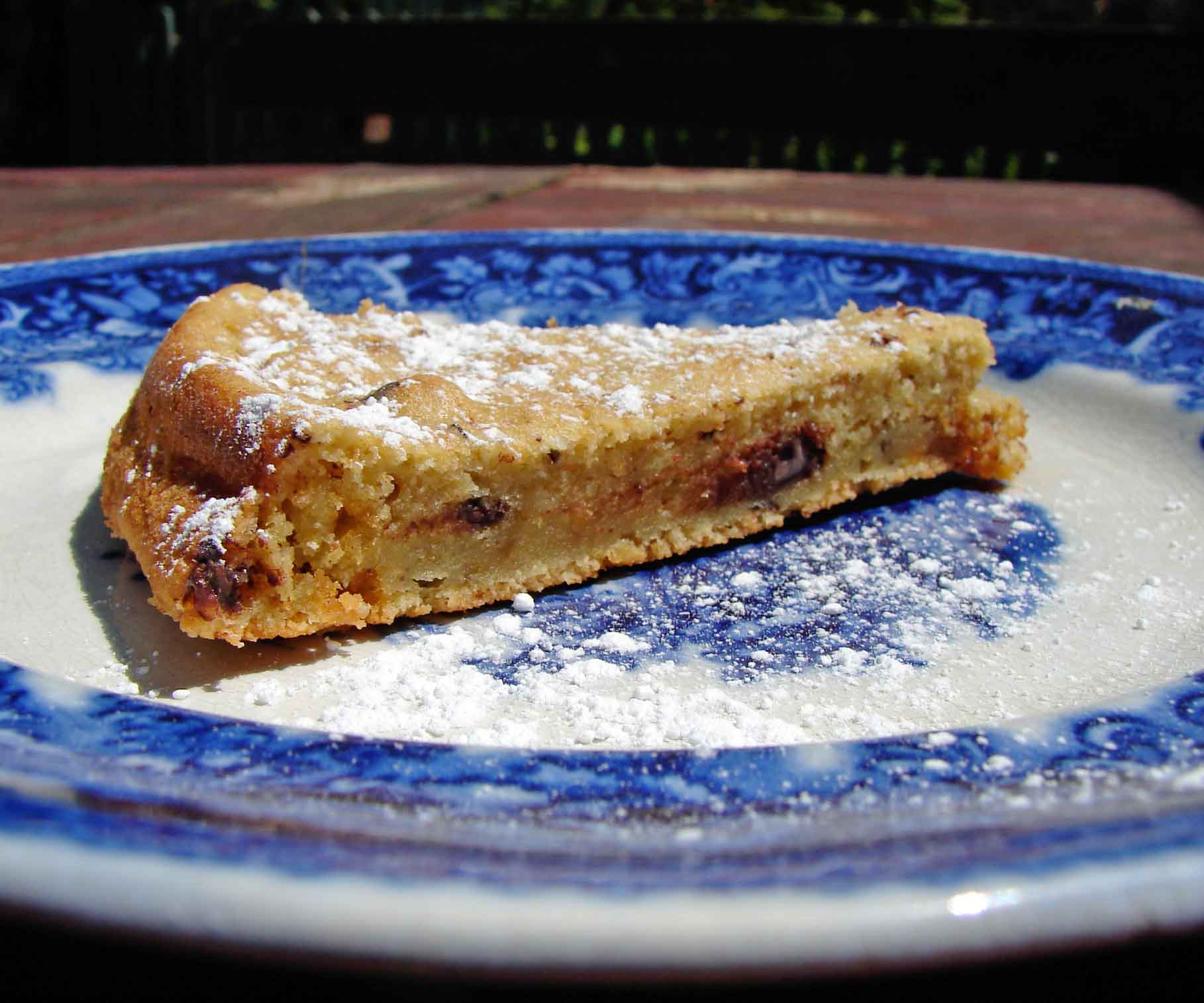
Dense apple cake with almond toffee and chocolate chips

Dense apple chocolate chip cake

Dense apple chocolate chip cake

Welcome to The Ordinary on this rainy Sunday morning! David bought a few new-old CDs recently, and I’ve been knocked over the head by how wonderful some of the songs are. Two blues compilations, and lots and lots of Buddy Holly. Buddy Holly!! Who knew? I mean, I sort of knew, but I had no idea. So sweet, and rocking, and generally amazing. So this week’s Sunday interactive playlist is songs that are new-to-you that you’ve been enjoying recently. I don’t hear much brandy new music these days, because I don’t listen to the radio all that much or watch TV ever. But I do love to discover old music that I hadn’t known existed. It’s like when you realize that there are bright yellow, red, and blue birds singing noisily in the trees above your head, and they’ve been there all along but you never noticed. So new new songs, or old new songs…anything you’ve recently discovered that is making you happy lately.

This cake was something of a surprise!! I added raw apples to the processor, and whizzed them up. I wasn’t sure how it would turn out, and it turned out really lovely. Dense and delicious, almost custard-y, but there’s only one egg in here. I added almond essence, because I’m adding that to everything these days, and I added chocolate chips, because I always add them to everything! Always! I also added some salted almond praline, crumbled up, which gave a nice crunchy salty texture to the soft cake. Anyway–a very simple, satisfying cake.

Here’s the link to the playlist. As ever, it’s interactive, so feel free to add what you like, or leave a song in the comments and I’ll add it for you.

Continue reading

Tarragon and walnut pesto

tarragon and walnut pesto

tarragon and walnut pesto

Hey, kids! It’s Saturday storytelling time! As I’m sure you recall, this means that along with your daily recipe and song, you’ll get a story, too! Each week, everybody in our small salon of auteurs (well, generally me and one or two other people) writes a story based on a found photograph. If you’d like to write a story about it, and I hope you do, send me a copy and I’ll post it here, or send me a link if you have somewhere of your own to post it. Who are these men? Where are they? What are they reading?
27306_10151345374324589_1225531051_n

I bought a bunch of tarragon. I put some in a tart, and I had a lot left. I love tarragon, but I can’t put it in every single meal! So I decided to use it all in this pesto. We ate it with flatbread, beans and greens. You could toss it with pasta, or spread it on a pizza, or even serve it as a dip with chips or crackers. Strangely, Malcolm has said in the past that he doesn’t like tarragon, but he loved this, an gobbled it right down. It is very tarragon-y. This is vegan, but if you wanted it to be more like a traditional pesto, you could add parmesan, if you liked.

Here’s Duppy Conqueror by Bob Marley. It’s about ghosts, you know.
Continue reading

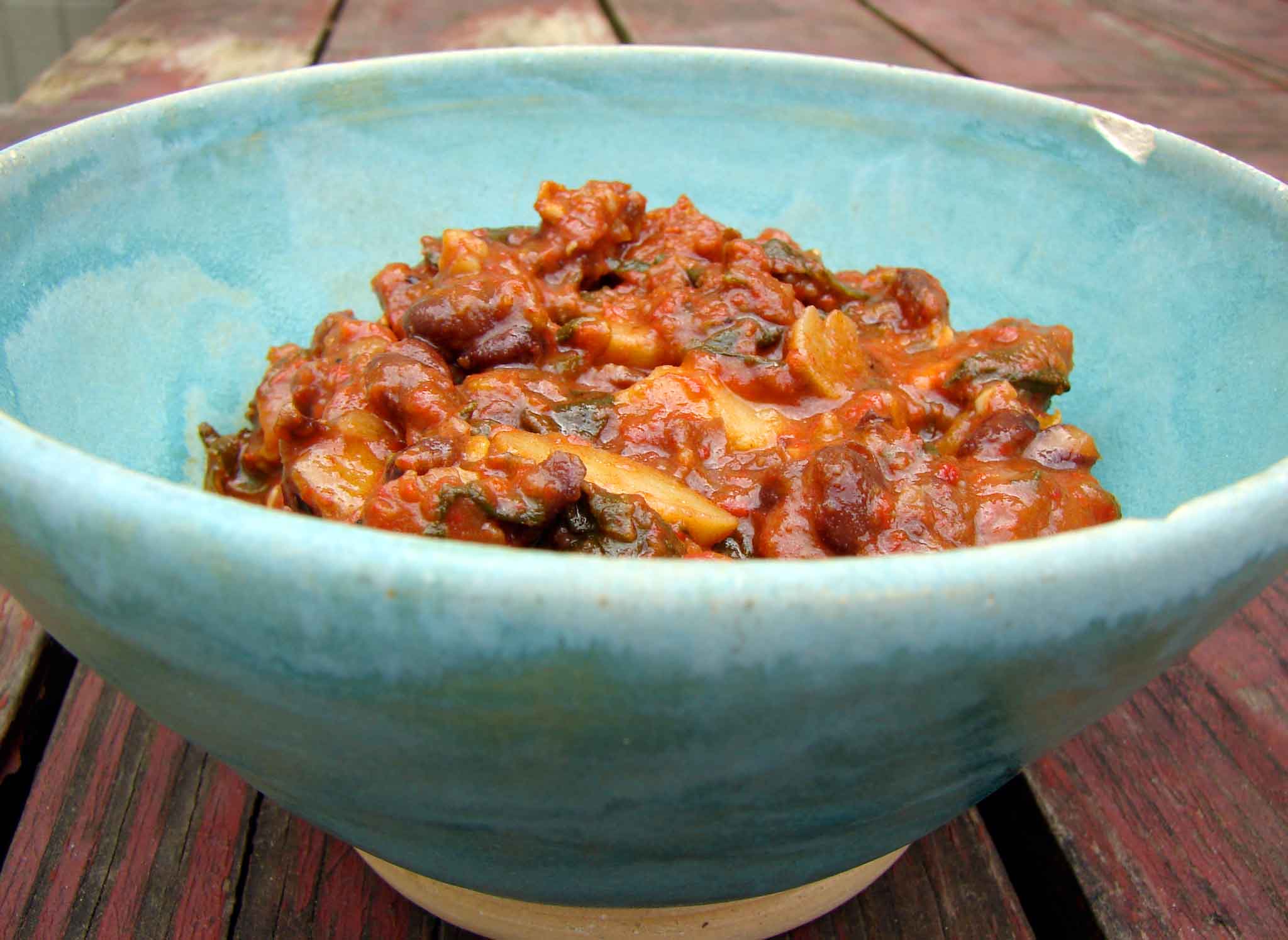
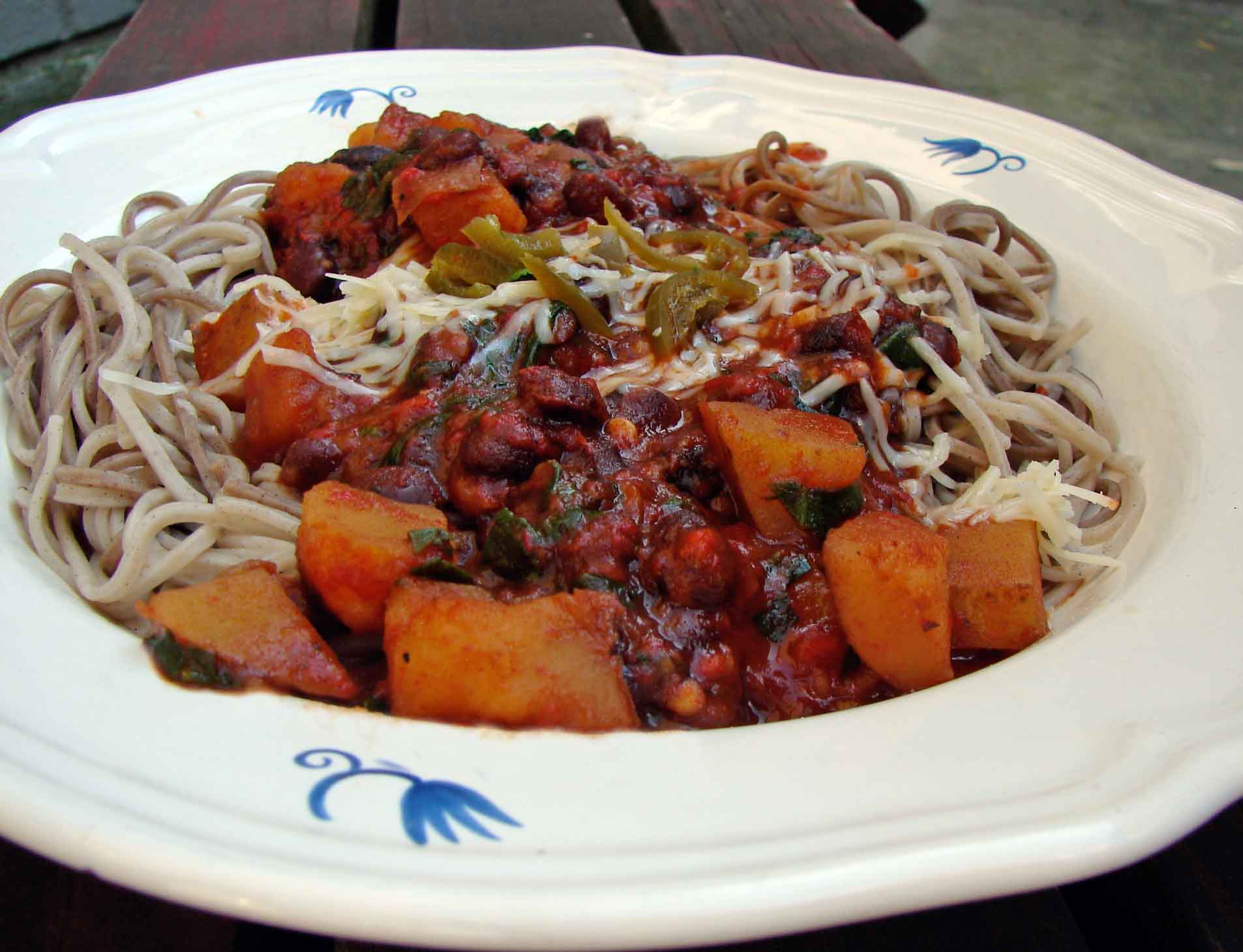
Soba noodles with potatoes, black beans and spinach in red pepper sauce

Roasted red pepper and black bean sauce

Roasted red pepper and black bean sauce

Each day on our way to school, Isaac and I pass a house that half-burned down a few years ago at Christmastime. Apparently it will be torn down before too long, but now it’s oddly beautiful with its charred, inside-out appearance. Many of its lovely architectural details remain intact, but now it feels as though you can catch a glimpse of its pretty bones. The last few times we’ve passed, a giant black vulture has peered down at us from the roof. I happen to think black vultures are remarkable birds–beautiful in their black-upon-black scruffiness. We have a lot in our area, and we’ll see them lined up with gothic gravity on abandoned barns and silos, or perching with unlikely balance on slim branches their weight should snap. They seem social, as they all stand together, long wings stretched in a wide arc to catch the sun. When we passed our local vulture today, my little modern-day Ben Franklin said that he likes turkey vultures better than eagles because eagles kill their prey, whereas vultures just take what’s already dead. They just clean up. So between Franklin and Isaac, we’ve established that bald eagles are thieves and murderers, whereas turkeys are brave, and turkey vultures mild and helpful. It’s funny that we saw the vulture just now, because my boys have spent the week scavenging. Not for carcasses of course (we’re vegetarian!) but for junk. It’s sparkle week in our town, which means that people put out their still-sometimes-useful garbage, and other people pick it up and take it home. It’s a nice idea, really, and many people I know have furnished their house this way, and in quite a stylie style, too. However, if you have two small pack rats, it can become dreadful. Isaac is sparkle-obsessed. He wants everyone else’s half-broken toys. He flies from garbage pile to garbage pile shouting “sparkle! sparkle!” Like some mad trash fairy. He roots through broken glass and dog crap, convinced that a treasure awaits if he only looks hard enough. Malcolm is an admirably efficient sparkler. He found a working door knob, a working watch, a perfect darth vader mask, and any number of small, intriguing objects. I suppose this bodes well for his chances of surviving in a post-apocalyptic landscape. He’ll build us a home of packaging foam and old dressers, and we’ll cook our food on abandoned grills and dismantled ovens. Personally, I’ve always been a little wary of used goods and thrift-store clothes. I can’t shake the idea that they take on the personality of the people that owned them. That they’re imbued with the sadness or happiness of the lives they were part of, and that they become spirits of their own as they pass from person to person. It’s silly, I know! I should saunter down the street, like Malcolm, hand in pocket, flannel shirt catching the breeze, coolly appraising each pile of reusables, happy to be part of the cycle of renewal that takes place each spring in our small town.

Soba noodles with roasted red pepper sauce, black beans, spinach and tomatoes.

Soba noodles with roasted red pepper sauce, black beans, spinach and tomatoes.

I seem to still be making warm and earthy meals, despite the fact that on paper it’s springtime. We’ve had a damp and chilly spring, and I haven’t found mounds of sweet peas, fiddleheads and ramps. Even the asparagus looks thick and woody, and costs a bundle for a bundle. So I’m still in the warm and saucy world of food. I think this would make a nice summer meal, though. It has the appealing color of a sun-drenched brick wall in summertime. It involves red pepper, which is summery, which I roasted under the broiler, but which would be even better grilled. Malcolm loves soba noodles. They’re made of buckwheat, and they have a nice nutty flavor. They go nicely with earthy potatoes and black beans, and I mixed them, in this instance with smoky peppers, smoked paprika and spicy red pepper flakes and jalapenos. You could eat this over rice with tortillas, or even on it’s own as a sort of chili.

Here’s Decemberists’ Sweet Clementine, because I borrowed a phrase for my essay today!

Continue reading

Baked chocolate-coated cake donuts

Chocolate covered cake donuts

Chocolate covered cake donuts

This morning was dark and gloomy, and when the rain finally came it felt like morning had never happened, we were cast right back into the night. But the sun eventually came out, and I walked to the bank and cashed a savings bond I’ve had for thirty years, and I went to the magical used book store across the street, which always has exactly what you want when you want it, to buy a biography of Jean Vigo. Jean Vigo made four films, and he died at the age of 29 in 1934. A lot has been written about Jean Vigo, and I don’t have much intelligent film criticism to add, or any revelatory biographical details, so I’ll just tell you why I’d like to meet him. Holden Caulfied said that he knew he loved a book when he wanted to write a letter to the author once he’d finished it. I know I love a film when I want to sit with the auteur over a glass of wine, and talk about film, and plan our next shoot. I feel that way about Vigo more than any other director I can think of. Vigo worked in a partnership with cinematographer Boris Kaufman (brother of Dziga Vertov). Kaufman described filming with Vigo, even in physically harsh conditions with little time and money, as “Cinematic paradise.” Apparently Vigo was demanding but kind and very funny. I love to think about their friendship. I imagine that Kaufman was precise and technically skilled, and Vigo was vague and anarchic, but somehow they inspired each other, they found a balance to shoot wild, emotionally beautiful, beautifully filmed scenes. I’d like to be friends with them, too. I believe that people have different kinds of intelligence. The other night, in a half-awake state, I aligned these with the elements. Some have a practical, earthy intelligence; some have a fiery and passionate intelligence that’s focussed and burns very bright; some have an airy and intellectual intelligence, far-reaching and dry. And some have a watery intelligence, vague, changing, emotional. Of course, most people have some combination of these, but for me, personally, it’s mostly watery. Jean Vigo’s films are beautifully watery. Literally, in most cases–A propos de Nice is set by the sea, Tari, Roi de L’eau is a portrait of a simmer, and L’atalante takes place on a barge. And they also have a fluid, luminous quality, like light through water, stylistically and emotionally. Like water, they follow exactly the path they’re supposed to follow, along the river bank or surging to the shore, but they’re riotous and unexpected, too, and spill out over anything that attempts to restrict them or tie them down. Vigo has been called one of the early advocates of poetic realism. And it’s true that his films are a delightful combination of near-documentary prosody with beautiful flights of fancy and dream-like forays into characters’ imaginations. But he shows imagination and poetry as an essential part of reality, not a departure from it, and so I believe it is. We spend at least half our lives dreaming, and we only understand the world as we filter it through the strange web of our own minds. Vigo’s very ordinary characters are fascinating and lovely because he gives us a glimpse into the beautiful chaos of their thoughts and desires. We see the every day cruelty and kindness of school children and their small moments of freedom and rebellion; we see the day-to-day life of a couple of newlyweds, and we watch as they pull apart and come together, as they lose each other and find each other, and grow to know and love one another. They’re drowning with longing, and confusion and desire have never been so beautifully rendered, or with such humor and honesty. Vigo’s films have such simplicity and grace, such sincerity and soul, but they’re also deeply political, even revolutionary. In watching them we see an uncanny representation of the world as it is, if only we’d take the time to notice–wild, unruly, unfair, mundane, magical, and deeply, abidingly beautiful.

I made donuts! I’ve been thinking about it a while–Malcolm and I had some schemes in place. Yesterday, I just made some! I wanted to bake them, because I don’t like the smell of my kitchen after I fry something. Funnily enough, I’d spilled some butter in the oven the day before, so when I baked these the kitchen filled with smoke. Sigh. I adapted the recipe from a couple of old mennonite recipes (although their donuts were fried.) The resulting donut is quite dense and sweet-biscuity, but I believe this must be how donuts were intended to turn out, because they’re absolutely perfect for dunking in coffee. The chocolate melts, the donut softens, and then, as David says, you want more! I just bought some almond essence, after resisting for years. I resisted because I was semi-obsessed with it as a child, and put it in everything. Well…I am once again putting it in everything! It was nice here, though. It made the donut interesting without adding too much texture or craziness. You could replace it with cinnamon or lemon zest or any kind of flavoring you like. Or just leave it out altogether.

Here’s the theme from L’atalante by Maurice Jaubert, another of Vigo’s lifelong collaborators.

Continue reading

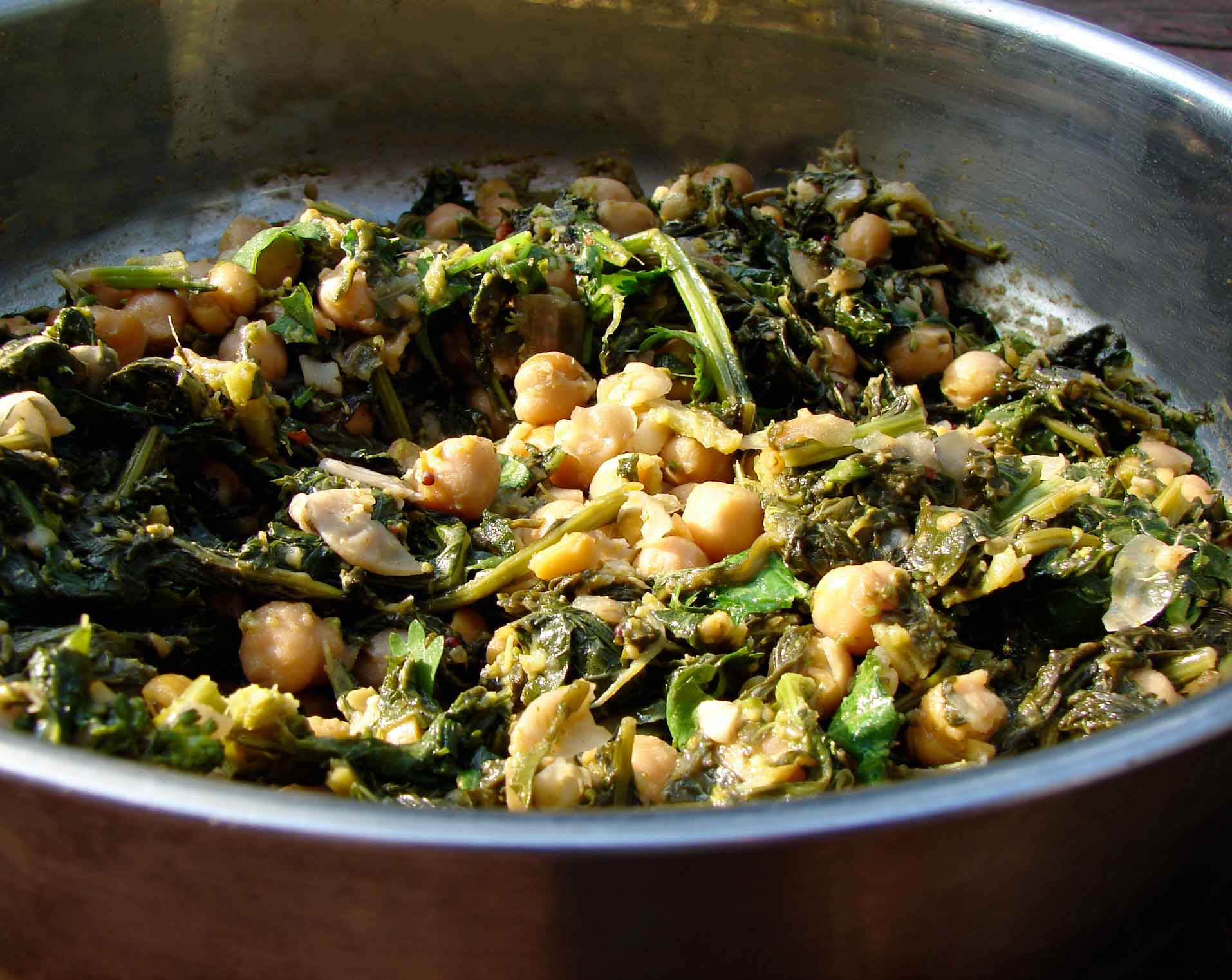
Curry-spiced chickpeas and broccoli rabe

Curried broccoli rabe and chickpeas

Curried broccoli rabe and chickpeas

When I was little I believed that there was something in the earth–in the trees and water and grass and dirt; call it spirit (for lack of a better word) or magic (for lack of a better word). Obviously, the animals can hear it and understand it–you can see that in their eyes and their quiet, graceful movements. But I believed that humans, in all their arrogance, didn’t acknowledge that it was there, or were frightened of it, and so they became unable to sense it. And then we bound it up and strangled it, with roads and buildings, and made it sick with chemicals and garbage. Yeah. I was a weird kid. David came across this quote, and of course I love it to pieces…

    One of the deepest and strangest of all human moods is the mood which will suddenly strike us perhaps in a garden at night, or deep in sloping meadows, the feeling that every flower and leaf has just uttered something stupendously direct and important, and that we have by a prodigy of imbecility not heard or understood it. There is a certain poetic value, and that a genuine one, in this sense of having missed the full meaning of things. There is beauty, not only in wisdom, but in this dazed and dramatic ignorance.

    – G.K. Chesterton, Robert Browning, 1903

(He found it on a website called Futility Closet) First of all, I love the phrase “prodigy of imbecility,” and I plan to incorporate it into my day-to-day dialogue, post-haste! Secondly, I’m obviously not the only weird kid in the room! I too, think there is beauty in dazed ignorance, and I find great cheer in that idea. Sometimes we comprehend something best when we don’t focus on it, when we see it glancingly from one side, when it flies off with a rustle of bright feathers into the shifting leaves. The less we can capture and hold something, the more beautiful it is. The more something grows and changes and decays, the more beautiful it is. And the more beautiful something is, the less we can imitate it or make a replica of it, because in freezing it we destroy it. I was reading about Yasujiro Ozu, a while back, and I came across the phrase mono no aware, coined by 18th century Japanese scholar Motoori Norinaga. According to my feeble understanding of the concept, this is a sort of sighing recognition of the transient beauty of all things–an idea that everything is more beautiful at the beginning and the ending, as it grows and as it decays, as it changes. And this understanding extends to all things that live and die, however inconsequential they seem. They have beauty worth noticing–they’re made beautiful because they’re noticed. And this feeling, this poignance, washes gently over a person, almost without their effort…it’s the feeling itself that is beautiful and important, but it can’t be studied or captured in words. Whereas in Western art, we try to define aesthetics, and seek symmetry or embellishment, and try to capture beauty in marble or oils, according to mano no aware (as I understand it) the beauty is in sensing imperfection, irregularity or decay, in feeling the sweetness and the sadness of it. Surely this is “one of the deepest and strangest of human moods.” This is the graceful, ever-changing, incomprehensible voice of the garden at night and the sloping meadows, which we love because we can never fathom it, we can only soak it in with dazed ignorance.

I love broccoli rabe, with its tenderness, and its bitterness, and its strong pleasant flavor. I’m the only one in my family that craves it. David will enjoy it from time to time, and the boys won’t go near it, so I feel like it’s the most indulgent thing that I cook. I make it because I want to eat it. This particular preparation was a sort of compromise. The boys do like curried chickpeas, so I served this with basmati rice, and picked out the chickpeas for them, and saved all the tender greens for myself!!

Here’s REM with Gardening at Night.

Continue reading