Tender buttery rolled-up rolls

Rolled up rolls

Rolled up rolls

Ezra Jack Keats seems like somebody I’d like to spend some time with. Like Ozu and Tati and Vigo, he seems like somebody that has a lot of answers but wouldn’t feel compelled to tell you about it. So you’d just have to spend some time with them, to listen and learn. He is, of course, the author and illustrator of The Snowy Day, as well as 21 other books. The Snowy Day tells the story of Peter, a little boy who wakes up to find that it has snowed. And then it describes his day – walking through the snow, making foot prints, making tracks with a stick, wanting to join a snowball fight but understanding that he’s too little when he gets knocked down with a snow ball, trying to save a snowball and surprised when it disappears in his pocket in the warmth of his house. It’s a perfect book. The language is simple and haiku-like, the illustrations a jumble of color and movement. The Snowy Day was published in 1962, which also happens to be the year the name of a crayola crayon was changed from “flesh” to “peach.” Peter is black, but that’s never mentioned in the text, and the book is not about that. In our literary history black characters had frequently appeared as caricatures or background figures, but Peter is just a little boy, just Peter, so full of personality and charm, so fully conjured with so few words. Keats has said, “My book would have him there simply because he should have been there all along.” The book is about the wonder of walking in a world transformed by snow… “I wanted The Snowy Day to be a chunk of life, the sensory experience in word and picture of what it feels like to hear your own body making sounds in the snow. Crunch…crunch…And the joy of being alive…I wanted to convey the joy of being a little boy alive on a certain kind of day—of being for that moment. The air is cold, you touch the snow, aware of the things to which all children are so open.” Like all of Keats’ books, the problems facing the boy are small and real – not as dramatic as being chased by death eaters, maybe, but all the more compelling for being universal and recognizable and honest. All good books and films about children are not about having children – not cynically appealing to what some focus group has suggested would sell to a certain age group. They’re about being children, about always being a child in certain situations, like when the snow falls. or when you feel inadequate or disappointed, or left out of a crowd. Keats has said that discovering collage made him feel like “…a child playing…I was in a world with no rules.” And it feels exactly like my boys’ lives and their creativity…pulling a bit of something from here, a scrap of something from there, and piecing it all together in their teeming, colorful little brains. It’s a good way to experience the world and connect everything you see and hear and feel…aware of the things to which children are so open. Keats understands.

tender rolled up rolls

tender rolled up rolls

These rolled up buttery rolls turned out really delicious! The perfect thing to eat after coming in from the snow! I wanted them to be really really soft and tender, so I added milk and butter and an egg. And I wanted them to be fun to eat, so I flattened them and then rolled them up. They were fun to eat! We could pull apart each soft layer. We could fill them with greens and beans, or with scrambled eggs the next morning. They’re very versatile, too. I added a bit of pepper in the layers, but you could add herbs or nuts or cheese. Or cinnamon sugar, if you want them to be sweetish. Or chocolate chips, if you want them to be really sweet!

Here are two songs by Elizabeth Cotten, another of those people who seems to have all the answers.

Continue reading

Black currant and bittersweet chocolate bakewell bars & cardamom ginger chocolate chip cookies

Bakewell bars

Bakewell bars

Our house was built in 1850, or thereabouts. This June, we’ll have been here a decade. In that time, for every part of the house we’ve repaired or prettied up, another has fallen apart. We’ve got cracking plaster, peeling paint, rickety railings. We’ve got brick dust and spider guests and inexplicably leaky ceilings. Seen from without or within, no two lines of this house are parallel. It’s a mad mess of slants and angles. Originally, it was probably only a few rooms, and parts have been added on over the years, with well-meaning foolishness. The middle of the house is held up by a piece of railway track over a cistern. At one time this was a two-family house, and the boys’ bedroom was a kitchen, as the linoleum tacked over pumpkin pine floors attests. It’s a ridiculous ramble, but I love it. During storms and blizzards, I always think about how crumbling it seems, and then I think about how long it has lasted, how many fierce winds have rattled its bones, with people inside huddled by candlelight, talking and playing games, trying to keep out the storm with the force of their bright cheer. People must have been born in this house, and died here, too. Couples must have fallen in love. Malcolm and Isaac learned to walk here, and dozens of other babies must have done so, too. When David was fixing up the house, before we moved in, he found lots of lovely artifacts. Toys that had been dropped through holes in the floor boards – jacks and doll parts and bits of clothes – just as Malcolm and Isaac drop their toys through today! He found newspapers from 1850, with little bits of news about people in the area – words on brittle brown paper to us now, but fully lived with warmth and emotion at the time. In the time that we’ve been here, we’ve left our mark. There’s a smudgy line at the height of a boy’s hand, that traces their progress through the house – up the stairs and down the hall. Nearly every wall has mad scribbles in crayon or marker. The floors and doors are forever scratched with dog’s claws, first Steenbeck’s and now Clio’s, and a dog’s life is such a time capsule, such a reminder that time is passing. It’s got personality, our house. It’s not perfect, but I love it.

black-board-tableIn an attempt to channel the creative efforts of our little artists off the walls and onto a more acceptable surface, David painted an entire table with black chalkboard paint. It’s a massive and handsome table that runs the length of our kitchen. It’s got drawers for paper and crayons and chalk. We can doodle while we dine! It’s been a lot of fun, over the years, watching the boys tell stories with their chalk. And I love the look of the rich, matte, black paint. This year David had the genius idea to apply chalkboard paint to some tins we had leftover from cookies and chocolates. chalkboard-tinThey’re beautiful! They’re crafty! They’re repurposed! And useful! You can write the name of the contents, and erase it when you put something new in. You have to sand the metal first, and then spray an even coat of paint on. I think they’d make nice packaging for a gift of food, because they’d be reusable.

Chalkboard tins
Chalkboard tins

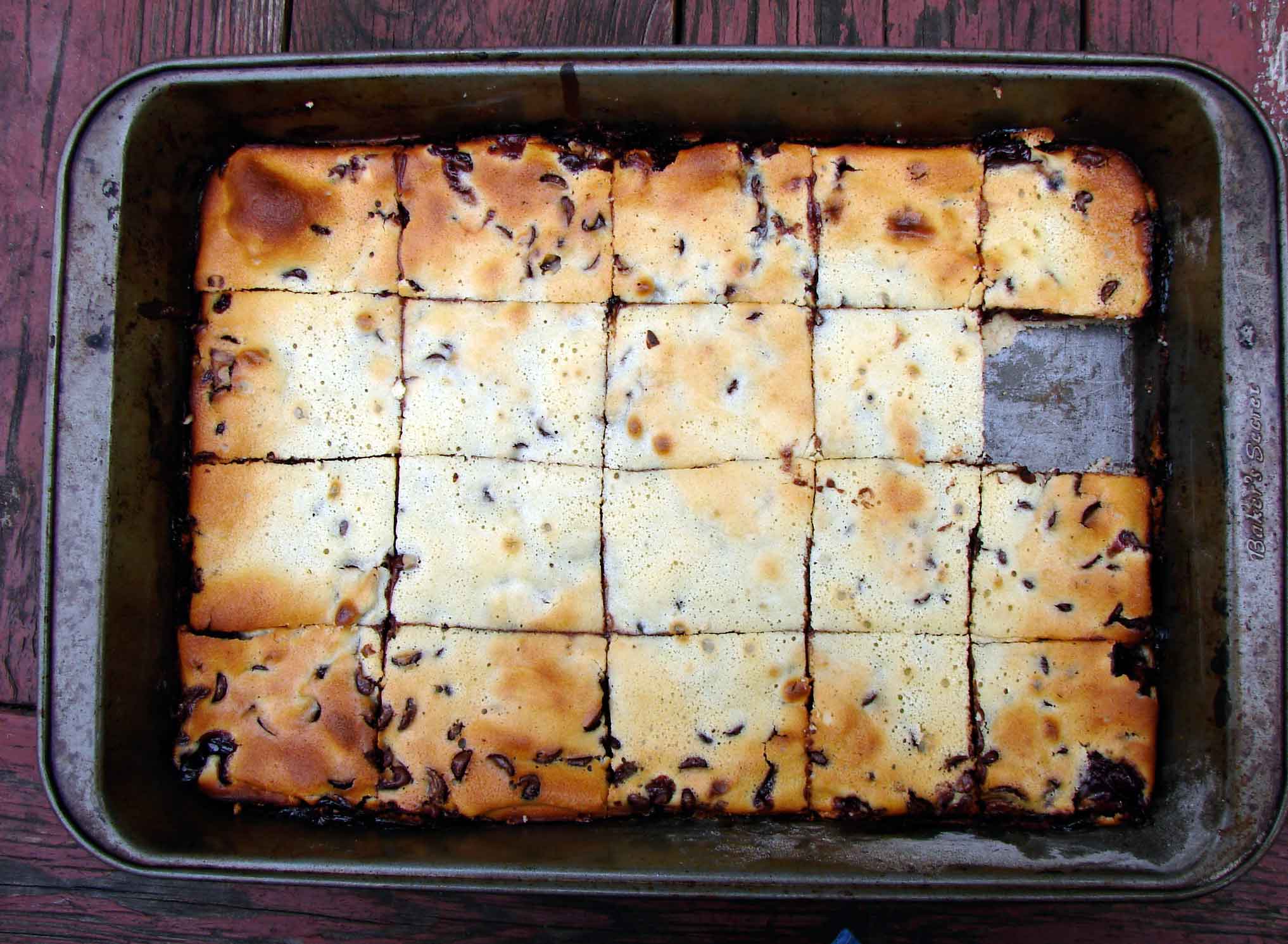
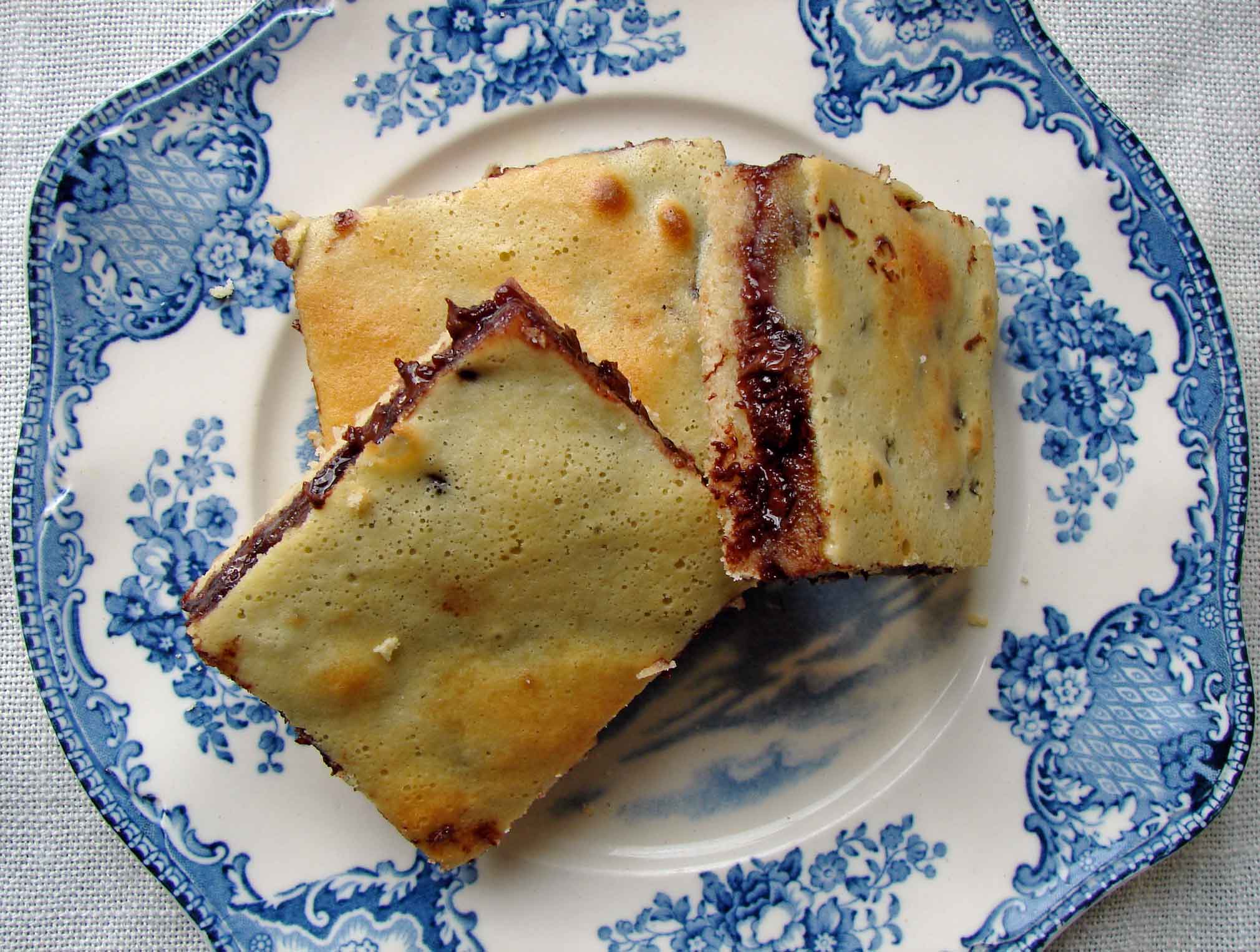
bakewell bars

bakewell bars

In honor of my lovely new cookie tins, I made some cookies. (Who am I kidding, I always make cookies!) I made some bakewell bars, a simpler version of a bakewell tart. They have a shortbread layer, a jam layer, and an almond frangipane layer. I made mine with black currant jam and bittersweet chocolate chips, because I love the tart-sweet combination of the two. But you could use any sort of jam you like, and omit the chocolate chips if you don’t want chocolate. (Who doesn’t want chocolate?) These were quite soft and flavorful. The other cookies are cardamom ginger chocolate chip cookies with just a hint of coconut. I think ginger and cardamom, which are mysterious and have a bit of bite, are very nice with chocolate, which is familiar and has just a hint of bitterness. I only used a small amount of chips and coconut, which made these cookies seem elegant to me!
Cardamom ginger chocolate chip cookies

Cardamom ginger chocolate chip cookies

Here’s Our House, by Madness, of course. What other song could I have chosen?
Continue reading

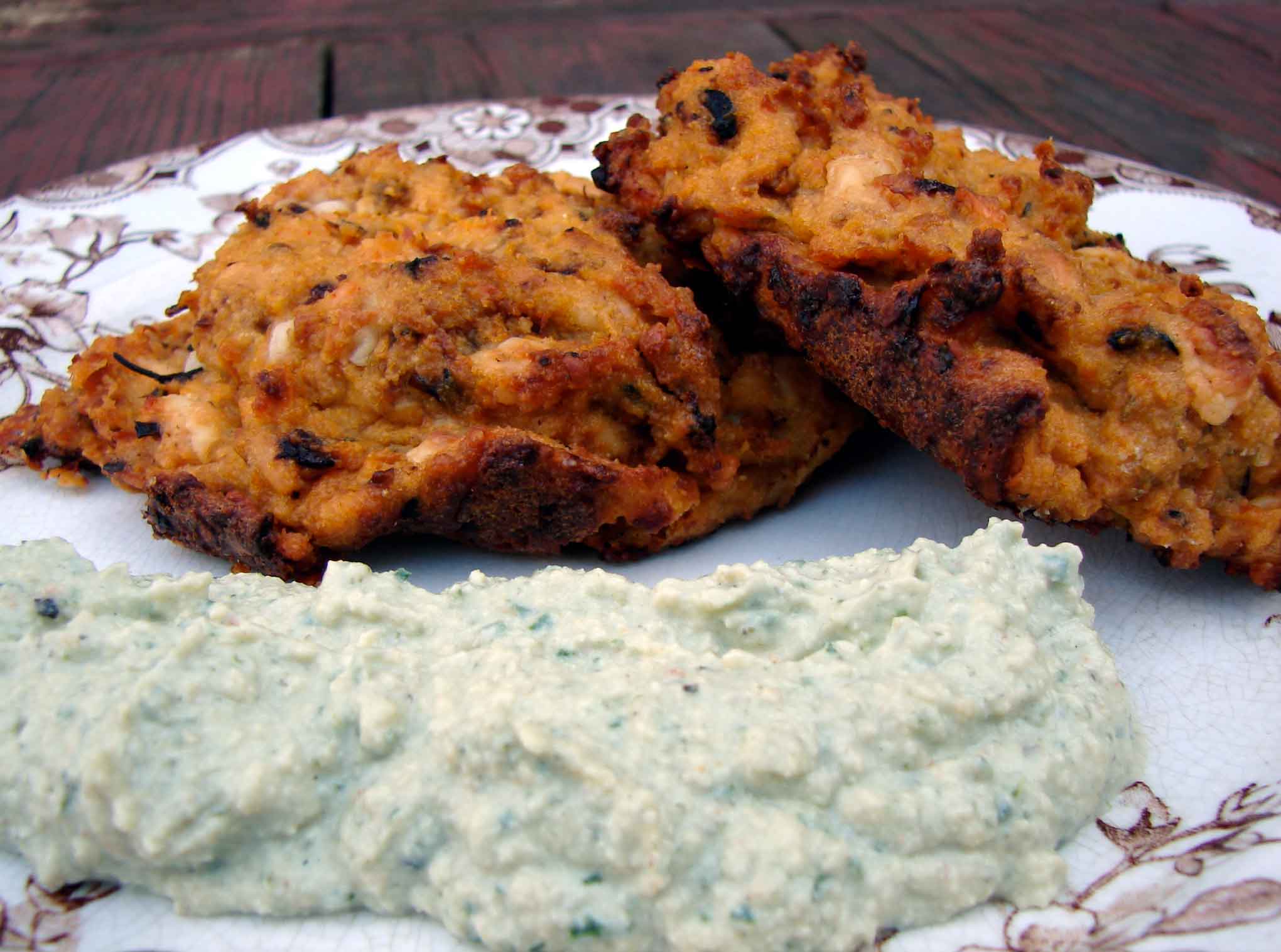
Roasted butternut semolina cakes with cauliflower pumpkinseed puree

Roasted butternut semolina cakes

Roasted butternut semolina cakes

Two brothers sit on a grassy patch below an elevated walkway. Behind each of them, in the far distance, stretches a long bridge that seems to connect the boys to the real, busy world. But they don’t care about that. The boys are in their stocking feet, comfortably eating rice with their fingers, and drinking tea out of the tea kettle lid or their cupped hand. “Messy, isn’t it?” “Yes! Fun, isn’t it!” Minoru and Isamu have run away from home with their teakettle and rice cooker, because their parents won’t buy them a television set. They’ve decided not to speak to anyone until their demands are met. This is, of course, Yasujiro Ozu’s tenderly beautiful film Good Morning. The film tells the story of a small suburban community and the havoc cast upon it by gossip, suspicion, and two small boys on a silence strike. The film was shot in 1959, and it reminded me of Tati’s films of the same period – full of grace, generosity and gentle humor. It’s about ordinary people going about ordinary lives, but it’s completely captivating. The boys decide to stop speaking because grownups talk so much and say nothing worth hearing…it’s all just a lot of meaningless talk. “Good morning, good evening, a fine day, where to? Just a ways, I see, I see.” The brothers can talk to each other, if they show the right sign. And they have a shared language of gestures and expressions that are full of meaning, and beautiful to see. Of course their gestures don’t always translate to the rest of the world, and when the little one, Isamu, tries to ask permission to speak in class, nobody knows what he means. The adults in the film, including the boys’ aunt and their English tutor, are amused by the boys’ assessment of grown-up conversation, but they recognize that there’s some truth in it.The film is full of misunderstandings and half-spoken thoughts and desires. The gossip that travels from small house to small house is a perfect example of meaningless words gone awry and striking out with their own destructive pattern. And yet, the real joy of the film is the moments of understanding between people, and in those moments when we recognize ourselves in the characters, our lives in their lives. They speak Japanese and a bit of English (“I love you!”). They talk in niceties and don’t say what they mean. But we know what they mean, whatever language they speak. Ozu is famous for defying Hollywood’s rules for creating melodrama in a film, not just by his quiet use of still, low-angled shots, but also because he utilized narrative ellipses. He doesn’t show the big events, he shows the spaces between them. In famous “pillow shots,” he gives us beautiful small poems of transition, static, but full of quiet, gentle motion within the frame. In the same way, we understand that what’s important in communication isn’t the words, but the spaces between them, and the meaning that they convey through gesture and expression and a universal understanding of human nature. In the last scene, the boys’ aunt and their English tutor stand at a train station talking foolishly about the shape of a cloud (“Yes, it does look like something…”) But from their barely contained smiles, we know that they know they’re saying so much more to each other. Throughout the film, there’s a running series of fart jokes. The boys eat pumice so that they’ll be able to produce a fart on demand when they push each other on the forehead. One of the housewives repeatedly mistakes her husband’s fart for language. During a callisthenic session, two boys admire the flatulent prowess of an older man, and say he has a lot of practice because he works for the gas company. The boys decide that farting is okay, as a form of communication, and doesn’t constitute a breach of their silence strike. This is more than a spate of fart gags, this is a nod to the things that connect us all…our humor and our humanity.

Grating and roasting butternut squash is my new favorite culinary technique! I use my food processor, which makes it super easy and fast. You might find you have a huge mound of grated squash, but it cooks down. I had mine piled about 2 inches deep on the baking tray to start, but it cooked down to about one cup in the end. Just keep stirring the outside pieces, which brown first, into the center of the tray. I added my grated butternut squash to a batter that was very similar to that for semolina dumplings or Roman gnocchi, which have quite a comforting consistency. I flavored it with sage, rosemary, smoked paprika, and a bit of cinnamon and cayenne. Delicious! To go with these big cakes, I made a puree of cauliflower and pumpkinseeds, with a little roasted garlic and spinach thrown in. It was creamy and smooth with a mild nutty flavor, and was very pretty with the butternut cakes.

Here’s Memphis Minnie with Good Morning.
Continue reading

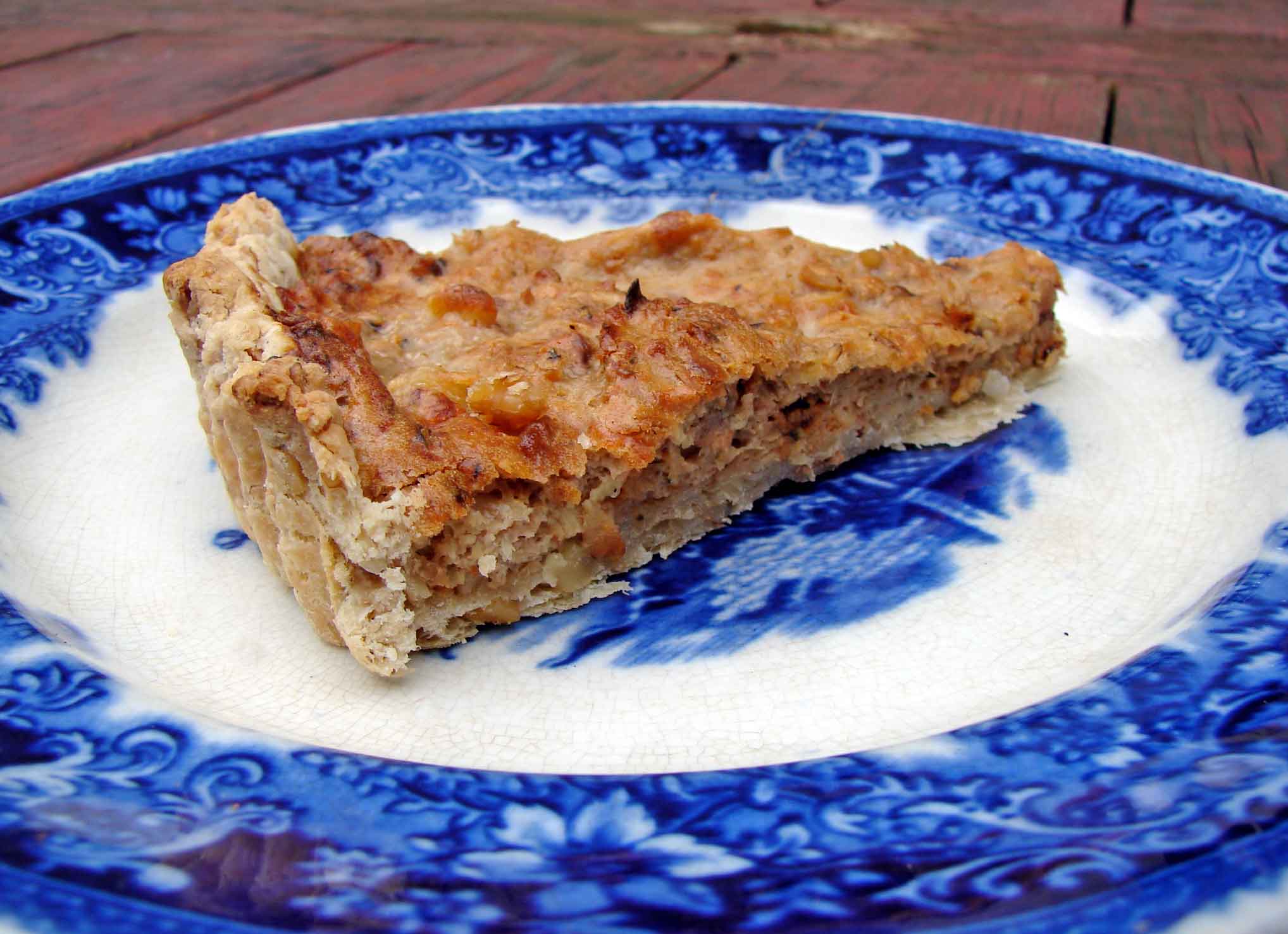
Parsnip and juniper berry tart with a walnut crust

Parsnip tart with a walnut crust

Parsnip tart with a walnut crust

In mid-February, a meteor streaked across the sky in Russia’s Ural mountains, which is news to absolutely nobody at this point. It’s one of those events that is almost too big to worry about – it’s so completely out of our control and (apparently) unpredictable. It’s one of those events that makes you see your day-to-day concerns in a new light. All of those gnawing anxieties, which you lie awake trying not to think about – are they suddenly incredibly important, or completely inconsequential? Typically, I have only a foggy notion of the facts relating to the case. What sticks with me is this video, which I’m sure everybody has seen. It’s a series of shots cobbled together from surveillance cameras mounted on cars and buildings. I find it so beautiful as a film! I find it so moving – the first time I watched, it made me weepy. (If you’re thinking to yourself “Pshaw, that’s no uncommon feat these days!” you are, of course, absolutely correct.) The landscape is austere and wintery, bare trees silhouetted against a pale sky. And the camera’s lens distorts the shot to focus everything on the horizon, the distant space where the sky meets the road, where the colors deepen. On the horizon the light changes in colors of dawn or dusk, which makes the road seem strangely lonely. We get a glimpse into the life of a series of strangers as they see it themselves. We hear what they’re listening to, we see what they’re seeing, we catch a hint of their voices. Each one is different from the other, and so distant from my life, so literally foreign. The scene repeats, starting from the same point in time. The light changes, the music changes, but the movement of the car and the movement of the meteor form a pattern, a rhythm that we follow across the sky. And they couldn’t have known about the meteor! As we watch, we know what it is, we know what happened, but the people in the cars, the people in the apartment buildings and walking by the side of the road, they didn’t know. They didn’t know what it was, where it came from or where it would go – this awesome, frightening, oddly beautiful glow. It moves across the sky, transforming the light like the hours of the day or the seasons of the year, but all in one smooth arc, all at once. The silent shots from buildings, with huge flickering shadows giving way to a burnishing radiance that obscures the scene entirely as it passes over, feel like a dream of a memory – too strange and huge to be real, and yet it is.
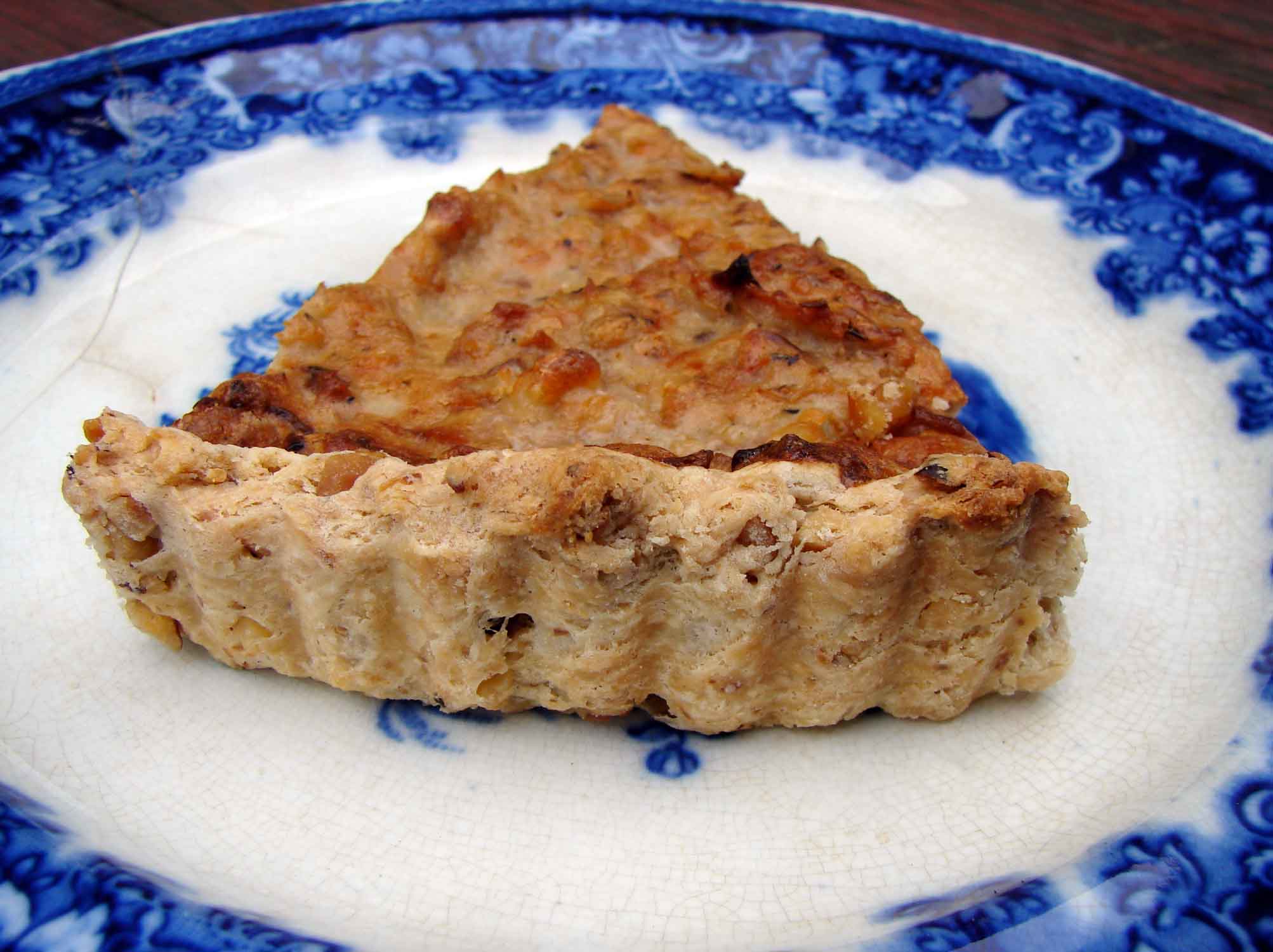
Walnut-crusted parsnip tart

Walnut-crusted parsnip tart

Last week I wrote about the fact that I didn’t have juniper berries. That same day, my generous friend Diane left a little jar of juniper berries in my mailbox! I’m so excited. They’re lovely, a little piney, a little citrusy. I decided to use them to flavor this parsnip tart. I kept the tart very simple otherwise, so that I’d be able to detect the juniper flavor. So the only other seasoning is thyme. And the only other ingredients are shallots and garlic, which play more of a starring role in this tart than I usually allow them. I used gjetost cheese, because I had some left from the other week, but you could easily substitute cheddar or mozzarella, or whatever else you like and have on hand. (And if you don’t have juniper berries, the tart would still be tasty. You could substitute a bit of rosemary, if you have some lying around.) This isn’t a light and fluffy tart, it’s dense and flavorful, and very delicious!

Here’s Regina Spektor with On the Radio, in honor of the curiously effective soundtrack of the video.
Continue reading

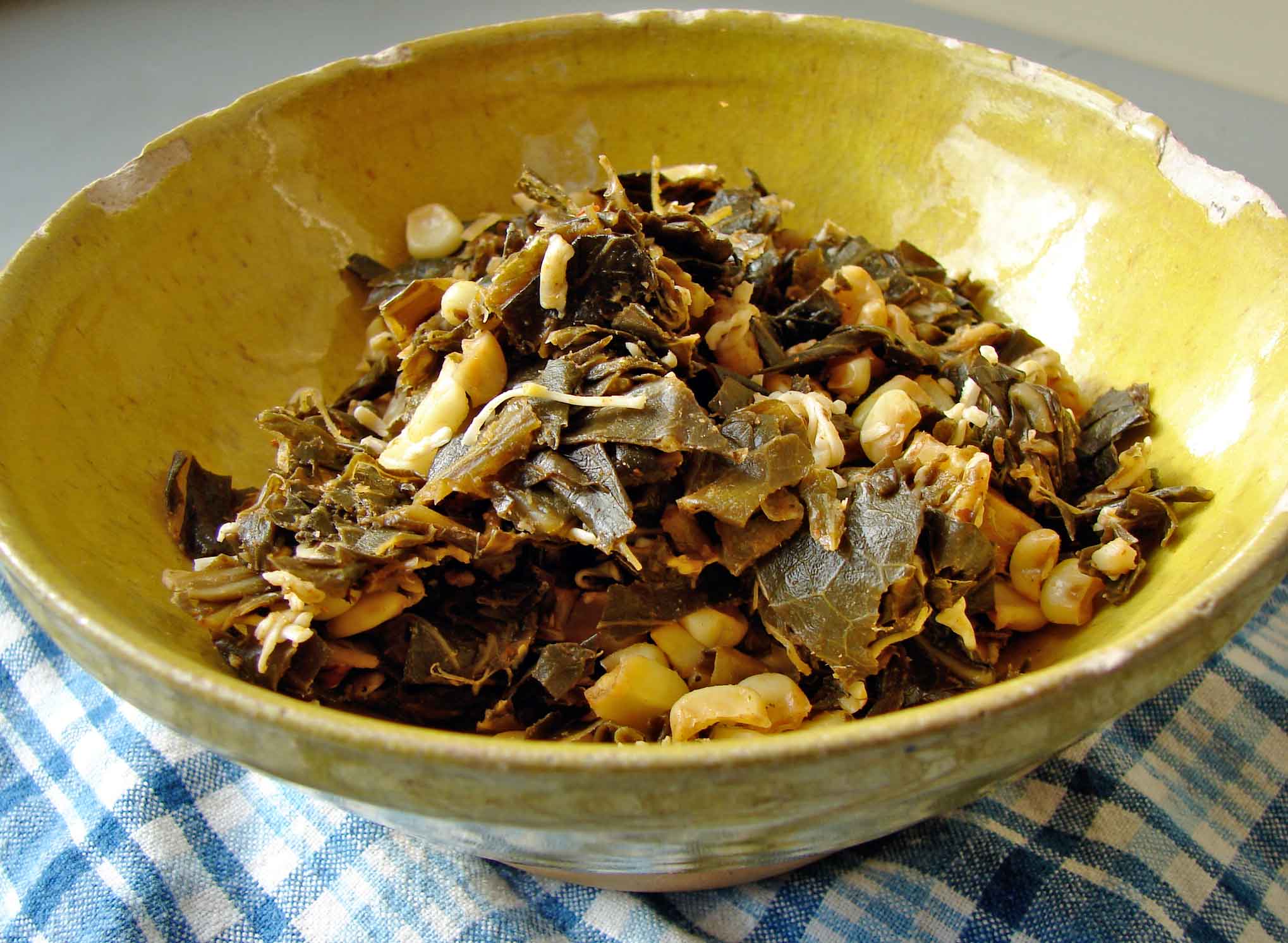
Collards with walnuts, corn and smoked gouda

Collards with corn, walnuts and smoked gouda

Collards with corn, walnuts and smoked gouda

Sometimes I’ll get a little speck of light in my vision, like a sunspot. And it will grow, and start to shimmer. It will take the shape of a laurel branch, climbing up the side of one eye. It will be jagged and flashing and electric. I can see around it, but I can’t see through it, and half of my vision will be obscured. Between me and the world is an odd animate light, sparkling and growing. It’s a little rip in the fabric, a small malfunction of the wiring. If this was a science fiction movie, it would be that moment when you’d say, “My god, I’m a robot! How long has this been true? Is anything real? Are my memories my memories? Have I actually felt all that I’ve felt and done all that I’ve done?” And then you’d look in the mirror and part of your skin would be torn off, and wires would be poking out, and sparks would start shooting all over the place! But it’s not a science fiction movie, and so it’s not the moment that I discover that I’m a robot, but that I’m a human, which is equally strange. Maybe more so. The frantic glow fades, eventually, but I always feel discombobulated for some time – sensitive to light, and wary of another episode. It’s hard to shake the strangeness of realizing that you’re a person, a bundle of thoughts and recollections and hopes and worries and tastes, looking out at the world through this strange, warm, vulnerable, incomprehensibly busy body. It feels so odd to discover that what I see – the world around me, my vision – is who I am. My impressions of the world, gathered from all of my senses, are more closely connected to my sense of myself than other people’s impressions of me, and this must be true for everybody! Each person is the world that they create around themselves as they experience life! It’s a weirdly freeing thought! (What is she going on about?) This morning I had the little shimmering light in my eye, but it never grew, it faded without incident. Obviously, it still left me feeling a little blurry, though, or I wouldn’t be rambling on in this ridiculous fashion!

Let’s talk about collards instead. This is all part of my fiendish plan to make collards as popular as kale. Why does kale get all of the attention? Just cause it’s frilly and pretty? Well, collards are delicious, too, despite their dull surface and flat leaves! I do love collards, they’re so nicely substantial. I mixed them, in this instance, with walnuts and corn, for a little crunchy sweetness, and smoked gouda, for a little melty smokiness. I also used pomegranate molasses, which is just enough strange and sweet to lively up this dish! This is a good side dish, but if you ate it with some rice (and beans, even) it would make a good meal.

Here’s the Ink Spots with When the Sun Goes Down (you don’t get sunspots any more!!)

Continue reading

Raggedy pasta filled with spinach, ricotta, artichoke hearts topped with roasted red pepper pine nut sauce

Spinach ricotta pasta with roasted red pepper & pine nut sauce

Spinach ricotta pasta with roasted red pepper & pine nut sauce

In a scandalous act of shocking laziness, I’m going to plagiarize myself for today’s post. (I have to get to work soon!) This appeared in the Guardian this week, I wrote it! So I’m just going to repeat myself here, with the original un-edited version. Ready?
Every city has its shantytowns, tenements, projects and favelas; cramped, tightly-knit urban regions in which people are thrown together, joined by poverty and a sense of stagnation. These spaces form a teeming world of their own within the larger macrocosm of the city, connected but self-contained. Life is stacked upon life in a confined area, making the situation rife for story telling; a perfect stage setting of tension and drama. People struggle to survive from day to day, and dream of escape. They form a network of friendship and support, but crowded conditions breed pressure, and the threat of violence is never distant. Privacy is scarce when one person’s front door opens onto another’s and a network of alleys or balconies forms the veins that connect them all. This is brilliant fodder for movies, but it makes for good songs, as well. So this week’s Sunday interactive playlist is on the subject of cramped urban housing.

Here’s a picture that Isaac drew a few weeks ago. He started drawing “city towers,” and then he got caught up drawing these crazy rambling houses that sprawl up the hillside, and connect and expand and have levels and layers and turrets. The oval area in front is an underground space where they meet (and apparently practice math facts!)Isaac's-picture
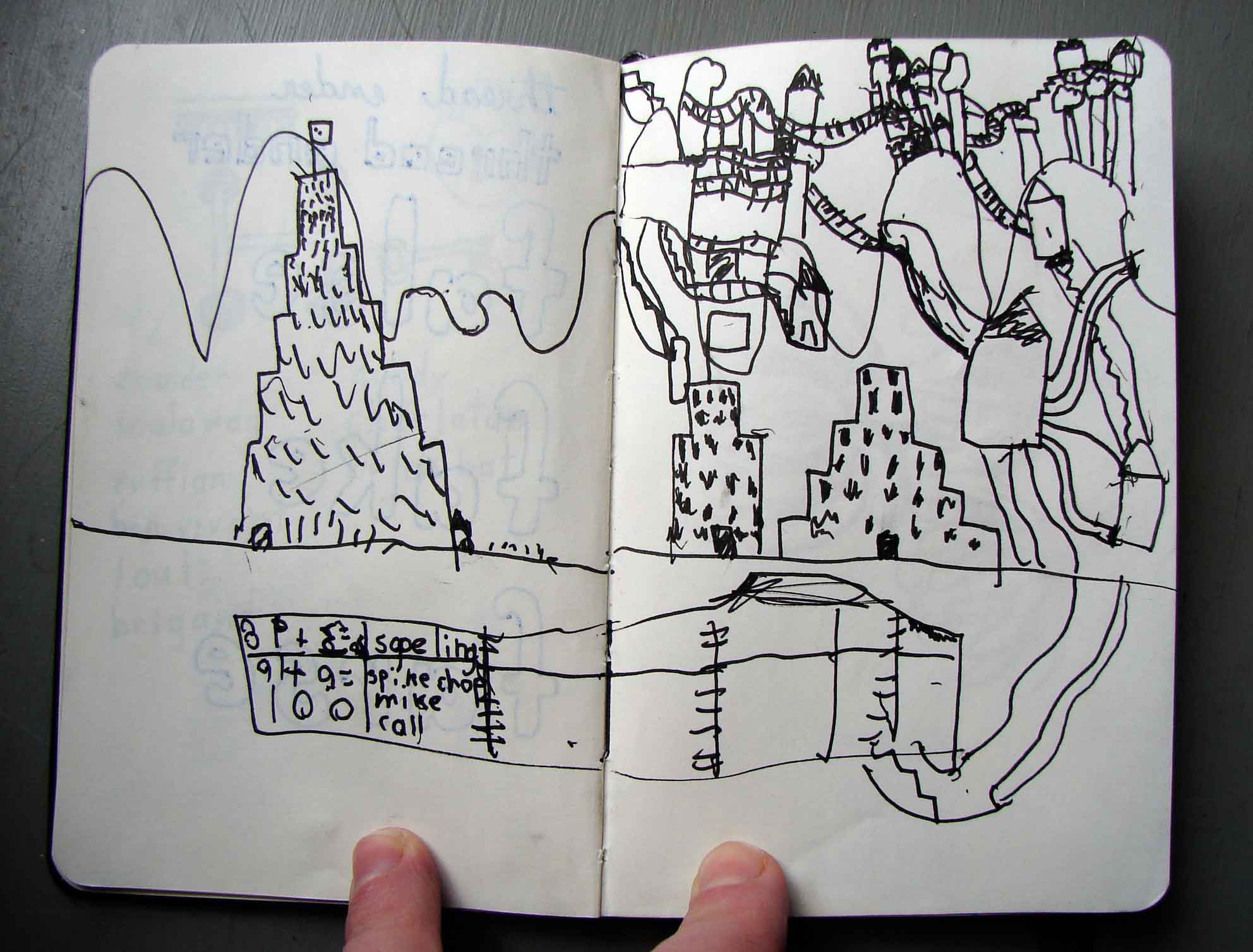
This pasta is kind of like his labyrinthine spread. It’s handmade pasta for people who don’t have a pasta maker. What you do is this…you make pasta dough (which is fun and easy!) You roll it as thin as you possibly can (which is a bit of work, but also fun!) You cut it into any shape you like – triangles, squares, rectangles. You fill each one with a spoonful of delicious filling, then you wrap it up any way you like – each one a different shape. Some you roll in tubes, some you make in pockets. Some you put seam-side down, some you put seam-side up. You pile them on top of each other or next to each other. (You try not to get too great a concentration of layers of pasta in one place, so it’s not stodgy.) You cover them with a delicious smoky sauce made of pine nuts and roasted red peppers. You sprinkle mozzarella on top. You bake the pasta. It has nice soft pockets of filling, some lovely melty cheese, some crispy parts where the pasta sticks out and crisps up as it bakes. And then you eat it! You could also easily use this filling and this sauce to make lasagna, stuffed shells, manicotti, or any other sort of stuffed baked pasta that you buy at the store. And that’s that!
Continue reading

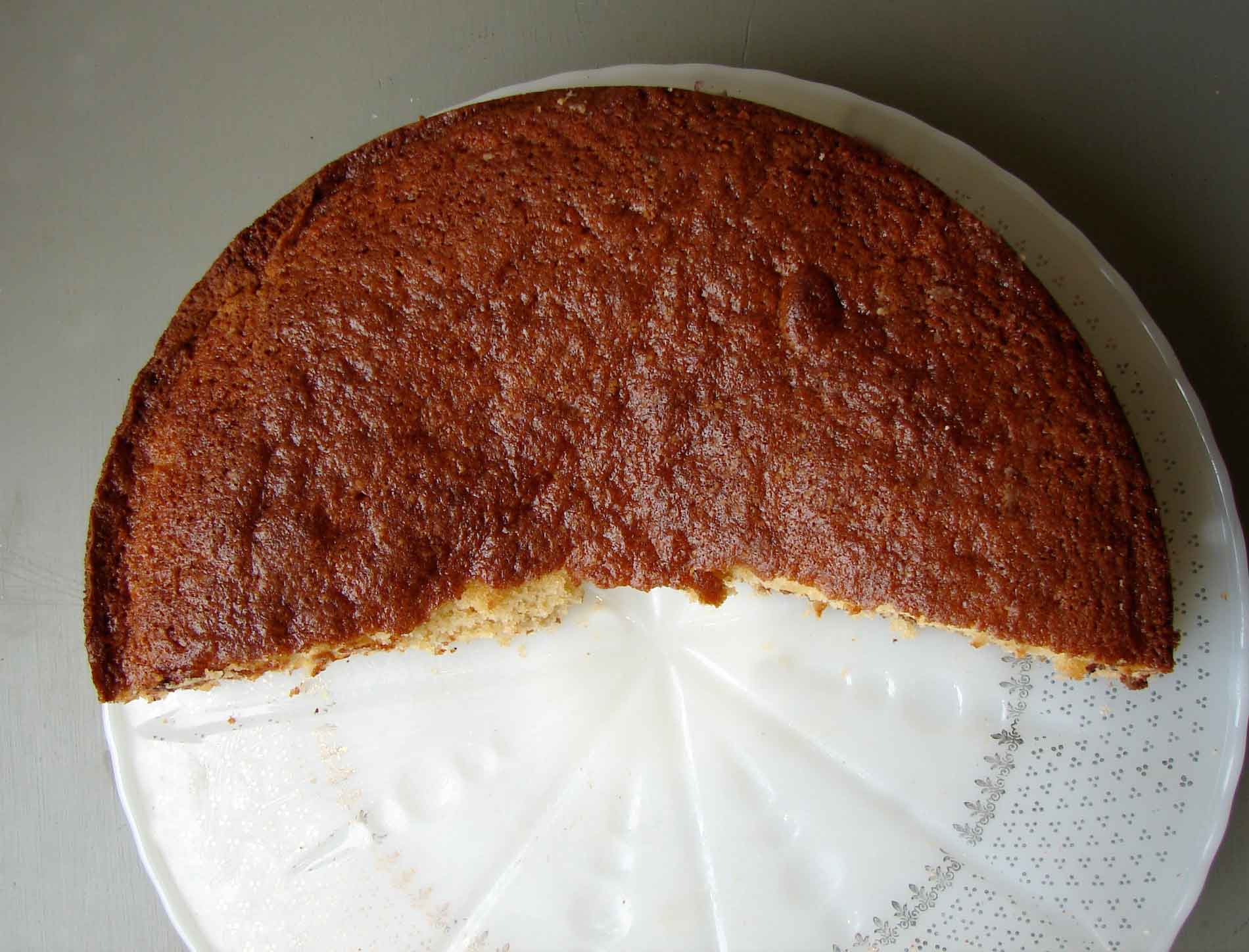
Almond cake with chocolate chips and ginger

Almond cake with ginger and bittersweet chocolate chips

Almond cake with ginger and bittersweet chocolate chips

Clio’s attitude towards fetching a ball is “I could, but why would I?” Some people might think this is a sign of stupidity, but I disagree. (And not just because I’m her biggest fan!) I think it’s funny that people take it as a sign of intelligence if an animal acts like a human, or in a way that a human wants them to behave. I had a theory when I was much younger. (I had lots of theories when I was younger, I had all sorts of philosophies to explain the universe. And then I grew up and realized that everything is too shifting and complicated to be explained.) My theory was this, this was the theory that was mine. I thought that animals were wiser than humans, and that the way that they understood to live in the world made more sense than the way that we did. A cow, for instance, who spends her day eating sweet grass, feeling the sun on her back, watching her world change subtly around her, thinking god-only-knows what thoughts behind her beautiful cow eyes, has everything figured out on a fundamental level better than, say, some girl that goes to school, and has her lunch packed in plastic, and learns what she’s told to learn by people who laugh at her for saying that cows are wiser than humans. The fools! And then they’ll say, yes, but what about the fact that people build highways and cities and cars and cure diseases! And the girl with the theory says, “That doesn’t prove anything! We created a lot of the pollutants and carcinogens that cause the diseases in the first place! And highways and cities bind up the world and hurt it, and make it impossible for us to understand the wild magical truth of nature, which is the only true religion! The electric lights of our homes blind us to the variations of the gradually changing sunlight and moonlight all around us! Our walls and windows make us immune to the cool winds that blow the stagnation from our brains and make us alive! The animals understand that, look into their eyes! They feel the beauty and truth of the world around them in a way that we will never understand, and that’s why they are wiser than we will ever be!” Yes, I was a very strange child, and I grew up to talk about my past self in the third person! So I think Clio is a wise child, and very smart not to fetch the ball, but to joyfully run after it and toss it around and drop it wherever she wants to.

My boys go through phases with food – they’ll love something for a while and eat it every day, and then one day, they just don’t want it any more. It takes me a while to catch onto these mood swings, so I often find myself buying something they used to like, and then having to figure out some other way to use it up when they reject it. One such item is vanilla yogurt. Malcolm used to eat it by the tub, so I’d buy a big carton of it, and he’d scarf his way through it in no time. Lately he hasn’t wanted it. So I decided to use it in a cake. Yogurt makes cakes nice and dense, and I combined it, in this instance, with almonds. I whirled the almonds and yogurt together in the blender until they were perfectly smooth and creamy. This cake also has candied ginger, chocolate chips, and a few spoonfuls of marmalade, so it’s a lovely cake, simple, but complexly flavored. Comforting yet piquant. If you don’t have vanilla yogurt, you can use plain, but you might want to add an extra smidge of vanilla flavoring, and be generous when you measure the sugar.

Here’s Done by the Forces of Nature by the Jungle Brothers

Continue reading

Vanilla ice cream with salty chocolate-toasted almond bark & Maple-spice ice cream with shaved chocolate

vanilla ice cream with salty toasted almond bark
vanilla ice cream with salty toasted almond bark

CAPTAIN’S LOG:
We’re breaking down! Tempers are flaring, the crew is becoming ragged and moody, crying one moment and laughing the next. Fits of pique! Excessive displays of spleeniness! We’ve entered day four of our excursion. Tuesday afternoon we left the SS Ordinary in our rickety couch-shaped vessel, possessed only of a spiderman blanket, a pillow, a grey puppy, a stack of books, a set of colored pencils, snacks and drinks, medicaments, philtres and tinctures, and a vat of lego bricks with which to fashion a new vessel, if the puppy tears too many holes in our current conveyance. And now that the fever had broken, and the quarantine will surely be lifted, the crew is falling to pieces!
Sigh. It’s not so bad, of course. It all started when I said Isaac should turn off the cartoons and do a little of the homework that was sent home. What? NO! He’s sick! His belly hurts, he HAS to watch cartoons, IT’S A BLATANT BREACH OF SICKDAY RIGHTS! ACTION WILL BE TAKEN! In the form of tears and foot stamping. Isaac tried to have a tantrum, I think probably in imitation of certain other members of the family. He can’t really maintain it, though. He can’t stop himself from giggling if you say anything remotely funny, and that spoils the whole effect. Everybody should have to spend a week with Isaac, cast adrift from real life on a messy couch, through drizzly rain and weak winter sunlight, through brief hopeful pools of afternoon warmth and quickening dusky winds. People come home from work and school, and leave again, and we sit on the couch, watching it all go by. It’s a rare pleasure.
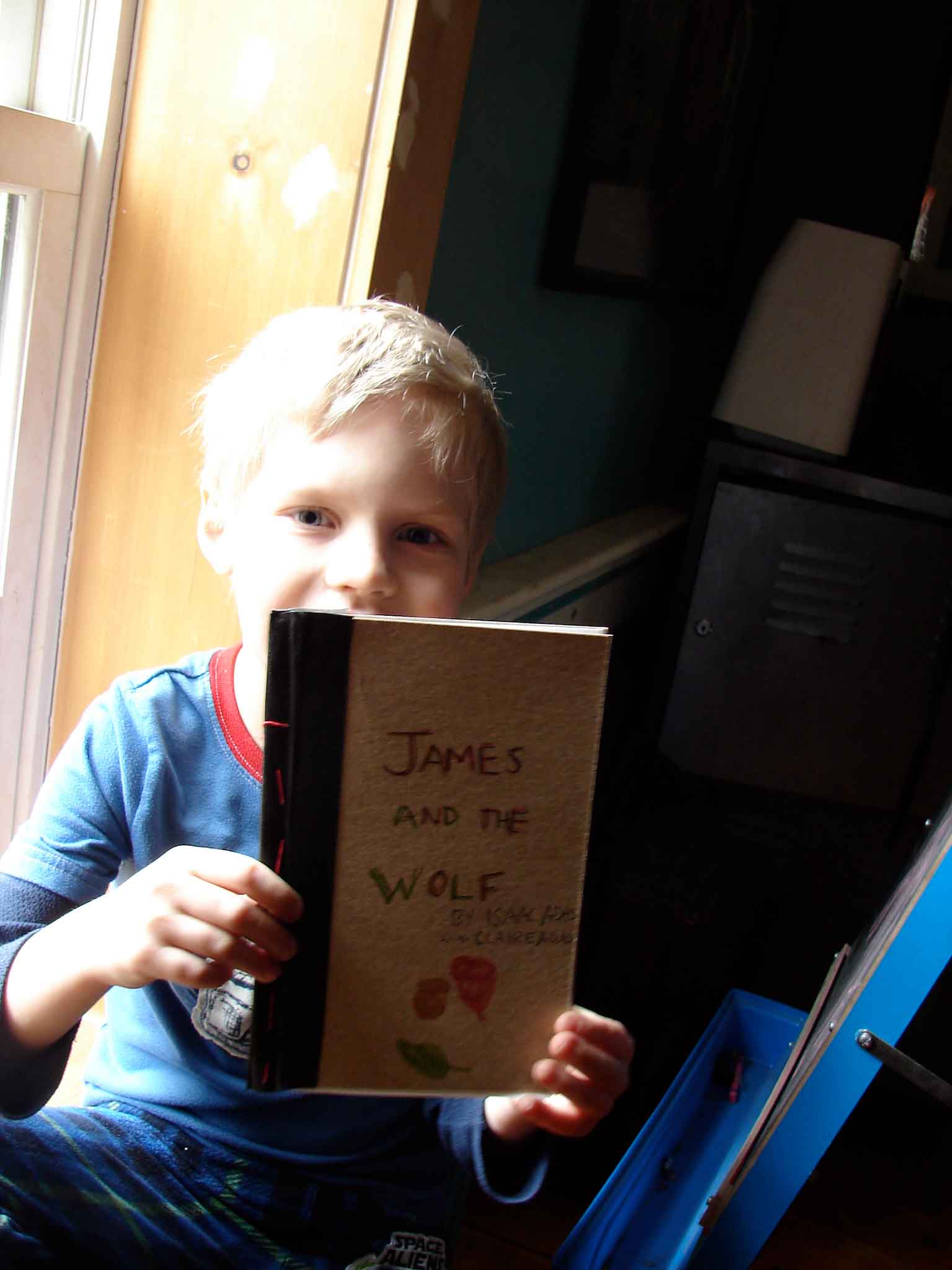
Isaac and James & the Wolf

Isaac and James & the Wolf

Isaac and I made a book. We gave it a cardboard and gaffer tape binding, and I broke a needle in two places trying to sew the pages through the tape. Isaac dictated, I wrote the words, and Isaac illustrated. It tells the story of a boy named James. He lives in the forest with a pack of vegetarian wolves who like to snuggle with him. (“Really?” David said, upon reading this part, “Isaac came up with that? Because it sounds suspiciously Claire-y to me.” It’s all Isaac, I swear! Of course, I made Isaac….) Let’s see, where were we? Ah yes, one day, Black Fur the wolf goes across the river to pick raspberries. A pack of non-vegetarian wolves surrounds him and tells him he should eat his friend James, because human boys are delicious. Suddenly, James and his wolves come up to the raspberry patch! (In a stunning twist nobody could have predicted, James is riding on a giant squirrel-dog named Scog.) James goes rushing at the leader of the other wolves, who is understandably afraid, but rather than hurt him, he feeds him a cake made of nuts, raspberries and leaves. Why, it’s delicious! All the wolves become vegetarian and they spend their days helping each other find food and making meals together. And that’s how it goes. The End.

Maple spice ice cream with grated chocolate

Maple spice ice cream with grated chocolate

We also made ice cream. I always bake with the boys when they’re home sick (if they’re up to it). It’s so companionable and comforting, and they have such surprising and tasty inspirations. Isaac and I wanted to make ice cream. He wanted to make “crispy ice cream.” So we had to decide what that meant. Isaac wanted to add almonds, I wanted to add chocolate. I remembered that we’d made some delicious chocolate almond bark last month, so we made that and dropped large pieces into the ice cream as it froze. So good! I toasted the almonds to deepen their flavor, and we put a sprinkle of sea salt on top. And the other week, as you may recall, Malcolm and I were playing with a hand grater and some chocolate chips. We wanted to see what the fine powdery slivers of chocolate would be like in ice cream instead of chocolate chips, so we made a simple maple spice ice cream to test it out in. Also so good!!

Here’s Precious Precious, by fellow Isaac, Isaac Hayes
Continue reading

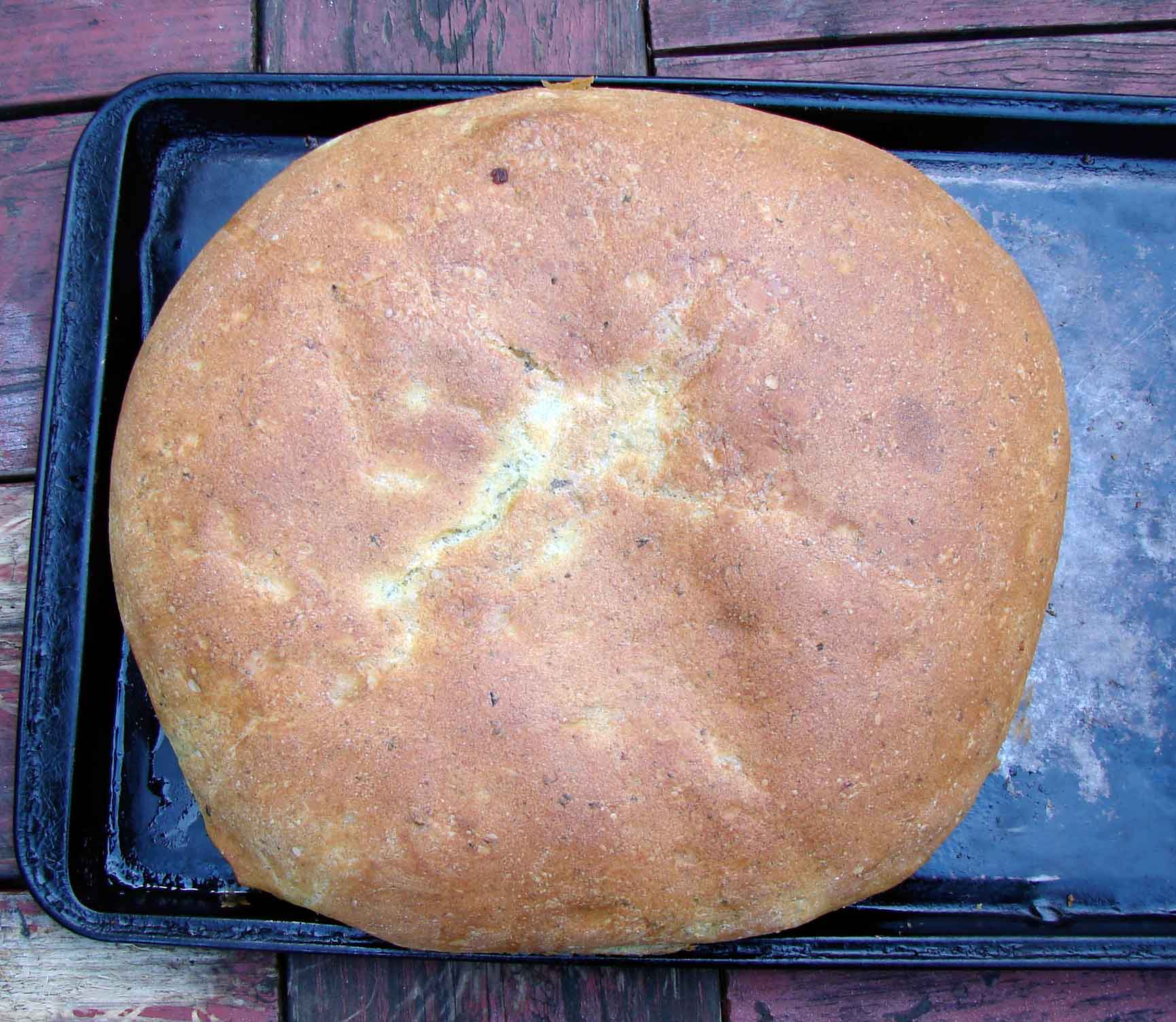
Colcannon bread (kale and potato bread)

Colcannon bread

Colcannon bread

Here at The Ordinary, we’re not quite well. Isaac has an actual fever, and the rest of us feel crummy in the head, throat, and spirits. Add to that the chilly drizzliness of the day, and you have a general idea of the mood here. Actually, I quite like a day off with Isaac, as long as he’s not miserably ill. He’s such a little chattery singer, and even as his fever rises he continues a cheerful warble. We’ve cuddled on the couch; made a paper sea-dragon from a book; drawn mixed-up animals, (which Isaac decided he could name any way he wanted to, and he could spell the name any way he wanted to, because he invented them. They won’t be on the test!); discussed the philosophical and moral implications of the statement that it’s hard to be mad at Clio because she’s so cute; made a pancake with cinnamon (Isaac wanted me to tell you about that!); and watched a movie. I’m going to keep it brief so I can get back to the cuddle-couch, but I want to tell you about the movie we saw, because it was remarkable and beautiful. It’s a short, wordless, animated version of Peter and the Wolf made by Suzie Templeton. Technically and aesthetically, it’s wonderful. The film takes place in a bleak and dingy village on the edge of the woods. It’s a modern setting, replete with graffiti and chain-link fences, but even the dreariness is gorgeously rendered. The characters – a boy, a runner duck, a hooded crow, a fat cat, a blue-eyed wolf, and a grumpy old man – are full of personality and glow with inner life. The film brings a real sense of compassion and soul to the familiar story – it’s about friendship and forgiveness, cruelty and kindness. You understand, as you watch, that prey can easily become predator, bullies can be bullied, and cruelty and aggression may be valued and rewarded, but that doesn’t make them right. Everybody wants to live, and empathy extends to all creatures. I can’t wait to watch it tonight with Malcolm and David!
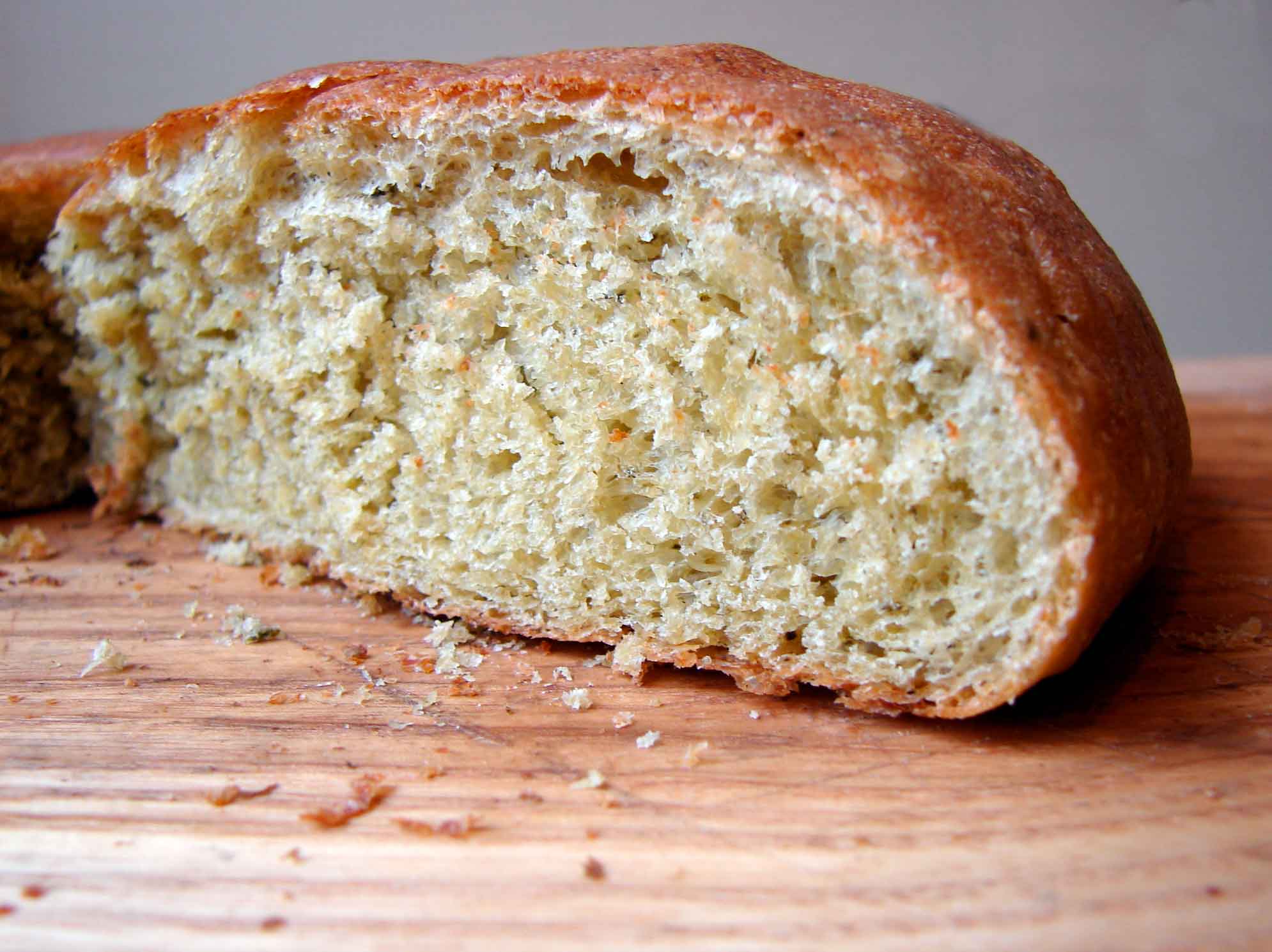
kale and potato bread

kale and potato bread

I’m very very excited about this bread! It’s the oddest thing, but I dreamed about it two nights in a row, and then I woke up and spent the rest of each night trying to figure out how to make it. Colcannon, of course, is an Irish dish that contains mashed potatoes and kale or cabbage. In my dream I made it into bread, and so…in real life I did just that! It’s a lovely, light but dense, pale green bread with darker green flecks. The flavor is very subtle – you don’t actually taste kale, just a nice savoriness (which means small boys will like it!). I added plenty of freshly ground pepper for flavor, and an egg and a bit of milk to make it soft inside. It’s got a nice crispy chewy crust. I made one huge loaf, which is very seussical looking, but it probably would have been more practical to make two smaller ones. Maybe next time!

Here’s REM with Wolves, Lower, appropriately, live in Ireland!

Continue reading

Jerk patties with pigeon peas, butternut squash and kale

Jerk patties with kale and butternut squash

Jerk patties with kale and butternut squash

Malcolm has been trying to remember a song. It’s a song I listened to all the time when he was little, that I sang along to. (These claims check out, because I do tend to become obsessed with songs and sing along with them over and over.) Malcolm is the boy with the long memory. If we’re trying to remember where we put something, or if we watched something, or who said what, we ask Malcolm. I love to think about Malcolm looking out on the world with his wise, observant, beautiful eyes, these past ten years, and collecting a trove of thoughts and images and recollections, and storing them in his remarkable brain. It’s one of the things that makes him seem wiser and more mature than his years. (As opposed to, say, giggling over fart jokes with his brother in the back seat. And there’s also plenty of that!) I used to have a good memory for strange, inconsequential things, but I feel as though my memory is fading with my eyesight, which is a weird sort of impaired, half-awake feeling. So we’ve been trying to recall this song. On Saturday night we sat on the couch, and he leaned heavily against me in the sweet way I’m sure he won’t do for much longer, and he played songs on his iPod (or fragments of songs – he’s an erratic DJ!). We thought about all the songs we’d listened to when he was very little. We listened to songs that used to make me burst into tears when I was very pregnant or just after he was born, because I was overwhelmed with the scale of our impending change. We tried to remember all of the songs he’d sing along to, with delightfully incorrect words. And there’s no medium more powerful for conjuring recollections than music! And as we listened for old memories in the songs, we were weaving new ones as well, so that years from now these songs will have layer upon layer of remembrance. We never did figure out which song he had in mind, but in the end, of course, it didn’t matter. The joy was not in remembering this one song, the joy was in remembering.

Food is another great trigger of memories! I remember walking around Central Park in the blazing hot sun during a street festival. I coveted the jerk patties, so bright and festive and fragrant, but they usually had chicken or beef in them. Not these, my friend! These have kale and pigeon peas. And I developed a new technique with the butternut squash. I grated it and then roasted it. I like it this way, especially in a pie – it turned out more roasty, and a lovely texture. I tried to minimize the time it took to make these by rolling out a long thin sheet of dough (two feet by ten inches, maybe) putting big glops of dough along one side, folding over, sealing, and then cutting apart. Kind of like making ravioli. If this seems, actually, to be more work, feel free to divide the dough in six, roll out thin rounds, and make this half-circle shaped.

Here’s Stars of Track and Field by Belle and Sebastian. Malcolm used to sing “Stars and dragons still too far.”

Continue reading