Kale and new potatoes with lemon and sage

kale and new potatoes with lemon and sage

kale and new potatoes with lemon and sage

Here at the Naive Political Philosophy department of The Ordinary, we’re alarmed and dismayed by a pervasive and corrosive trend that we’ve noticed. What is it? You ask. Well, (we answer) it’s nothing other than the very breakdown of all communication into cynical marketing speak–insipid at its best and genuinely pernicious at its worst. Everybody is trying to sell us something, and it’s getting us down! All forms of communication–real mail, e-mail, phone calls, visitors to our esteemed institution–it’s all somebody asking for money, with a product for sale. It’s almost gotten so we don’t trust a friendly gesture, any more, and isn’t that a terrible shame. Everything the boys bring home from school is asking them to sell something or buy something, they’re learning how to be little consumers, little salesmen. This isn’t a new problem, and it hasn’t crept up on us in secret, it’s been going on for decades, and it’s poured over our heads by the steaming bucketful, as if there was no shame in it at all, as if it was a system that makes sense. And it’s down to the very words we speak with. We read the OED, we’re not ashamed to admit it, and we’re saddened to see the trajectory of almost every word from something mysterious and meaningful to something lacking in meaning or confounding in meaning, used to make us want to buy something or to describe the way people buy things. Because it’s an art, a study, a science, a career, this method of persuading people to part with their money for something they don’t need, this way of appealing to people’s insecurities, of making them feel empty and insufficient, of making them feel ugly and inferior. It’s all part of a system that we defend with our lives, that we can’t question or change, because it’s been sold to us so neatly for so long. Well, here at The Ordinary, we think it’s not working, or it’s working so well that it’s impossible for anything of genuine substance to thrive. We want to live in a world where we can make something we love, something we think is good, and we can send it out in the world to share with others, who are making good things that they love, which we’ll share, too, and pass along to our friends. We want to live in a world where everything has value, and nothing has a price. We want to live in a world where we can look how we look, and think what we think, and age how we age, and nobody will try to tell us it’s all bad, and sell us something to fix it–as if the very passing of time, so natural and strange and beautiful, is something you could stop with anything as absurd and insignificant as money. When we communicate, we want to share thoughts and ideas and emotions, we don’t want to buy meds or printer paper or a new phone. And this is our highly-detailed, pragmatic and sensible plan for moving forward into the future.

kale & new potatoes with lemon and sage

kale & new potatoes with lemon and sage

I always think of kale and potatoes, and any combination of kale and potatoes, as being very wintery. Well, guess what? We joined a new CSA (that I’m very excited about!) and we got bundles of kale (very pretty kale, as it happens, I’ve never seen any quite like it), and wonderful handfuls of fresh herbs. And we bought some lovely new potatoes at the store. And we combined them in a light, fresh lemon, kale and white wine preparation. It was delicious! It tasted bright and green, like spring. David said it was the best kale he’s ever eaten. I added some sumac, for tanginess and nigella seeds, for a bit of subtle smokiness, but it would be just fine if you don’t use these.

Here’s Tom Waits with Step Right Up.

Continue reading

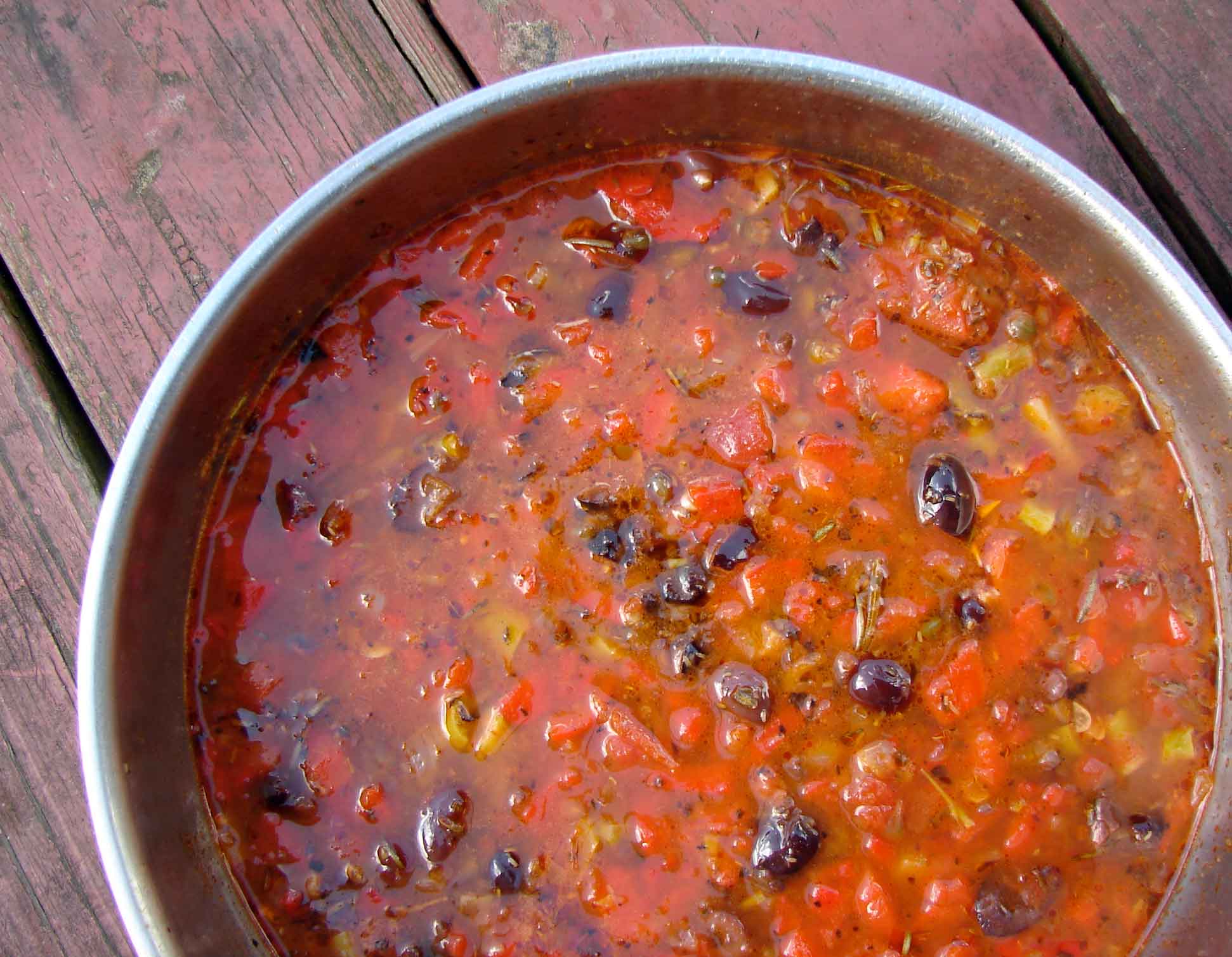
Perciatelli pasta with brothy asparagus, roasted pepper & olive sauce

Asparagus and red pepper sauce for pasta

Asparagus and red pepper sauce for pasta

Well, I survived another mother’s day lunch shift as a waitress. Nine hours with no break at all, literally not one second to sit down. I’ll pause for a moment so that you can shed a small tear for my plight. Aw, it’s not so bad. This is a fairly typical shift for the restaurant business, and it certainly suits me better than a job at which you can’t do anything but sit! I like the non-stop pace, I like being active, I enjoy talking to people. But it was tiring, and by the end of the day I stood in the middle of the restaurant yelling, “I’M A MOTHER TOO, DAMMIT! SOMEBODY HAD BETTER BUY ME A GLASS OF WINE RIGHT NOW!!” And when I walked Isaac to school this morning, and joined a group of parents talking about their mother’s day celebrations, I said, “I spent nine hours serving mothers lunch, and let me tell you, mothers are horrible people.” Heh heh, I can say that, because I am a mother! I’m kidding once again, of course. Mothers are wonderful people, each and every one of them. But mother’s day is widely recognized in the restaurant business as a particularly difficult day. You walk away from it bewildered by just now needy everybody is. Why is this? You ask yourself, as you walk home on tired feet. Why do people seem so needy on mother’s day? Maybe it’s because mothers are as needy as everyone else, but we have to suppress that neediness 364 days of the year, and on the one day we’re told by the media and the greeting card companies that somebody should take care of us, we’re going to squeeze every drop of sympathy and attention we can get. Because mothering, though it is a gratifying and demanding job, is not a very well-rewarded job in the usual ways that jobs are considered rewarding. We have no pay, no awards, no performance-reviews, no gold stars, no bonuses, no free gifts, no paid vacations, no benefits, no gala luncheons. We do have people who don’t listen when we talk to them, who keep us up all night when they’re sick, who expect us to feed them even when we’re sick, who act embarrassed when we talk to them in front of their friends, who shudder visibly when we try to feed them delicious foods that we’ve worked on for hours. And most of the time, that’s fine. Isaac has had some sort of stomach virus the last few days, and I haven’t gotten a lot of sleep, but I’ve been thinking that it’s sort of perfect for mother’s day weekend, because it makes you realize how good it feels to be needed by someone, to actually make somebody feel better if you rub their back or cuddle with them, to love someone so much that you’re always glad to hear them call your name, even at 3 in the morning (and 4 in the morning, and 6 in the morning…). So if a mother wants to fuss a little when her family takes her out, and be sure the meal is exactly as she likes it, and that her water has precisely the right number of ice cubes and lemon slices, more power to her!! If she wants to send something back because it’s not just the way she ordered it, that’s fine–she should have the perfect meal. If she wants proof that somebody is actually listening to her, even if it’s a stranger in an apron and stupid white shoes, I’m okay with that.
For mother’s day Isaac gave me a hand-print flower glued into a flowerpot made of brown construction paper. It was quite a big flowerpot, and I believe he was supposed to fill the whole thing with a poem. In his usual wise and simple way, he wrote, “I love my mom because she’s my mom.” And that sort of says it all. It defies rational expectation, but it’s true–we love our moms because they’re our moms. Because in reality all moms aren’t wonderful people, and no mom is always wonderful, but children have a remarkably elastic and forgiving sort of love, and most of the time, that’s reward enough.

Both of my boys actually liked this meal! I made long tube-shaped pasta called perciatelli. Like spaghetti, but with a hole in it. I wanted to make a brothy sauce to go with it, so I made this concoction of asparagus, roasted red peppers, olives and capers. It’s got white wine and lots of herbs, and a little bit of tomatoes. The boys used the pasta like a straw to suck up the broth, but they ate all the vegetables as well, miracle of miracles.

Here’s Goody Mob with Soul Food

Looking to be one of dem days
When Momma ain’t cooking
Everybody’s out hunting with tha family
Looking for a little soul food
Continue reading

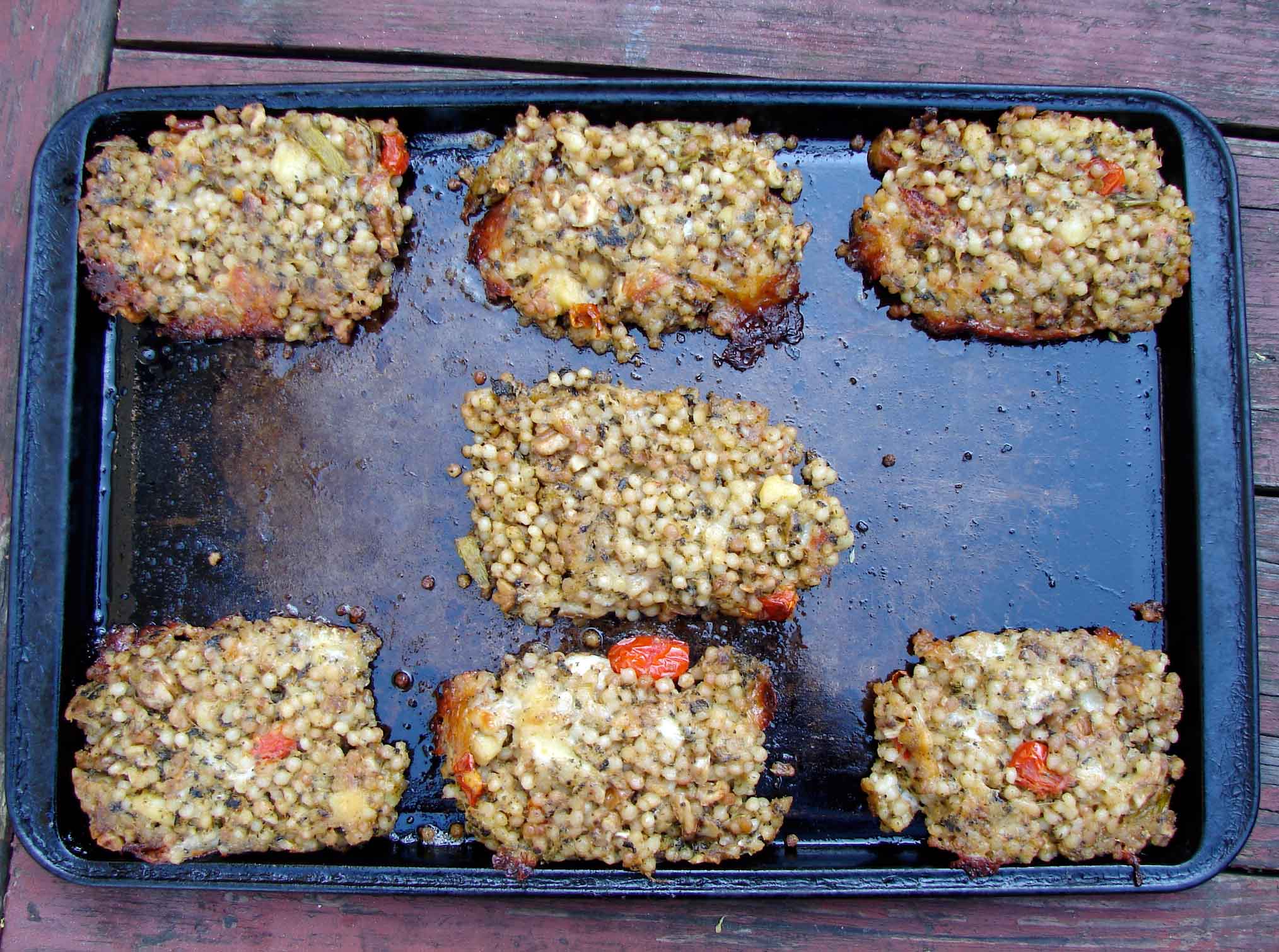
Couscous and kale croquettes

Couscous kale and potato croquettes

Couscous kale and potato croquettes

Hey, kids! It’s Saturday storytelling time! As I’m sure you recall, this means that along with your daily recipe and song, you’ll get a story, too! Each week, everybody in our small salon of auteurs (well, generally me and one or two other people) writes a story based on a found or vernacular photograph. This week’s photo is a doozy. What is she dreaming about? If you’d like to write a story about it, and I hope you do, send me a copy and I’ll post it here, or send me a link if you have somewhere of your own to post it.

THE PHOTO
546786_10151345376679589_1870895765_n

My story, which you can find after the jump, turned out inexplicably sad. It’s a sort of loose retelling of a myth, painted over with grim economic reality.

Kale & couscous croquettes

Kale & couscous croquettes

I made these croquettes out of leftover pearled couscous and leftover kale and potatoes, but I’ve given you directions to make it from scratch. You could make it with leftover mashed potatoes and sauteed spinach or chard as well. They were quite tasty – delicate and crispy outside and soft within. Even the boys liked them.

Here’s Tom Waits with Come On Up To the House, because I borrowed a line from it for my story.
Continue reading

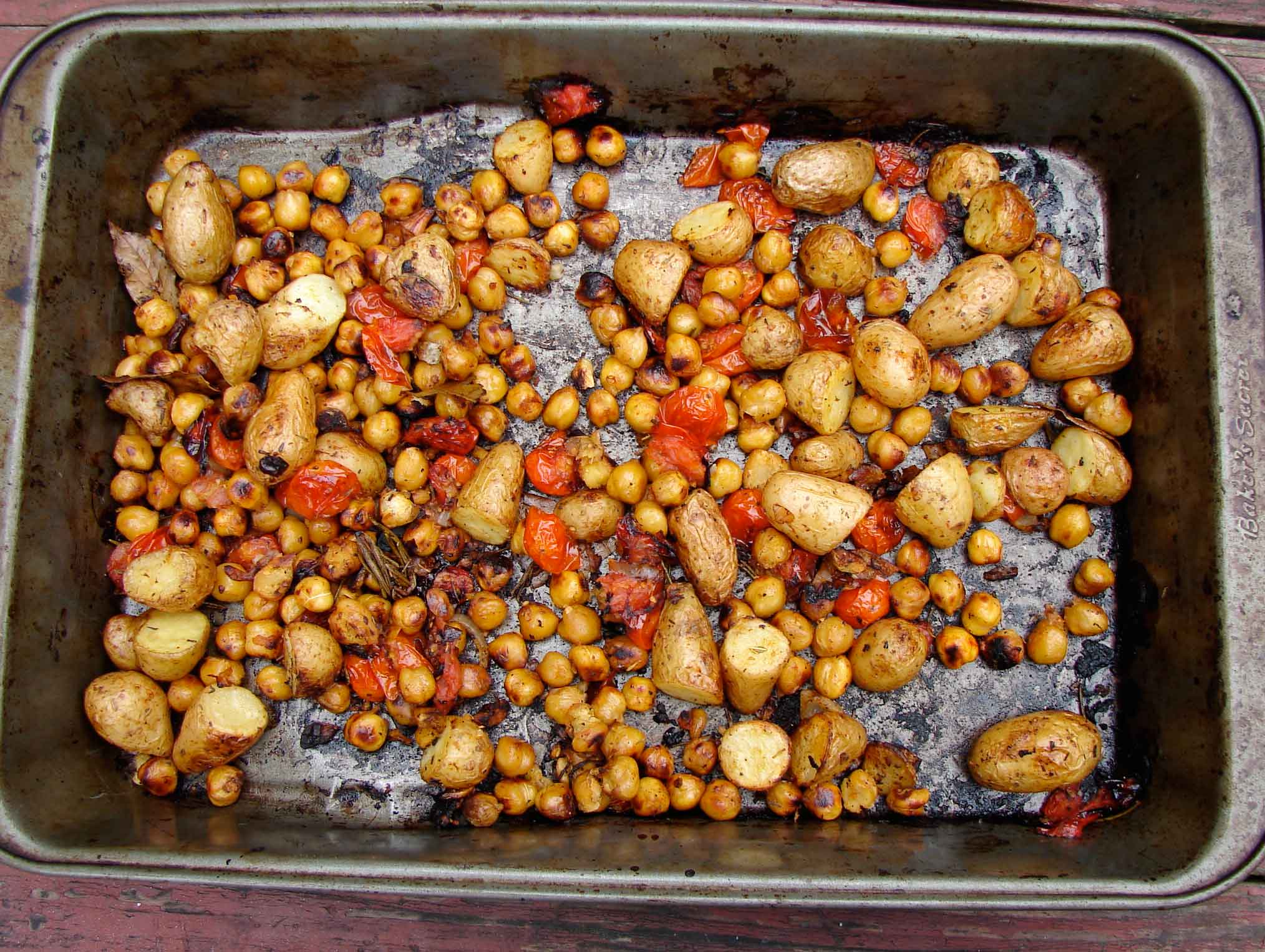
Roasted chickpeas, potatoes and tomatoes

Roasted chickpeas, potatoes and tomatoes with sage and rosemary

Roasted chickpeas, potatoes and tomatoes with sage and rosemary

Thoreau famously warned us to “beware of all enterprises that require new clothes.” As I was going about my chores this morning, thinking my confused thoughts, I came up with my own version. “Beware of any enterprise that requires you to stifle your sense of compassion.” Beware of any occupation that requires you to think of other lives as less valuable than your own life. Beware of any undertaking that requires you to treat people in a way you wouldn’t treat the people you most love. Beware of any job that forces you to think of people as enemies. If you’re being trained that the suffering of strangers is less tragic than the suffering of your friends, quit your training. Beware of anybody that asks you to respond to any situation with only anger and fear. Beware of anybody that tells you love, pity, and empathy are signs of weakness. Beware of any goal that requires cruelty or thoughtlessness to achieve. Beware of anyone that asks you to act without understanding.

    It is the job of thinking people not to be on the side of the executioners. – Albert Camus

So! Tiny new potatoes, chickpeas and tomatoes, all tossed together with shallots, garlic and olive oil. Seasoned with rosemary and sage, and roasted till crispy and caramelized. Delicious! This smells so good while you’re cooking it. I like potatoes and tomatoes together, for some reason it seems very summery and harvesty to me. We’re not there yet, obviously, so this is like a wish or a preview. This would be nice in summer with chopped ripe tomatoes, but for the time being I used little sweet grape tomatoes. They became almost like sundried tomatoes. Rich and flavorful. The first time we ate this, it was crispy and firm. The second time, I added some white wine at the end, used it to scrape up all the nice caramelly bits, covered it, and cooked it till everything was tender. It was very nice both ways! We ate it on a bed of baby spinach and arugula. Lovely.

Here’s Compassion, by Nina Simone.

Continue reading

Creamy vegan spinach & herb sauce

Creamy vegan spinach and herb sauce

Creamy vegan spinach and herb sauce

My favorite song at the moment is that of the white throated sparrow. It’s a simple little song consisting of four tones; apparently the second is a whole note lower than the first, and it ends a minor third below that. It sounds to some people as though the bird is saying “Po-or Jack Peabody Peabody Peabody.” And that is our clumsy, human way of describing this wild wistful little song. I asked Malcolm what it sounded like, and he said, “Sad but hopeful.” And that’s exactly how it sounds to me, too! It’s nostalgic and full of memories, but it sounds like spring and good thoughts for the future. I love the fact that birds have dialects and regional accents. Your knowledge of a white throated sparrow’s song will be different from mine if you live in a distant part of the country. I feel so lucky to have this particular song be my white throated sparrow-neighbor’s song. And a sparrow is such an ordinary little bird. If you saw sparrows in your garden you’d say, “Oh it’s just a bunch of sparrows,” and not even take the trouble to find out what kind of sparrow they are. They’re small and plump and drab and brown. But the white throated sparrow has dashing yellow spots on his head, and when he opens his mouth…glory! I love the fact that we can try to define the song according to our understanding, and describe the intervals between pitches and the rhythms of the notes, but in reality, the song contains subtleties beyond our human musical language. We can never pin down the specifics of melody or meter, just as we can never know what the bird is saying when he repeats his song over and over. And that mystery makes it even more beautiful. So this is the song stuck in my head, that I whistle over and over as I go through my day. This is my favorite song at the moment.

This week’s interactive playlist will be all of our favorite songs at this moment in time. I obviously need your help with this one, or it will just be a short list of songs that I like. Funnily enough, all of the songs I added to the list sound wistful to me. Must be springtime! I haven’t been listening to anything new lately. I’ve been playing some songs for the boys that I used to love, and I’ve had a few longtime favorites buzzing around in my head for one reason or another. What about you? What have you been listening to? Add your songs to the playlist, or leave a comment and I’ll add them myself.

This vegan sauce was very smooth and flavorful. I utilized two of my favorite creamy-vegan-sauce making tricks…cauliflower and almonds. They’re both quite mild flavors, but they blend up nicely. This sauce, as you can see, is lovely and GREEN!! It’s a good sauce for spring. I added grape tomatoes and capers, for a little juicy tangy kick, but you could use it as it is, or add any kind of vegetable or bean you like. White beans or chickpeas would be nice. We ate it over orchiette pasta. If you add less water, you’d have a nice purée as a side dish or base for a more substantial main meal. If you added more water or vegetable broth, you’d have a smooth velvety soup…a bisque.
Continue reading

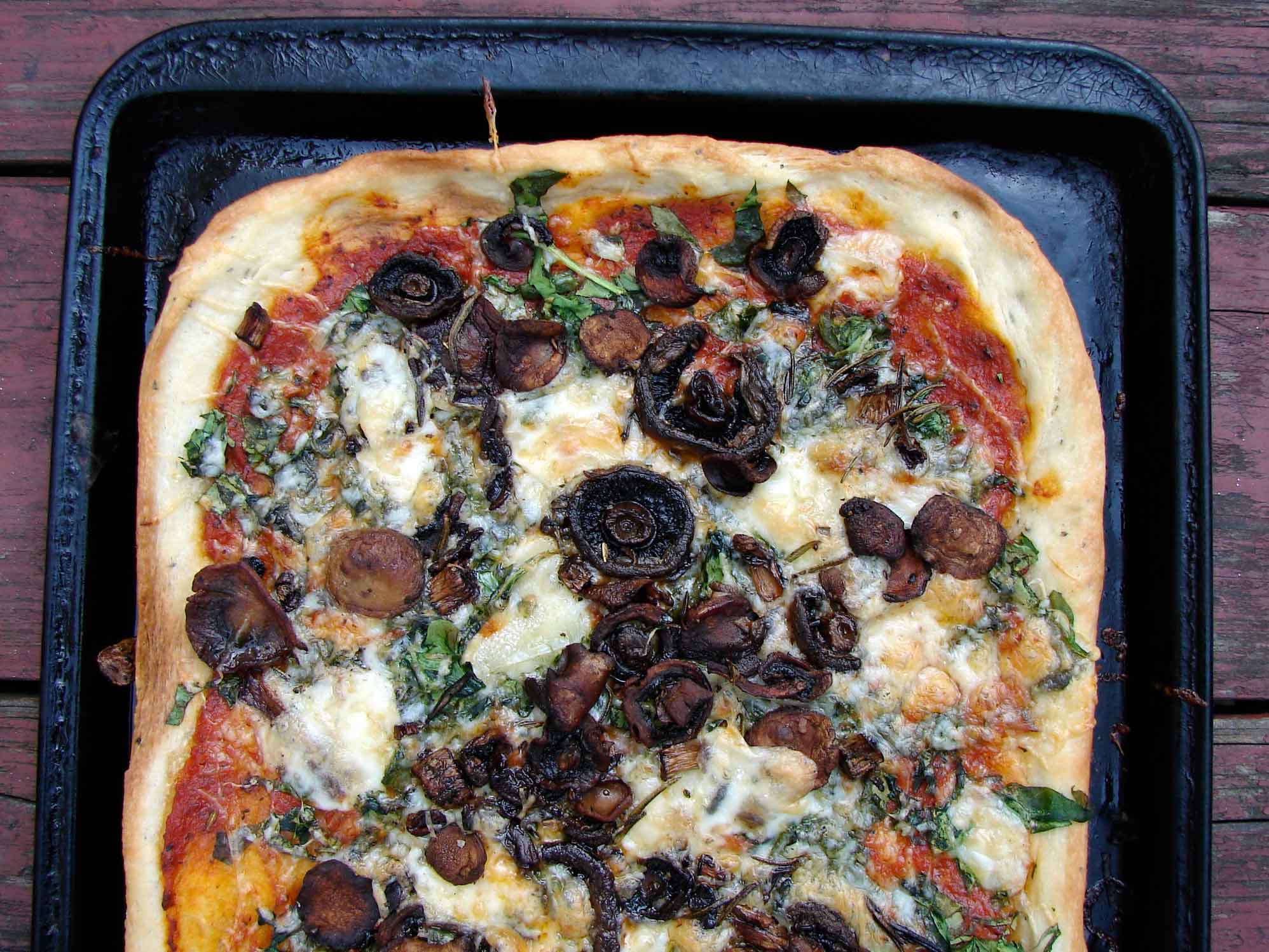
Pizza with baby spinach, rosemary-roasted mushrooms and brie

Roasted mushroom, spinach and brie pizza

Roasted mushroom, spinach and brie pizza

I find it very beautiful and moving that people make connections–not just that we’re able to, but that we need to. We connect little bits of fact to make stories, because it helps us to understand and to share those little bits of fact. When an event occurs that’s hard for us to understand or explain, we find ways to connect ourselves to it, to make sense of it through our experiences. We do this almost without thinking, it’s our first reaction. And our second is to share those connections, to tell others about them, to talk and talk and try to understand. We’ll say, “I’ve lived in that place,” “I knew that person,” “I knew someone that knew that person.” We’ll make connections to other similar events that we’ve lived through, that we’ve survived. It’s tempting, in a less generous or a myopically hypocritical moment, to say, “We only talk about violence when it happens in a place where we love, to people like us!” Or even to shout, “It’s not about you!” But, of course, it is about you, whoever you may be. It’s about all of us. It’s our way to lend our strength to strangers we may never meet, to suffer with the sufferers and explain the inexplicable. It’s our way to give hope for a better time after a strange, sad time. It’s our way to connect ourselves not just to events but to people, our way to extend our sense of family, to create new bonds of responsibility and affection through compassion and empathy. It’s probably facile and foolish to say it, but it seems that if we could expand these connections to reach beyond similarities of geography or experience, if we could make a larger more universal connection–if we could sympathize with somebody not because we lived in the same place but because she, too, has a daughter, or is a daughter, or is human, or, simply, is alive–if we could do this then we would have fewer of these incomprehensible events to explain, and fewer people to mourn.

So this is what I’ve been thinking all morning, as I kneaded dough and rolled out dough and shaped quite a few tarts. Baking as comfort and therapy! Over the weekend we made some pizzas. I wanted to make something the boys liked to eat, that they’d actually look forward to, and pizza never fails. I made the dough before I went to work, and then when I came home we made all the toppings. The dough rose for quite a few hours, this way, but it turned out extra crispy! This makes two big cookie-tray-sized pizzas. I made one plain, with just sauce and cheese, and one fancy, with spinach and musrhooms and brie. I’ve given the toppings in amounts here to make two fancy pizzas, but do as you like! That’s the beauty of pizza!

Here’s Elmore James with It Hurts Me Too. One of the best songs ever ever ever.
Continue reading

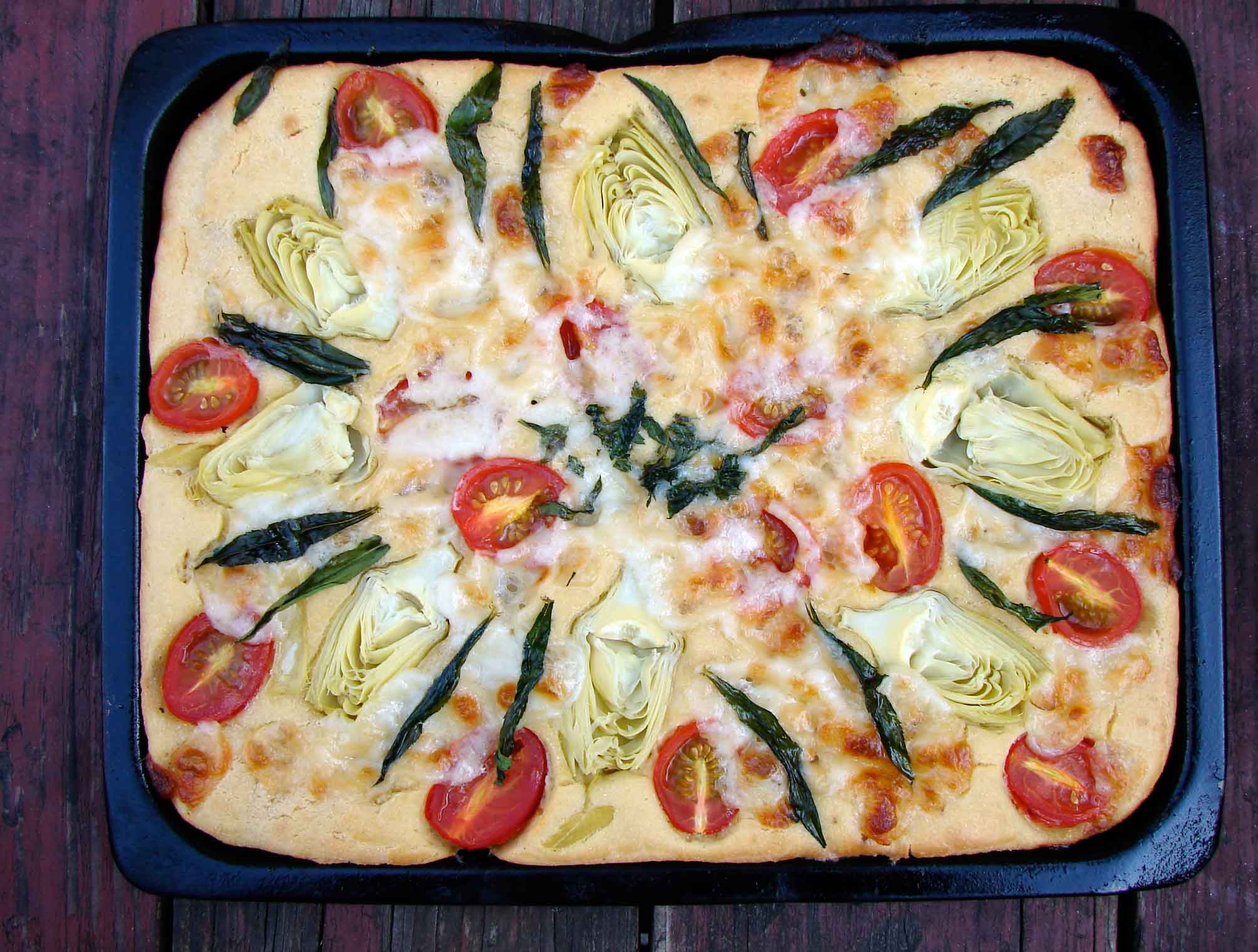
Chickpea flour cake baked with tarragon and artichoke hearts AND spinach sauteed with white beans and black truffle butter
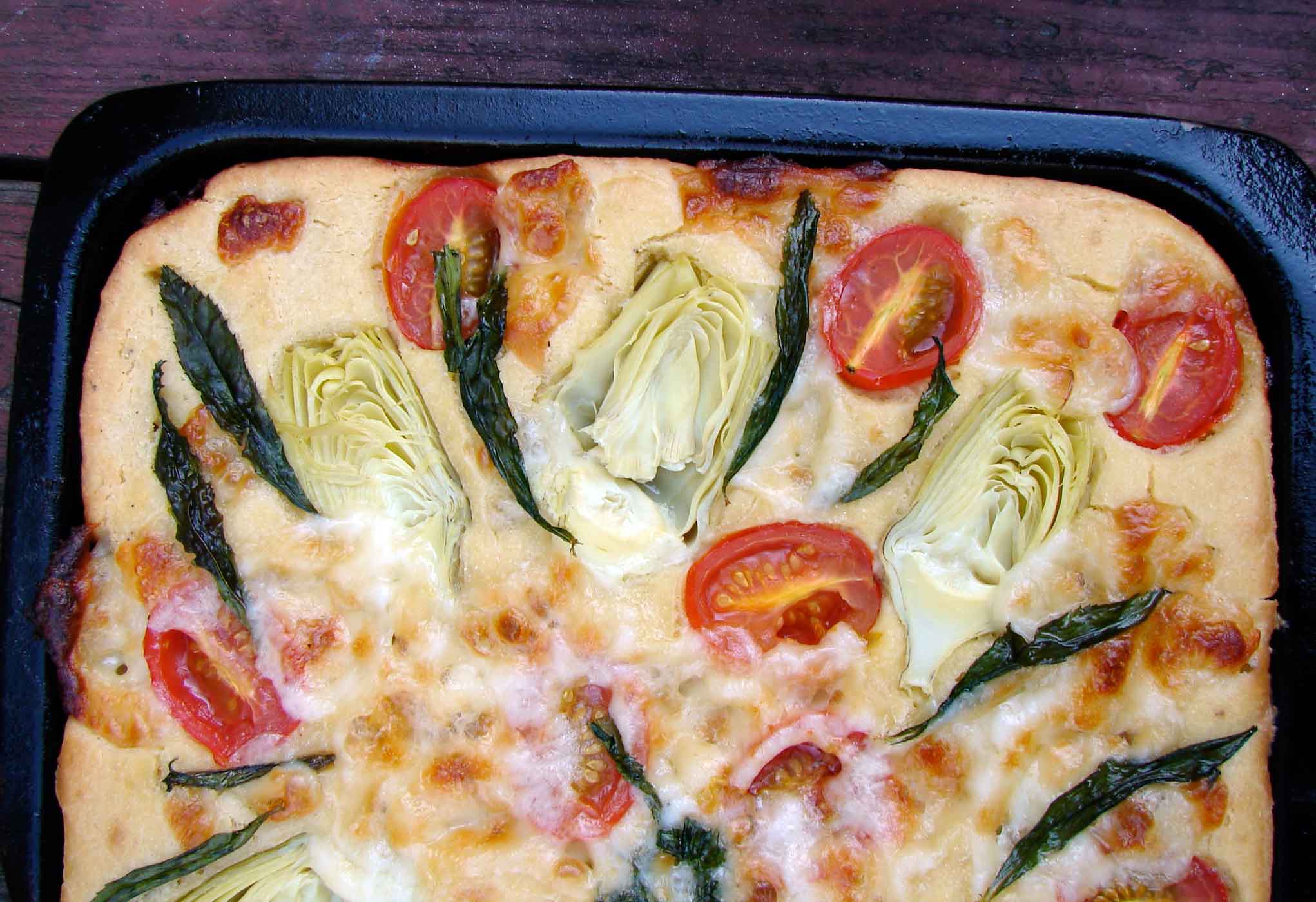
chickpea flour cake baked with tarragon and artichoke hearts

chickpea flour cake baked with tarragon and artichoke hearts

Malcolm wore flannel pajamas under his trousers all winter long. Why did he do it? He has his reasons! Was it for warmth? for comfort? for a sense of extra security? Out of laziness? Was it a nouveau-grunge look? (Grunge is more than a stylistic choice for Malcolm, it’s a way of life, and if you doubt his devotion to the cause, look at his fingernails.) These last few days, the unseasonably cool weather has given way with complete submission to the unseasonably warm weather. No peaceful transition of balmy spring-like days. Cold to hot, just like that. We took a walk after dinner one evening, and we were all a little overdressed and a little warm, and none more so than malcolm, with flannel pjs inside of his flannel-lined trousers. We said, “Are you really still…?” He said, in a sweetly funny, sighing voice, “I regret it.” And, of course, this got me thinking about Malcolm and regrets. It really seems as if children have no regrets – my children anyway! Perhaps they’re prodigiously lacking in compunction, but it seems as if their friends are just the same. And this is yet one more way that I wish I was more like them. I feel as though I live my life under the weight of a vast network of regrets. They cling to me like spider webs as I pass through my days. They seem silly, but they add up, and they slow me down. Why did I have that last cup of coffee when my heart already feels like it’s going to explode? Why did I have that last glass of wine when my head feels as if it’s going to explode? Why did I say what was on my mind when I knew nobody wanted to hear it? Why was I so snappish with Isaac when he hadn’t really done anything bad? Why did I curse angrily in front of Malcolm when I know it makes him sad? And on and on it goes. Sometimes, I’ll have a faint hint of uneasiness, a nagging feeling that I’d done or said something regrettable, and in trying to unravel that one string, I’ll pull on a million others, so I can feel my heart sinking over something foolish I said decades ago. But my boys aren’t like that. They move right on with their lives. They’re never angry for long, they’re not resentful. They don’t store up bitter feelings about something somebody else has done, and they do themselves the same favor. This makes them light of heart despite the fact that their hearts are endearingly full at all times. Sometimes they’re irritatingly on-with-the-next-thing. Sometimes I have to stop myself from shouting, “You just spilled a pint of juice on your homework! Show some remorse you little psychopath!!” I think I’ll try to be more like them. I think I’ll imagine myself throwing away my regrets the way the boys throw rocks into the water–joyously and wildly, never worrying about the splashes, never regretting the loss of the stones.

Chickpea flour tart

Chickpea flour tart

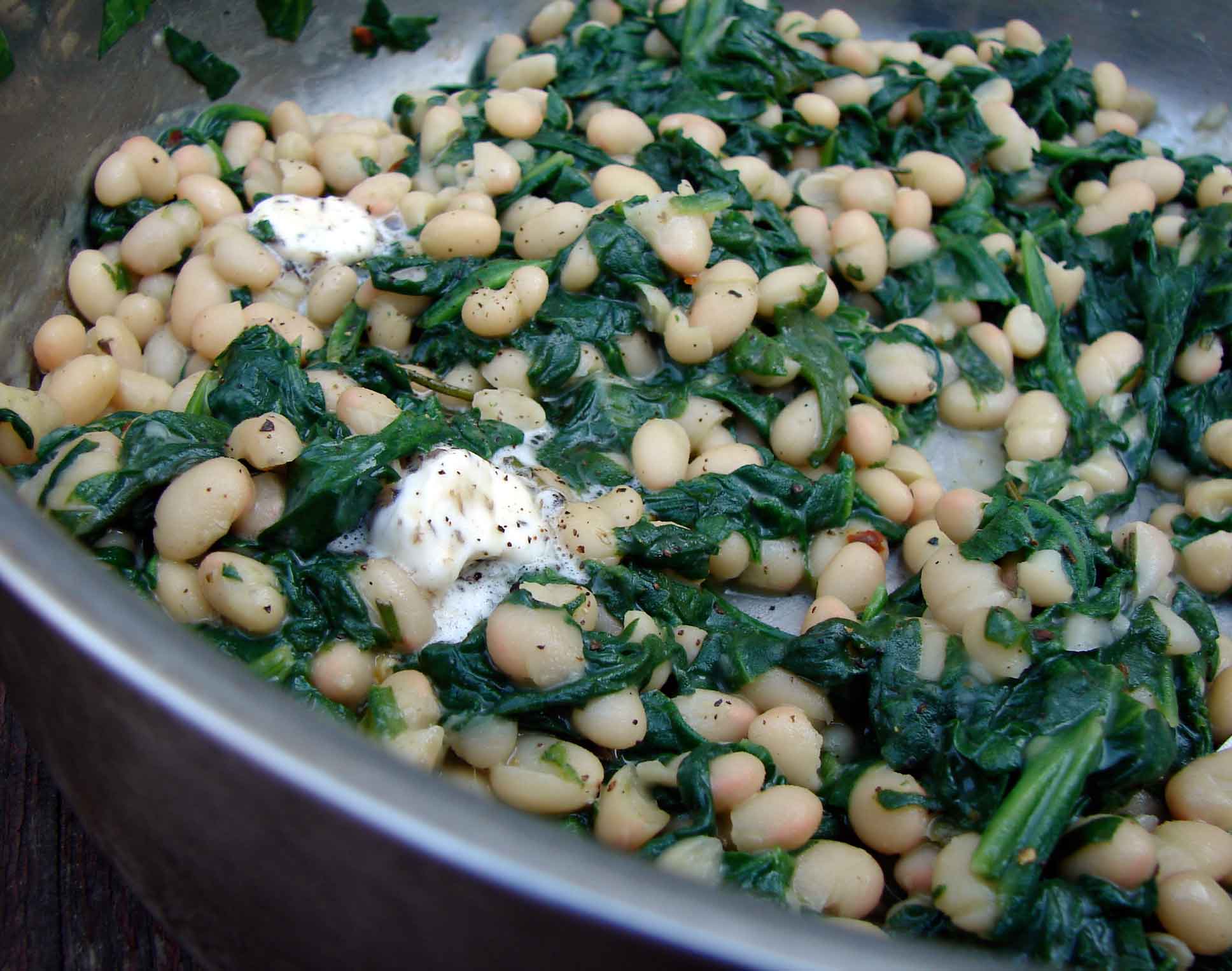
I thought this dinner turned out so pretty! I’m not even sure what to call it. I made a batter such as I might make for puffy socca or chickpea flour crepes. I cheat and add eggs and a bit of white flour, as you may recall, and this makes the batter lighter and easier to work with, whilst retaining the singular taste and texture of chickpea flour. So I did this, and then I arranged artichoke hearts, grape tomatoes, tarragon leaves and mozzarella cheese in a pretty pattern on the surface of the batter, and then I baked it! I thought it tasted very good! I love tarragon, but my boys were disconcerted by whole leaves of it, so you might want to chop it up. Or use rosemary or basil instead. Chickpea flour tends to result in a slightly dry texture, so we ate this with sauteed spinach, white beans, and black truffle butter. The combination was absolutely delicious!! You could eat it with any kind of soft sauteed vegetable or even a simple tomato sauce, though.
spinach sauteed with white beans and black truffle butter

spinach sauteed with white beans and black truffle butter

Of course it’s going to be Edith Piaf, with Non, Je ne regrette rien, isn’t it?
Continue reading
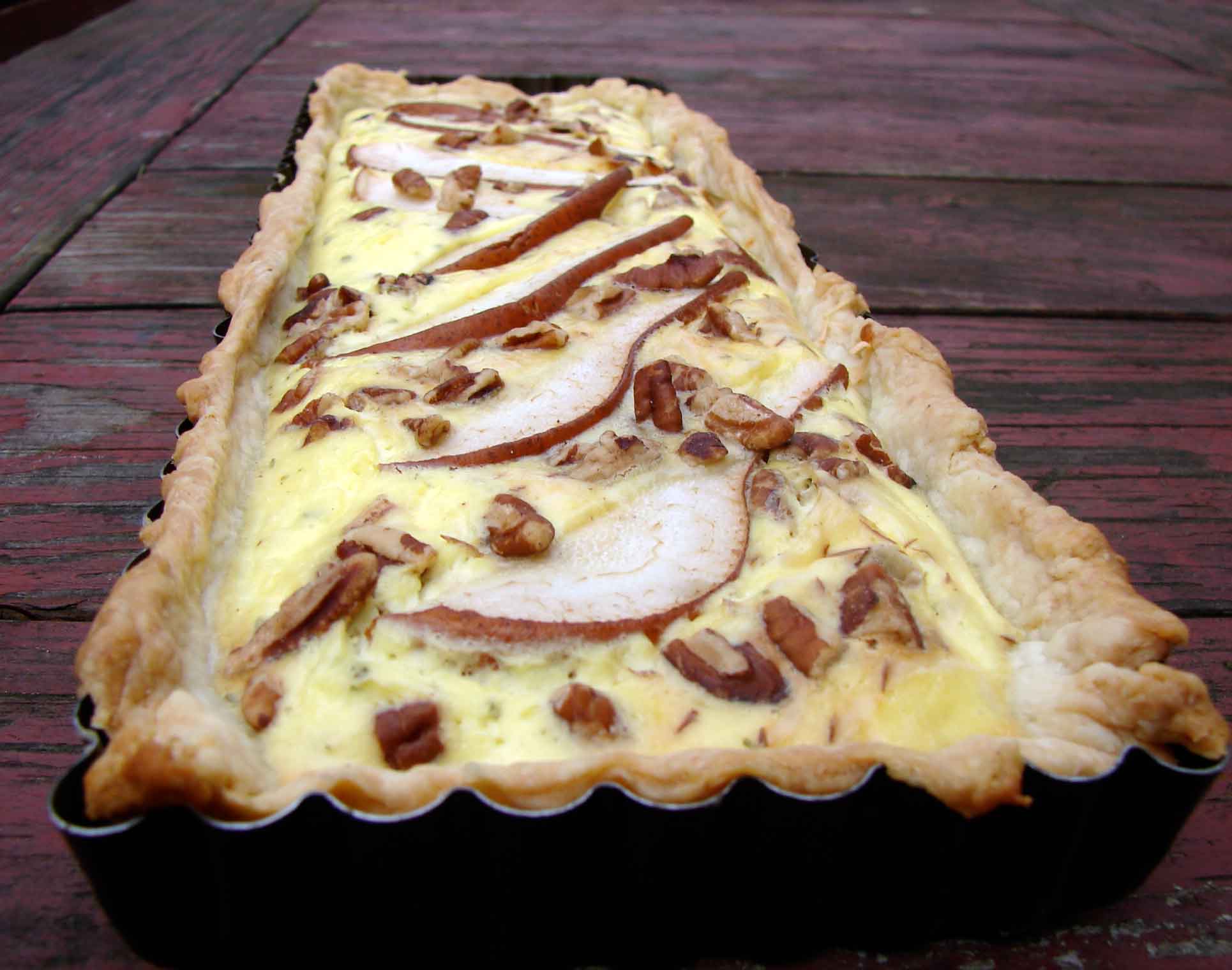
Ricotta rosemary tart with two toppings: smoked gouda, pear and pecan or brie, castelvetrano olive and pine nut

Smoked gouda bosc pear tart

Smoked gouda bosc pear tart

Yesterday, in a characteristically glib and off-handed fashion, I started a discussion about fate and choices, and how they shape our lives and our history. My friend Tony responded with some thoughtful comments, which I thought about as we drove home late at night through fields so bright with full-moonshine they seemed snow-covered. A metaphor slowly developed in my slow brain, and as I mulled it over, the metaphor expanded and evolved, and it started to make more and more sense to me as a way to explain ideas I may have clumsily set out in yesterday’s post. Never one to shy away from stretching an extended metaphor as far is it can possibly go, I’ve decided to share it with you here. Tony brought the specter of Hitler to the discussion. Because nothing makes sense when you think about the scale of Nazi atrocities – neither fate nor free will. Here’s how I responded, and how this giant metaphor was born.

    The way I see it history is like a tapestry, and we’re all madly weaving away at our little portion of it, and making some sort of pattern that makes sense sometimes and makes less sense others. Sometimes we start out in wrong directions, sometimes we make mistakes, sometimes we can fix them and cover it up or make a new pattern, sometimes not. So Hitler is the result of an infinite number of choices that his ancestors made, for centuries and centuries, down to his mother and father. Every single tiny choice they made every day of their lives resulted in Adolph Hitler’s existence, and not one of them could have had any idea how that would turn out. They were weaving a pattern in their portion of the tapestry, and when we look at it from miles above the fabric, and many years on in history, we see the pattern and the tragedy of it, but at the time, even after Hitler’s rise to power and the millions of people that made stupid, scared, even evil choices to follow him or not question him, even after that, they might not have seen the pattern that was forming, so close in it, as they were, so busy making it as time flew by them. And so concerned with the millions of other choices in their day-to-day lives that distracted them from the bigger picture, as we see it so clearly now.

Well, the more I think about it, the more sense it makes to me–this idea of history or fate (depending on which way you look at it) being a sort of tapestry. From the beginning of time people have been weaving their own small portion, aware of people working nearby, but incapable of seeing the larger picture they’re all making together until much later in life. They know from the first that they have a pattern to follow, but there’s no clear plan for it, no diagram, they make it up as they go along, trying one thing or another until it makes sense. They might be following a pattern that their parents taught them, or copying from the people working close by. Various shapes and colors will come into and go out of fashion–some will notice and follow, others will not. My father is a historian, and I once did some work copyediting a textbook he cowrote–an overview of world history. It was remarkable to me the way that these sweeping events would overtake humanity every few hundred years: wars, natural disasters, famine, plagues. These formed huge, horrible changes in the pattern that everybody was weaving, but they couldn’t have known at the time. Most of this was beyond the control of ordinary people, struggling to make their part of the tapestry as beautiful as possible. It made it hard for them to weave, or stopped them weaving at all. Caught up in the struggle of keeping ourself and our family alive, so deeply close to it and inside of it, we’re caught unaware by these waves of change sweeping over the tapestry. And as people make a decision to use a certain color, or continue in a certain direction, they’re thinking what’s best for them at that time, they’re making narrow decisions based on survival and their idea of success. (Hitler is an interesting example of this, I think…the decisions he made might have been considered smart for him at the time, because in terms of his career and his ambition, he might have been considered highly successful, up to a certain point. In the view of people around him…well, I don’t want to go on about Hitler too much. I’m not sure he belongs on a stupid food blog.)
Looking back at my own little piece of the tapestry, it’s funny how it’s worn through in parts, so that I can’t even remember what the pattern was like there, when it was fresh. I just have some memory of the color of my mood at the time. Was I blue? Was I rosy? Was I working in golden thread or gloomy grey? And parts of it are folded up on itself so I see them as clearly as the patches I’m working on now, but it’s never the parts that I’d expect to have nearby. Patches that felt impossibly tangled at the time I worked on them, looked at from here are actually quite pretty. It’s a constant surprise.
Well, dear old extended metaphor, I think I’ve taken you about as far as we could go, in the time I now have.

Brie & castelvetrano tart

Brie & castelvetrano tart

It’s spring break, which means that I took Malcolm and Isaac to the grocery store with me. And they both got to pick out special things. Malcolm picked smoked gouda, Isaac picked brie and pears. I picked castelvetrano olives, and decided to combine everything in two different-but-the same tarts! The crust is simple. I added a little olive oil in a nod to the pizzaness of these tarts. The basic tart base is ricotta, a touch of mozzarella, lots of rosemary and eggs. Simple, but with a versatile flavor to show off the toppings. I think that brie and pears is a fairly classic combination, so I decided to mix it up a little and do pears and smoked gouda. Soooooooo good. Like bacon, somehow, as I remember it. And I combined the creamy tang of brie with the sweet brininess of castelvetrano olives. Nice! These would be good to make for a party of a special meal that lots of people were eating. You could vary the toppings any way you like to appeal to your various guests, and everyone would be happy!
Bosc and smoked gouda tart

Bosc and smoked gouda tart

Here’s Fisher Hendley with Weave Room Blues
Continue reading

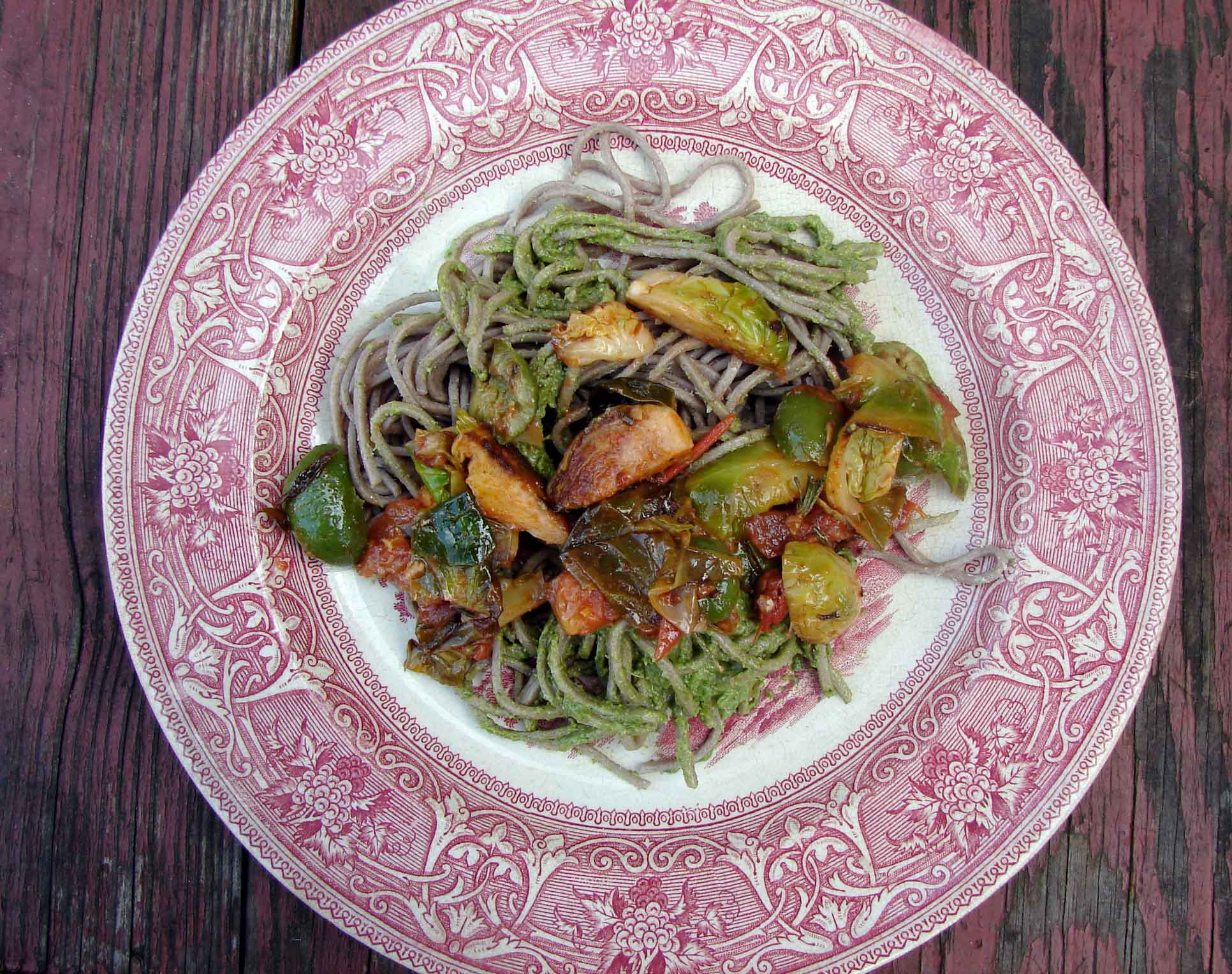
Soba noodles with arugula pecan pesto and sauteed brussels sprouts and castelvetrano olives
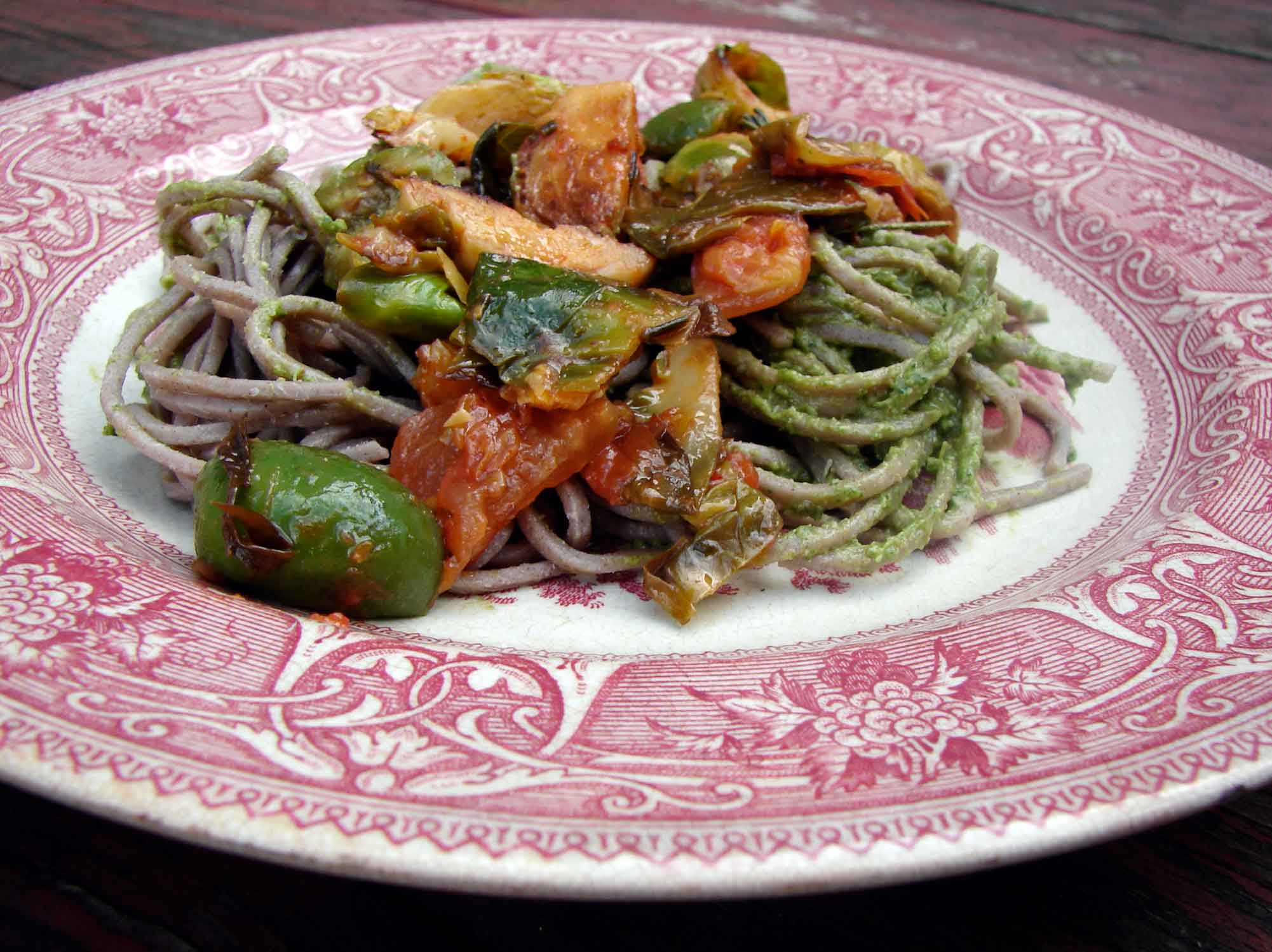
Soba noodles with arugula-pecan pesto and sauteed brussels sprouts

Soba noodles with arugula-pecan pesto and sauteed brussels sprouts

Malcolm’s teachers talk about making “smart choices.” It’s something he needs to work on. Because I’m a terrible parent, the phrase seems to have lodged itself in my head as something almost funny, and I find myself using it in less-than-serious situations. I had to have a talk with Clio because she doesn’t make smart choices in the throes of separation anxiety, and she’s become a danger to herself and our furniture. (I’d like to state for the record, before I continue, that I agree with his teachers that “making smart choices” is something Malcolm needs to work on (as do we all!), and I respect their efforts to remind him of that!) I worry a little bit for him, because he’s my son, and I have a lifelong history of crippling indecision and poor choices. Why would a person drop out of Oxford a third of the way through? Why would a person apply to film school, get in, and then not go? Why would a person waste time and money on a second independent feature when the first was a big failure? Why would they do it? Although on paper it may seem that I have made dumb choices, I have no regrets. I think it’s impossible to harbor regrets once you’ve had children, because every single decision that you ever made your entire life–massive or minute, important or seemingly inconsequential–resulted in their creation. It boggles my easily boggled mind! It makes a person think about fate! I believe in fate in the sense that it’s the same thing as history looked at from the other end. Once something has happened, it was obviously meant to happen and it becomes part of the pattern that connects one life to every other life on the planet, as we all move inexorably in the same direction. But I also believe that we control our fate, at least in part, by the smart and dumb choices that we make. And we determine the quality of our lives, as we’re swept along on our fateful journey, by these choices as well. I’m fascinated by the word “fate,” which is closely related to the word “faith,” and to the words “fay” and “fey.” I’m comfortable with the idea that whatever we think about fate, generally, and our own fate, specifically, we have to understand that we’ll never fully understand it, and we have to accept that we’re frequently powerless to control it, as it rolls ceaselessly over us. I also believe that what may seem like a dumb choice if you’re looking at your life from a certain angle at a certain time, might seem like the smartest possible choice looked at any other way. (Hence the lifetime of indecision!) Although small choices have always rendered me a useless mass of anxiety, as I look back on my life I realize that the big choices, like being with David, were simple. There was only one option, only one wise choice. That feels like fate! That gives me faith! And I have faith that Malcolm will make good choices. They might not always be smart and practical choices, but they’ll be brave choices, and (hopefully) kind choices.

Soba with pesto, brussels sprouts and castelvetrano olives

Soba with pesto, brussels sprouts and castelvetrano olives

Malcolm loves soba noodles. He gets very excited about them. He likes them plain, with tamari, so that’s how we most frequently eat them. This week, I decided to augment their sweetly savory nuttiness with a pesto made from pecans and nutty arugula. I added some smoked gouda, because I thought that would be nice, too. And it was! The pesto also has a bit of sage and honey, to balance the sharp strong flavors. Brussels sprouts and castelvetrano olives are pretty together. They’re so GREEN! And this pesto was very GREEN! This whole meal had a solid-earthy-wintery-melting-into-summmery flavor. If you know what I mean.

Here’s Once in a Lifetime by The Talking Heads, because it seems to fit!

Continue reading

Spicy, tangy, smoky, sweet: catsup with pomegranate molasses

Pomegranate molasses catsup

Pomegranate molasses catsup

We’re going to try something new, here at The Ordinary, and I’m quite excited about it! Allow me to explain… Once there was a website called Square America. I loved this website! It presented found photographs from various eras, arranged into albums. Some of the photographs were remarkably beautiful – snapshots from a time when you couldn’t take a million pictures at once, when you had to wait for the film to develop, and you’d never know what you’d find. I always found it profoundly moving to think that we were allowed a tiny glimpse into the lives of the people in these pictures, and that we’d never know what they were really like, what they were thinking, how their lives would turn out. I’d always thought that if I had some kind of writer’s group, it would be a fun exercise to choose one picture, and see what kind of stories various people would write about it (or haikus or epic poems or essays…) Well, I never actually had a writer’s group, so I never organized anything like this. As it happens, Square America is back on facebook, and the photos are as beautiful and inspiring as ever, so I thought…why not do it here? Why not host a virtual writer’s group at The Ordinary, for anybody that has the time or interest? So that’s what we’re going to try. Snacks will be provided! I’ve chosen a photo for the first story, and I’ve written my (very short) story, and I welcome others to contribute as well. Of course, you can make your own rules. For myself I had a few…keep it short, don’t think about it too much, and try to be respectful, because these were real people, after all. I haven’t completely worked out all of the technical details. If anybody does actually write anything, e-mail it to me and I’ll post it (with mine) after the jump. If you have someplace of your own to post it, give me a link, and I’ll post that here. We’ll see how it goes!

This is the photo I’ve chosen for the first story. Beautiful, right? My story is after the jump!
562868_10151491304304589_1162433175_n-1

Pomegranate molasses catsup

Pomegranate molasses catsup

Hopefully, it will go as well as this catsup! What a nice combination of flavors. Pomegranate molasses is sweet & sour and delicious! As the title says, this catsup was a nicely balanced mix of spicy, tangy, sweet and smoky. It had a nice texture, too, a little jammy. And a lovely deep brick red color. And it was very very quick to make! We ate it with oven-roasted french fries, but you could eat it with anything you eat with catsup. It would be good with croquettes or kofta or pakoras… David even liked it, and he doesn’t like catsup much!!

Here’s A Tribe Called Quest with 8 Millions Stories.
Continue reading