

Millet dal and pumpkin flatbread
There is something to be learned from a rainstorm. When meeting with a sudden shower, you try not to get wet and run quickly along the road. By doing such things as passing under the eaves of houses, you still get wet. When you are resolved from the beginning, you will not be perplexed, though you will still get the same soaking. This understanding extends to all things.
I found that I didn’t feel quite so unproductive, because my mind was busy, and then I felt foolish for thinking that. Then I thought about writing about thinking about writing about sitting there. And then Clio said, “Man, you’re cramping my style. I’ve got some napping to be getting on with.” The mail came, but I didn’t bring it in because it’s only bills and advertisements. Then I went up to clean the bathroom, and thought about writing about that, but luckily for you I won’t do that. When I was little, I used to narrate my actions in my head in the third person. Not all the time, because that would be crazy! But often. “And then Claire sat on a bench in the middle of the room. She always got through with looking at paintings before everyone else. She did everything quickly. And now she sat and watched the people looking at the paintings…” And on an on it goes! I feel like I’ve been doing that again lately, because of The Ordinary. Not in third person now, so it’s slightly less eccentric. But when I cook, I’ll think about writing about it, and aboutexplaining how it’s done. And sometimes I’ll wake up in the middle of the night, and try to occupy my brain with whatever I might say on here the next day (explains a lot about the quality of the work, doesn’t it?) and I’ll find myself writing in my head. And, yes, this might seem crazy, but I think this is a good thing!!! I firmly believe that the more you write, the more you write. The more you think about writing, the more you’ll write, and hopefully it will become a habit. (This doesn’t guarantee good writing, mind you! It just makes it easier to get started.) I think this understanding extends to all things. The more you draw, the more you’ll draw. If you want to make movies, you should watch movies, talk about movies, take photographs, write movies, make shorts. The more you cook, the more you’ll think about cooking, and the more you’ll want to try new things and experiment with new ingredients, until you’ll get sick of it all and go out to dinner. If you want to make music, the more you listen to songs, and practice making music, and think about music, the more life will present itself to you as a song. Because even if writing and making movies and drawing aren’t important, which, arguably they’re not at all, I’d still like to go through life looking for things to write about (or sing about or draw pictures of.) Just as the actors that work with Jaques Tati started to see little comic pieces in everyday exchanges in the world around them, you’ll start to find that even small things are worth noticing and remembering and examining, which in some way makes life worth living.
And now I feel foolish for writing about writing, so let’s talk about this dal instead. It’s made with red lentils, millet and sweet potatoes, and it’s cooked for some time, which makes it dense and soft and porridgey. Red lentils are nice because they cook quickly, but if you cook them longer, as (I believe) Indian dals are cooked, they take on a whole different life. I added spinach and peas to pep things up and provide a little texture. And I used beautiful black cardamom pods, which are so smoky and sweet (but watch out for them when you eat the dal, you wouldn’t want to bite down on one!) I decided that cumin was too obvious in this dish, so I left it out in favor of other sweet and smoky spices, like cardamom, nigella seeds and smoked paprika. The flat breads were quick and easy to make – they have a little pumpkin puree and a little ricotta, which gives them a nice flavor and texture, and they were just crunchy enough to provide a pleasant contrast to the soft dal.
Here’s Station Showdown from the Yojimbo soundtrack, cause it’s all about the millet. Golly, this soundtrack is brilliant!

 As you may recall, I’m reading The Brothers Karamzov, and I have been for some time. (It’s not that I don’t have time to read, but I feel a little guilty taking the time to read, which is sort of funny, because I was an English major, so once-upon-a-time, reading was my job.) Anyway, be that as it may, I’m slowly working my way through Bros. Karmazov, and I’d like to talk about Alyosha. I’ve been thinking about him a lot lately. He’s one of the most appealing characters in literature (to me), and I’ve been pondering this fact, and thinking about other characters of his type that I’ve also been drawn to over the years. Alyosha was named after Dostoyevsky’s own son, who died as a child, and I can’t help but think that the character is a sort of embodiment of the man Dostoyevsky might have hoped his son would become. He’s handsome, kind, good but not preachy, thoughtful, sympathetic. But I don’t find him cloyingly good, because, strangely, despite all of his ridiculously good qualities, he’s a very real and human character. He’s full of wonder, he’s often confused, his mood shifts from one sentence to the next, as we’ve all felt our own do. He’s part of the drama, obviously, he’s one of the brothers Karamzov, so he’s a major character, but he’s aside from the drama. Most of his struggles are internal – they’re philosophical or spiritual. He has faith, but he’s constantly questing and questioning, swayed by his cynical brothers, but very strong within himself. He reminds me of Gareth, from Once and Future King, who was one of my favorite characters when I was little. Like Alyosha, Gareth grows up in what we would today call a dysfunctional family. His father is at war, his mother rivals Alyosha’s father for evilness, and his brothers are caught up in the brutality around them. But Gareth is different. He has a sort of natural gentleness, “Gareth was a generous boy. He hated the idea of strength against weakness. It made his heart swell, as if he were going to suffocate.” In one scene, the four brothers attempt to catch a unicorn, but they kill it, and then, faced with the reality of butchering it, they’re sick, covered in sweat and blood and punctured intestines, and by the time they get the head home to their mother, there’s nothing left but a grisly, unrecognizable lump of flesh. This scene was so powerful to me when I first read it! And it made me love Gareth, who begged his brother not to kill the unicorn, and who lies crying in the heather once it’s killed, staring into the sky and imagining himself plummeting off the earth, and catching onto the clouds to stop his fall. And like Alyosha, as the story goes on, Gareth does not become as embroiled in the violent family turmoil. I love these characters, and I’m sure there are others (Kostya Levin from Anna Karenina comes to mind,
 We had a lovely snow on Christmas eve, light and soft, the kind that makes the whole world seem clean and quiet. Snow makes Clio crazy, it brings out one of the “four formes of canine madnesse, the frantic or crazed madnesse.” She leaps about the yard, and then races in with icy snow in her pink paw pads, and leaps off of the furniture with mad abandon. I watched her on Christmas eve, and thought of Steenbeck, our old dog, buried in the yard under Clio’s frenetic paws, sleeping beneath a blanket of silent snow. I felt a sudden sadness, but it was a comforting sadness, in some inexplicable way. And on New Year’s Day we went to a party at a friend’s house, up on the hill above our small city. We walked up, it being a clear, cold day, and it felt good to shake some of the holiday-induced torpor from my mind. The party was lovely, with many children instantly interacting, as they so delightfully do, making things, and sharing things, and giggling. And we drank some good red wine, and talked to friends from town and just out of town – some we see nearly every day, some we see once or twice a year. It felt social, and cheerful, and just right for a New Year’s day. We left at dusk, which still comes early though the days are getting longer, and we walked home through the big old cemetery that over-looks our town. The stones were centuries old, but the names were familiar – the names of families that still live in our community. We read the name of the man who built our house in the 1850s, the name of the man we bought our house from ten years ago, the names of the people that own businesses in town, of families that our children go to school with. My boys raced along the paths, pelting each other with snowballs and laughing. And we walked down into town back to our old house, sleepy from the wine but sober from my thoughts, and made a warm meal, and watched a Buster Keaton movie, cuddled on the couch. It sounds idiotic, but I’d been thinking the night before about all the people that have ever lived. All of the humans that have walked on this earth, and lived, and loved, and wanted, and worked. Some in good fortune and freedom and wealth; most, probably, in poverty and servitude. But all wanting the same things, surely: affection, friendship, some degree of comfort, a kind hand, a warm meal. And I thought about it again, up on the hill, covered in a blanket of melting snow…”falling faintly through the universe and faintly falling, like the descent of their last end, upon all the living and the dead.” I felt, again, that sort of comforting sadness, looking out on our beautiful town, on all of the houses lit up and ringing with laughter, with people crying, “happy new year!” Which brings us to my resolution, if I have one, and, I think I do, but in true Clairish style, it’s vague and muddled, so I hope you’ll forgive this ramble. I don’t make resolutions to lose weight, or be healthy, or give up bad habits. I’ve said before that I believe in finding a balance in everyday life, and that those things are built into the fabric of that balance, cycling continually day-to-day, working against each other. Everybody gains a bit of winter weight, but we’ll eat soup meagre for a week, run up and down the towpath with Clio a few times, and be fighting-fit come spring! To me, “resolve” doesn’t mean to give something up, but to come into focus, to become harmonious, to be solved, or healed. So I hope to bring things into focus and harmony in this new year, moment-to-moment and day-to-day. To notice everything, to recognize how vivid and poignant every moment is, how completely alive each person that I meet – how like me and how completely unique. I hope not to let fatigue, crankiness, or laziness cloud my senses or lessen my appreciation of time spent with my children and David; of strong flavors, good sounds, beautiful sights. Not to be crippled by the sense that time is passing, but to let that awareness help me to feel more keenly. Not to be distracted by our fast, cold, cluttered, cynical world from clarity, light and warmth.
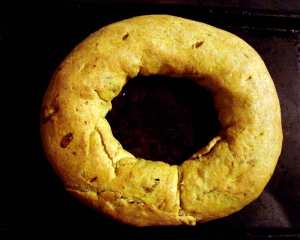 Ring-shaped pie[/caption]
 We’re experiencing a bit of a lull, here at The Ordinary, characterized by a dearth of energy, a lack of purpose, and a general, fuzzy feeling of a vast network of spiderwebs taking over our brains. Oh yes, the post-holiday doldrums. Not a bad thing, in many ways, the mind needs to lie fallow, sometimes. But it’s a feeling that’s hard to shake!! I feel like I’ve got nothing to say but I can’t stop talking! I feel like I’m treading water. Pleasant, warm, sleepifying water, granted, but I’m not getting very far in it! Well! Last night, after dinner, I was feeling very drowsy, warm in our toy-strewn living room, when Malcolm said, “Mom, do you want to take Clio for a walk with me?” DO I?!?!? Of course I do. He even got me my coat and hat! It had been a day of creeping damp cold, and we’d gone on a walk earlier, but it just wasn’t pleasant. Now, in the dark, it was even colder…but it felt good! We decided to head for the bridge across the river, to see if Clio was scared of it the way Steenbeck used to be. Of course it was even colder there, but the sky was so dark and clear, the moon was almost full, everything was black and silvery, and the wind blowing icily across the bridge was helping to clear out the cobwebs. Then Malcolm showed me how to do his happy walk, which is a broad side to side skip. It is a walk that you do when you’re happy, but I’m here to tell you people, it’s a walk that makes you happy, as well. Flying across the bridge, dark icy water flowing fast far below, coats flapping behind, Clio pulling us ahead quicker than a human can walk, I felt nearly ecstatic, and we tumbled home cold, and breathlessly laughing.





 Out of the Ordinary